Category
page 1Deeds of Zeus
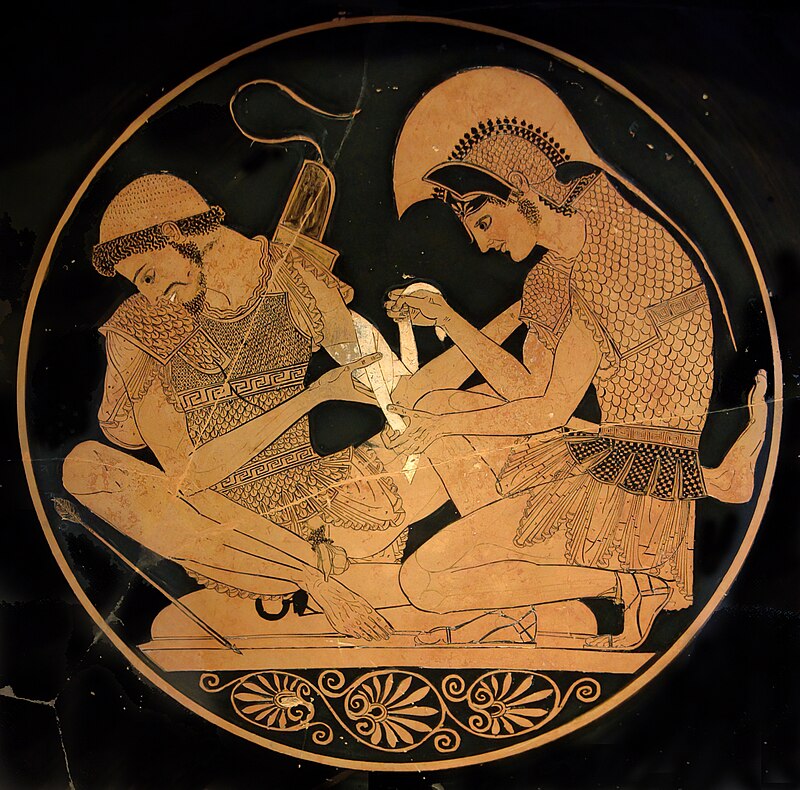
Trojan War
legendary war in Greek mythology

Prometheus
In Greek mythology, Prometheus (; ) is a Titan responsible for creating or aiding humanity in its earliest days. He defied the Olympian gods by taking fire from them and giving it to humanity in the form of technology, knowledge and, more generally, civilization.

Odysseus
In Greek and Roman mythology, Odysseus (; , ), also known by the Latin variant Ulysses (, ; ), is a legendary Greek king of Ithaca and the hero of Homer's epic poem, the Odyssey. Odysseus also plays a key role in Homer's Iliad and other works in that same epic cycle.

titan
thumb|upright=1.3|The Fall of the Titans (1596-98), a mythological painting by Dutch painter [[Cornelis van Haarlem.]]

Hephaestus
Hephaestus ( , ; eight spellings; ) is the Greek god of artisans, blacksmiths, carpenters, craftsmen, fire, metallurgy, metalworking, sculpture, and volcanoes. In Greek mythology, Hephaestus was the son of Hera, either on her own or by her husband Zeus. He was cast off Mount Olympus by his mother Hera because of his lameness, the result of a congenital impairment; or in another account, by Zeus for protecting Hera from his advances.

Perseus
In Greek mythology, Perseus (, ; ) is the legendary founder of the Perseid dynasty. He was, alongside Cadmus and Bellerophon, the greatest Greek hero and slayer of monsters before the days of Heracles. He beheaded the Gorgon Medusa for Polydectes and saved Andromeda from the sea monster Cetus. He was a demigod, being the son of Zeus and the mortal Danaë, as well as the half-brother and great-grandfather of Heracles (as they were both children of Zeus, and Heracles's mother was Perseus's granddaughter).

Atlas
deity in Greek mythology

Asclepius
Asclepius (; ; ) is a hero and god of medicine in ancient Greek religion and mythology. He is the son of Apollo and Coronis, or Arsinoe, or of Apollo alone. Asclepius represents the healing aspect of the medical arts; his daughters, the , are: Hygieia ("Health, Healthiness"), Iaso (from ἴασις "healing, recovering, recuperation", the goddess of recuperation from illness), Aceso (from ἄκεσις "healing", the goddess of the healing process), Aegle (the goddess of good health) and Panacea (the goddess of universal remedy). He has several sons as well. He was associated with the Roman/Etruscan god Ve

Sisyphus
thumb|alt=Sisyphus depicted on a black-figure amphora vase |Persephone supervising Sisyphus in the Underworld, Attic [[black-figure amphora, BC, Staatliche Antikensammlungen]]
thumb|Sisyphus and Amphiaraus, copy of a mural in the [[François Tomb, Vulci, made in 4th century BC]]

Rhea
female Titan in Greek mythology, mother of Zeus and mother of Hera

Pandora
thumb|Pandora by John William Waterhouse, 1896

Nike
goddess of victory in Greek mythology

Argonauts
thumb|Gathering of the Argonauts, Attica|Attic red-figure [[krater, 460–450 BC (Louvre G 341)]]
The Argonauts ( ; ) were a band of heroes in Greek mythology, who in the years before the Trojan War (around 1300 BC) accompanied Jason to Colchis in his quest to find the Golden Fleece. Their name comes from their ship, Argo, named after its builder, Argus. They were sometimes called Minyans, after a prehistoric tribe in the area.

Ganymede
son of Tros in Greek mythology

Orion
giant huntsman in Greek mythology

Adonis
In Greek mythology, Adonis (; , ) was the mortal lover of the goddesses Aphrodite and Persephone. He was considered to be the ideal of male beauty in classical antiquity.

Leto
In ancient Greek mythology and religion, Leto (; ) is a childhood goddess, the daughter of the Titans Coeus and Phoebe, the sister of Asteria, and the mother of Apollo and Artemis.

Styx
In Greek mythology, Styx (; ; lit. "Shuddering"), also called the River Styx, is a goddess and one of the rivers of the Greek Underworld. Her parents were the Titans Oceanus and Tethys, and she was the wife of the Titan Pallas and the mother of Zelus, Nike, Kratos, and Bia. She sided with Zeus in his war against the Titans, and because of this, to honor her, Zeus decreed that the solemn oaths of the gods be sworn by the water of Styx.

Typhon
thumb|right|280px|Zeus aiming his thunderbolt at a winged and snake-footed Typhon. Chalcidian black-figured [[hydria ( BC), Staatliche Antikensammlungen (Inv. 596).]]
Typhon (; , ), also known as Typhoeus (; ), Typhaon () or Typhos (), was a monstrous serpentine giant and one of the deadliest creatures in Greek mythology. According to Hesiod, Typhon was the son of Gaia and Tartarus. However, one source has Typhon as the son of Hera alone, while another makes Typhon the offspring of Cronus. Typhon and his mate Echidna were the progenitors of many famous monsters.

Epimetheus
In Greek mythology, Epimetheus (; ) is the brother of Prometheus, with the complementary pair serving as archetypal representations of mankind. Both are sons of the Titan Iapetus; while Prometheus ("forethought, or foresight") is portrayed as ingeniously clever, Epimetheus ("afterthought, or hindsight") is considered inept and foolish. In some accounts of the myth, Epimetheus unleashes the unforeseen troubles in Pandora's box.
%20(14569094819).jpg)
Chiron
In Greek mythology, Chiron, also Cheiron or Kheiron, (; or , , , or ) was held to be the superlative centaur amongst his brethren since he was called the "wisest and justest of all the centaurs".

Cadmus
In Greek mythology, Cadmus (; ) was the legendary Phoenician founder of Boeotian Thebes. He was, alongside Perseus and Bellerophon, the greatest hero and slayer of monsters before the days of Heracles. Commonly stated to be a prince of Phoenicia, the son of king Agenor and queen Telephassa of Tyre, the brother of Phoenix, Cilix and Europa, Cadmus traced his origins back to Poseidon and Libya.

Atalanta
thumb|Atalanta surrounded by three Erotes, Attic white-ground [[lekythos, c. 500–470 BC]]

Bellerophon
Bellerophon or Bellerophontes () or Hipponous (), was a divine Corinthian hero of Greek mythology, the son of Poseidon and Eurynome, and the foster son of Glaukos. He was "the greatest hero and slayer of monsters, alongside Cadmus and Perseus, before the days of Heracles". Among his greatest feats was killing the Chimera of the Iliad, a monster that Homer depicted with a lion's head, a goat's body, and a serpent's tail: "her breath came out in terrible blasts of burning flame."
thumb|Bellerophon, Pegasus, and [[Athena, a Roman fresco in Pompeii, first half of the 1st century]]

Metis
Oceanid of Greek mythology, goddess of wisdom, daughter of Oceanid and Tethys

Hecatoncheires
thumb|The Hundred-Hander Briareus used as an allegory of the multiple threat of labour unrest to capital in a political cartoon, 1890.

Tantalus
thumb|300px|Tantalus on an Apulian red-figure volute krater, 330-320 BC, Staatliche Antikensammlungen.

Thetis
Thetis ( , or ; ) is a figure from Greek mythology with varying mythological roles. She mainly appears as a sea nymph, a goddess of water, and one of the 50 Nereids, daughters of the ancient sea god Nereus.
.jpg)
Hypnos
In Greek mythology, Hypnos (; Ancient Greek: , 'sleep'), also spelled Hypnus, is the personification of sleep. The Roman equivalent is Somnus. His name is the origin of the word hypnosis. Pausanias wrote that Hypnos was the dearest friend of the Muses.
%20(cropped).jpg)
Daphne
.jpg)
Semele
In Greek mythology, Semele (; ), or Thyone (; ), was the youngest daughter of Cadmus and Harmonia, and the mother of Dionysus by Zeus (her own great-grandfather).

Harmonia
thumb|250px|Statue of Harmonia in the Harmony Society gardens in Old Economy Village, Pennsylvania.

Atreus
thumb|The Farnese Atreus (1574 engraving by Antonio Lafreri and [[Cornelis Cort) depicts Atreus and one of the sons of Thyestes, whom Atreus is about to kill]]

Phaethon
Phaethon (; , ), also spelled Phaëthon, is the son of the Oceanid Clymene and the sun god Helios in Greek mythology.

Maia
In ancient Greek mythology, Maia (from ; or ), also spelled Maie, is one of the Pleiades and the mother of the messenger god Hermes by Zeus.

Giants
Giants from Greek myth

Callisto
nymph in Greek mythology

Aeolus
god of winds, son of Hippotes in Greek mythology
Titanomachy
thumb|300px|Cornelis Cornelisz van Haarlem, [[The Fall of the Titans, 1596–1598.]]

Niobe
thumb|Paestan lekythos depicting Niobe turning to stone, c. 330 B.C, [[Altes Museum, Berlin]]
.jpg)
Pelops
thumb|Roman mosaic with Pelops and Hippodamia, kept in the D. Diogo de Sousa Museum in Braga, Portugal.

Eurystheus
thumb|338x338px|Hercule apporte à Eurysthée la ceinture de la reine des Amazones by Daniel Sarrabat
.jpg)
Tiresias
thumb|300px|right|alt=A person with flowing robes holding a staff strikes two intertwined snakes on the ground|Tiresias strikes two snakes with a stick, and is transformed into a woman by Hera. Engraving by Johann Ulrich Kraus c. 1690. Taken from Die Verwandlungen des Ovidii (The Metamorphoses of Ovid).
thumb|300px|alt=A baroque painting showing a male and female figure together|Pietro della Vecchia, Tiresias Transformed into a Woman, 17th century.
In Greek mythology, Tiresias (; ) was a blind prophet of Apollo in Thebes, famous for clairvoyance and for being transformed into a woman for seven

Actaeon
thumb|The death of Actaeon on Red-figure pottery|red-figure [[skyphos from Paestum, 4th century BC (Karlsruhe, Badisches Landesmuseum).]]

Ixion
thumb|The Fall of Ixion by Cornelis van Haarlem

Plutus
In ancient Greek religion and mythology, Plutus (; ) is the god and the personification of wealth, and the son of the goddess of agriculture Demeter and the mortal Iasion.
Ladon
Greek mythological serpent

Anchises
thumbnail|Aphrodite reveals baby Aeneas to Anchises (1st century AD).

Deucalion
thumb|Deucalion from Promptuarium Iconum Insigniorum

Momus
thumb|upright=1.6|''Momus Criticizes the Gods' Creations, by Maarten van Heemskerck, 1561, [[Gemäldegalerie, Berlin]]
Momus (; Ancient Greek: Μῶμος Momos'') in Greek mythology was the personification of satire and mockery, two stories about whom figure among Aesop's Fables. During the Renaissance, several literary works used him as a mouthpiece for their criticism of tyranny, while others later made him a critic of contemporary society. Onstage he finally became the figure of harmless fun. Today, celebrations of Momus survive in the Momoeria New Year's festivals of Northern Greece.

Asopus
Asopus or Asopos (; ) is the name of four different rivers in Greece and one in Turkey. In Greek mythology, it was also the name of the gods of those rivers. Zeus carried off Aegina, Asopus' daughter, and Sisyphus, who had witnessed the act, told Asopus that he could reveal the identity of the person who had abducted Aegina, but in return Asopus would have to provide a perennial fountain of water at Corinth, Sisyphus' city. Accordingly, Asopus produced a fountain at Corinth, and pursued Zeus, but had to retreat for fear of Zeus' terrible thunderbolt.

Daughters of Danaus
thumb|331x331px|The Danaides (1904), a Pre-Raphaelite interpretation by [[John William Waterhouse]]
In Greek mythology, the Danaïdes (; ), also Danaides or Danaids, were the fifty daughters of Danaus, king of Libya. In the most common version of the myth, the daughters were forced to marry the sons of Danaus' brother Aegyptus. In retaliation, Danaus commanded them to kill their husbands on their wedding night, and all but one, Hypermnestra, obeyed. The Danaids were then condemned to spend eternity carrying water in a sieve or perforated jug.
Endymion
son of Aethlius in Greek mythology

Memnon
thumb|Attic neck-amphora featuring [[Heracles and Memnon (detail), BC]]
thumb|Eos retrieving the body of her son Memnon from the battlefield (detail); Etruscan bronze mirror, BC

Athamas
thumb|right|206x206px| The Fury of Athamas by John Flaxman (1755-1826).

Thyestes
thumb|Thyestes and Aerope, painting by Nosadella

Asteria
In Greek mythology, Asteria or Asterie ( ; ) is a daughter of the Titans Phoebe and Coeus (Polus) and the sister of Leto. According to Hesiod, by the Titan Perses she had a single child, a daughter named Hecate, the goddess of witchcraft. Other authors made Asteria the mother of the fourth Heracles and Hecate by Zeus.

Pyrrha
thumb|16th-century woodcut by Virgil Solis, illustrating lines 347–415 of [[Ovid's Metamorphoses]]
In Greek mythology, Pyrrha (; ) was the daughter of Epimetheus and Pandora, or of Prometheus.

Erechtheus
thumb|A possible sculpture of Erechtheus
Erechtheus (; ) in Greek mythology was a king of Athens, the founder of the polis and, in his role as god, attached to Poseidon, as "Poseidon Erechtheus". The name Erichthonius is carried by a son of Erechtheus, but Plutarch conflated the two names in the myth of the begetting of Erechtheus.

Amphiaraus
thumb|right|250px|Amphiaraus on his chariot.
Amphiaraus or Amphiaraos (; ) was in Greek mythology the son of Oicles, a seer, and one of the leaders of the Seven against Thebes. Amphiaraus at first refused to go with Adrastus on this expedition against Thebes as he foresaw the death of everyone who joined the expedition. His wife, Eriphyle, eventually compelled him to go.