Category
page 1Deities in the Iliad

Zeus
Zeus (, ) is the chief deity of the Greek pantheon. He is a sky and thunder god in ancient Greek religion and mythology, who rules as king of the gods on Mount Olympus.

Aphrodite
Aphrodite (, ) is an ancient Greek goddess associated with love, lust, beauty, pleasure, passion, procreation, and as her syncretised Roman counterpart , desire, sex, fertility, prosperity, and victory. Aphrodite's major symbols include seashells, myrtles, roses, doves, sparrows, and swans. The cult of Aphrodite was largely derived from that of the Phoenician goddess Astarte, a cognate of the East Semitic goddess Ishtar, whose cult was based on the Sumerian cult of Inanna. Aphrodite's main cult centers were Cythera, Cyprus, Corinth, and Athens. Her main festival was the Aphrodisia, which was c

Apollo

Athena

Artemis
In ancient Greek religion and mythology, Artemis (; ) is the goddess of hunting, the wilderness, wild animals, transitions, nature, vegetation, childbirth, care of children, and chastity. She was often said to roam the forests and mountains, attended by an entourage of nymphs. The goddess Diana is her Roman equivalent.

Poseidon
thumb|right|280px|Poseidon greeting Theseus (on the right). Detail, Attic red-figured calyx-krater by Syriscos Painter, 450-500BC from Agrigento. BnF Museum (Cabinet des médailles), Paris

Hermes

Hera
thumb|right|360px|Iris (on the left) with Zeus and Hera, east frieze of the Parthenon, [[British Museum.]]

Ares
Ares (; , Árēs ) is the Greek god of war and courage. He is one of the Twelve Olympians, and the son of Zeus and Hera. Many Greeks were ambivalent towards him. He embodies the physical valor necessary for success in war but can also personify sheer brutality and bloodlust, in contrast to his sister Athena, whose martial functions include military strategy and generalship. An association with Ares endows places, objects, and other deities with a savage, dangerous, or militarized quality.

Hades
Hades (; , , later ), in the ancient Greek religion and mythology, is the god of the dead and riches and the King of the underworld, with which his name became synonymous. Hades was the eldest son of Cronus and Rhea, although this also made him the last son to be regurgitated by his father. He and his brothers, Zeus and Poseidon, defeated, overthrew, and replaced their father's generation of gods, the Titans, and claimed joint sovereignty over the cosmos. Hades received the underworld, Zeus the sky, and Poseidon the sea, with the solid earth, which was long the domain of Gaia, available to all

Dionysus
In ancient Greek religion and myth, Dionysus (; ) is the god of wine-making, orchards, fruit, vegetation, fertility, festivity, insanity, ritual madness, religious ecstasy, and theatre. He was also known as Bacchus ( or ; ) by the Greeks (a name later adopted by the Romans) for a frenzy he is said to induce called baccheia. His wine, music, and ecstatic dance were considered to free his followers from self-conscious fear and care, and subvert the oppressive restraints of the powerful. His thyrsus, a fennel-stem sceptre, sometimes wound with ivy and dripping with honey, is both a beneficent wan

Demeter
In ancient Greek religion and mythology, Demeter (; Attic: Dēmḗtēr ; Doric: Dāmā́tēr) is the Olympian goddess of the harvest and agriculture, presiding over crops, grains, food, and the fertility of the earth. Although Demeter is mostly known as a grain goddess, she also appeared as a goddess of health, birth, and marriage, and had connections to the Underworld. She is also called Deo ( Dēṓ).

Hephaestus
Hephaestus ( , ; eight spellings; ) is the Greek god of artisans, blacksmiths, carpenters, craftsmen, fire, metallurgy, metalworking, sculpture, and volcanoes. In Greek mythology, Hephaestus was the son of Hera, either on her own or by her husband Zeus. He was cast off Mount Olympus by his mother Hera because of his lameness, the result of a congenital impairment; or in another account, by Zeus for protecting Hera from his advances.

Cronus
In ancient Greek religion and mythology, Cronus, Cronos, or Kronos ( or ; ) was the leader and youngest of the Titans, the children of Gaia (Earth) and Uranus (Sky). He overthrew his father and ruled during the mythological Golden Age until he was overthrown by his son Zeus and imprisoned in Tartarus. According to Plato, however, the deities Phorcys, Cronus, and Rhea were the eldest children of Oceanus and Tethys.

Rhea
female Titan in Greek mythology, mother of Zeus and mother of Hera

Oceanus
In Greek mythology, Oceanus or Okeanos was one of the Titans, the children of Uranus (Sky) and Gaia (Earth), and the god of great river which encircled the entire world. He was the brother and husband of the Titaness Tethys, and by her was the father of the river gods and the Oceanids.

Helios
In ancient Greek religion and mythology, Helios (; ; Homeric Greek: ) is the god who personifies the Sun. His name is also Latinized as Helius, and he is often given the epithets Hyperion ("the one above") and Phaethon ("the shining"). Helios is often depicted in art with a radiant crown and driving a horse-drawn chariot through the sky. He was a guardian of oaths and also the god of sight. Though Helios was a relatively minor deity in Classical Greece, his worship grew more prominent in late antiquity thanks to his identification with several major solar divinities of the Roman period, partic

Themis
In Greek mythology and religion, Themis (; ) is the goddess and personification of justice, divine order, law, and custom. She is one of the twelve Titan children of Gaia and Uranus, and the second wife of Zeus. She is associated with oracles and prophecies, including the Oracle of Delphi.

Nyx
In Greek mythology, Nyx (; ) is the goddess and personification of the night. In Hesiod's Theogony, she is the offspring of Chaos, and the mother of Aether (Upper Sky) and Hemera (Day) by Erebus (Darkness). By herself, she produces a brood of children which are mainly personifications of primarily negative forces. She features in a number of early cosmogonies, which place her as one of the first deities to exist. In the works of poets and playwrights, she lives at the ends of the Earth, and is often described as a black-robed goddess who drives through the sky in a chariot pulled by horses. In

Eos
In ancient Greek mythology and religion, Eos (; Ionic and Homeric Greek Ēṓs, Attic Héōs, "dawn", or ; Aeolic Aúōs, Doric Āṓs) is the goddess and personification of the dawn, who rose each morning from her home at the edge of the river Oceanus to deliver light and disperse the night. In Greek tradition and poetry, she is characterized as a goddess with a great sexual appetite, who took numerous human lovers for her own satisfaction and bore them several children. Like her Roman counterpart Aurora and Rigvedic Ushas, Eos continues the name of an earlier Indo-European dawn goddess, Hausos. Eos, o

Leto
In ancient Greek mythology and religion, Leto (; ) is a childhood goddess, the daughter of the Titans Coeus and Phoebe, the sister of Asteria, and the mother of Apollo and Artemis.
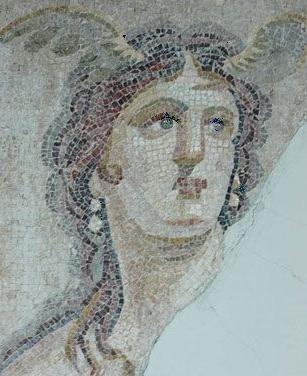
Tethys
ancient Greek mythological figure; mother of the river gods and the Oceanids

Hebe
ancient Greek goddess of youth

Hyperion
Titan in Greek mythology

Erinyes
thumb|upright=1.2|Clytemnestra tries to awaken the sleeping Erinyes. Detail from an [[Apulian red-figure bell-krater, 380–370 BC.]]

Eris
Greek goddess of discord
%20at%20the%20National%20Archaeological%20Museum%20of%20Athens%20on%2030%20August%202018.jpg)
Thanatos
In Greek mythology, Thanatos (; , Thánatos, pronounced in "Death", from θνῄσκω thnēskō "(I) die, am dying") was the personification of death. He was a minor figure in Greek mythology, often referred to but rarely appearing in person.

Iris
the personification of the rainbow in ancient Greek religion and mythology

Thetis
Thetis ( , or ; ) is a figure from Greek mythology with varying mythological roles. She mainly appears as a sea nymph, a goddess of water, and one of the 50 Nereids, daughters of the ancient sea god Nereus.
.jpg)
Hypnos
In Greek mythology, Hypnos (; Ancient Greek: , 'sleep'), also spelled Hypnus, is the personification of sleep. The Roman equivalent is Somnus. His name is the origin of the word hypnosis. Pausanias wrote that Hypnos was the dearest friend of the Muses.

Proteus
thumb|right|Illustration of Proteus by Andrea Alciato from The Book of Emblems (1531)

Phorcys
In Greek mythology, Phorcys or Phorcus (; ) is a primordial sea god, generally cited (first in Hesiod) as the son of Pontus and Gaia (Earth). Classical scholar Karl Kerenyi conflated Phorcys with the similar sea gods Nereus and Proteus. His wife was Ceto, and he is most notable in myth for fathering by Ceto a host of monstrous children. In extant Hellenistic-Roman mosaics, Phorcys was depicted as a fish-tailed merman with crab-claw legs and red, spiky skin.

Eileithyia
Eileithyia or Ilithyia (; , ; (Eleuthyia, ) in Crete, also (Eleuthia, ) or (Elysia, ) in Laconia and Messene, and (Eleuthō) in literature) was the Greek goddess of childbirth and midwifery, and the daughter of Zeus and Hera.

Dione
Greek goddess, mother of Aphrodite

Anemoi
thumb|Wind rose of ancient Greece, created by the scholar [[Adamantios Korais around 1796]]
Atë
ancient Greek goddess of mischief

Scamander
thumb|300px|Water, or the Fight of Achilles against Scamander and Simoeis by Auguste Couder, 1819.
Paean (god)
Greek deity, physician of Olympian gods
Litae
In Greek mythology, Litae (; Ancient Greek: Λιταί means 'prayers') were personifications of prayers offered up in repentance and were ministers of the god Zeus. They were described as hobbling, old women. Their opposite number was Ate, the spirit of delusion and folly, in whose wake they followed.
Clymene
name of multiple figures in Greek mythology

Charis
Greek goddess, spouse of Hephaestus
Pherusa
Pherusa or Pherousa (Ancient Greek: Φέρουσα means 'the bringer') was the name of two female deities in Greek mythology:
Ianira
Ianeira or Ianira (; Ancient Greek: Ἰάνειρά means 'lady of the Ionians') or Janira was a name attributed to three characters in Greek mythology.
Dynamene
In Greek mythology, Dynamene (; "the bringer") was a Nereid or sea-nymph, one of the 50 daughters of the "Old Man of the Sea" Nereus and the Oceanid Doris. Her name, a participle, means "she who can, the capable one." She, along with her sister Pherusa, was associated with the might and power of great ocean swells. Dynamene had the ability to appear and disappear rapidly. Some variations of her name were Dyomene and Dinamene
Thaleia
Nereid of Greek mythology
Doto
nereid in Greek mythology
Speio
thumb|right |Andromeda Chained to the Rock by the Nereids by [[Théodore Chassériau (1840). Oil on canvas, 92 x 74 cm (36.2 x 29.1 in). Louvre, Paris]]
In Greek mythology, Spio (Ancient Greek: Σπειώ means 'the dweller in the caves') was one of the 50 Nereids, marine-nymph daughters of the "Old Man of the Sea" Nereus and the Oceanid Doris. Variations of her name were Speio and Speo.
Callianassa
Nereid of Greek mythology
Amatheia
Nereid of Greek mythology
Amphithoe
Nereid of Greek mythology
Nesaea
In Greek mythology, Nesaea, Nesaia or Nisaea (Ancient Greek: Νησαίη Nêsaiê means 'the dweller on islands') was the "white" Nereid of islands, one of the 50 marine-nymph daughters of the "Old Man of the Sea" Nereus and the Oceanid Doris.
Apseudes
Nereid of Greek mythology
Orithyia
In Greek mythology, Orithyia or Oreithyia (; ; ; ) was the name of the following women:
Orithyia or Orythya, the Nereid of raging seas and one of the 50 marine-nymph daughters of the 'Old Man of the Sea' Nereus and the Oceanid Doris. She and her other sisters appear to Thetis when she cries out in sympathy for the grief of Achilles at the slaying of Patroclus.
Orithyia, a daughter of Cecrops, wife of Makednos and mother of Europus.
Orithyia, a daughter of Erechtheus, who was abducted by Boreas.
Orithyia, a nymph, called by some the grandmother of Adonis.
Orithyia, queen of the Amazons.
Cymodoce
Nereid of Greek mythology
Cymothoe
Nereid of Greek mythology
Proto
Nereid of Greek mythology
Ioke
Greek deity
Amphinome
In Greek mythology, the name Amphinome () may refer to the following deity and women:
Amphinome, the Nereid who feeds Poseidon's flock. As one of the 50 marine-nymphs, she was a daughter of the 'Old Man of the Sea' Nereus and the Oceanid Doris. Amphinome and her other sisters appeared to Thetis when she cries out in sympathy for the grief of Achilles for his slain friend Patroclus.
Amphinome, wife of Aeson, King of Iolcus. She was the mother to Jason and Promachus, Aeson's sons. She and her husband were persecuted by king Pelias of Iolcus. After Pelias had killed her husband and younger son,
Maera
set index of Greek mythological characters
Dexamene
Nereid of Greek mythology