Category
page 1Demand

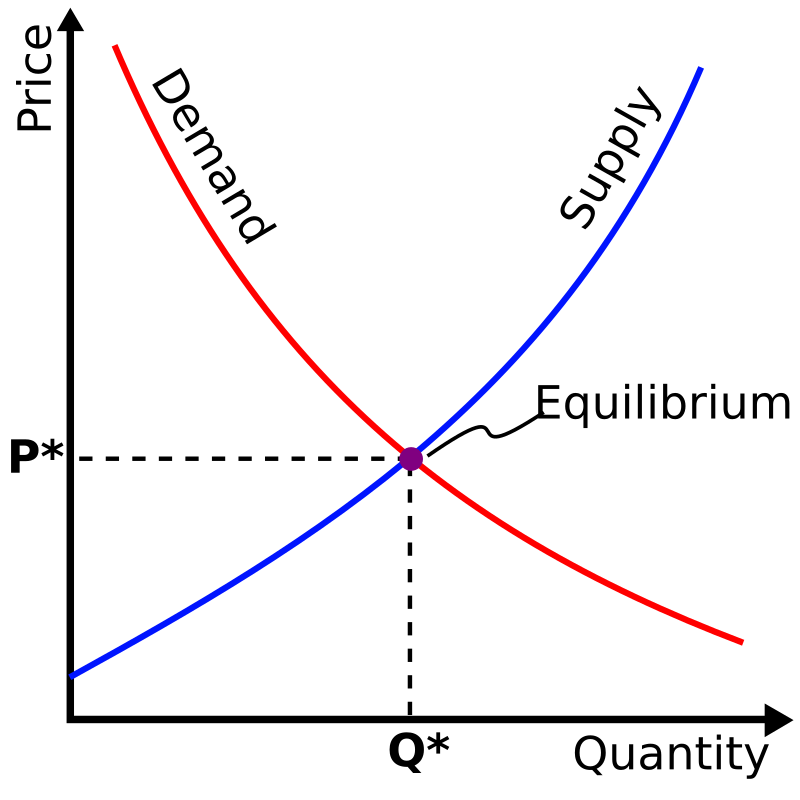
supply and demand
economic model of price determination in microeconomics
demand
In economics, demand is the quantity of a good that consumers are willing and able to purchase at various prices during a given time. In economics "demand" for a commodity is not the same thing as "desire" for it. It refers to both the desire to purchase and the ability to pay for a commodity.
price elasticity of demand
responsiveness of the quantity demanded of a good or service to a change in its price
aggregate demand
total amount of demand for goods and services in an economy
demand curve
graph depicting the relationship between the price of a certain commodity and the amount of it that consumers are willing and able to purchase at that given price
Say's law
concept in market economics
induced demand
transport economics term; when increase in supply results in a decline in price and an increase in consumption
income elasticity of demand
responsiveness of demand for goods with respect to income change
law of demand
principle in economics
Slutsky equation
equation in economics
cross elasticity of demand
responsiveness in the quantity demand of one good when a change in price takes place in another good
demand shock
sudden economic event that temporarily changes consumer demand, with accompanying shift in pricing pressure
effective demand
demand in a constrained marketplace
demand forecasting
process of making future estimations in relation to customer demand over a specific period
Marshallian demand function
function that specifies what the consumer would buy in each price and income or wealth situation, assuming it perfectly solves the utility maximization problem
demand-pull inflation
type of inflation where aggregate demand increases faster than aggregate supply
1980s oil glut
massive oversupply of crude oil in the 1980s
Hicksian demand function
demand of a consumer over a bundle of goods that minimizes their expenditure while delivering a fixed level of utility
kinked demand
a demand curve featuring a concave, non-differentiable bend, leading to a leads to a jump discontinuity in the marginal revenue curve, used as a model of oligopoly and monopolistic competition
derived demand
demand for a factor of production that occurs as a result of the demand for another (e.g. final) good
consumer capitalism
condition in which consumer demand is manipulated through mass-marketing
demand management
methods andactivities used to forecast, plan for and manage the demand for products and services.
Baumol–Tobin model
economic model
Artificial demand
creation of economic demand by deliberately influencing consumers
Price-consumption curve
economic concept
inverse demand function
function expressing price as a function of quantity demanded