Category
page 1Demoi

Piraeus
Piraeus ( ; ; , Ancient: , Katharevousa: ) is a port city within the Athens urban area ("Greater Athens"), in the Attica region of Greece. It is located southwest of Athens city centre along the east coast of the Saronic Gulf in the Athens Riviera.

Elefsina
thumb|250px|Plan of ancient Eleusis
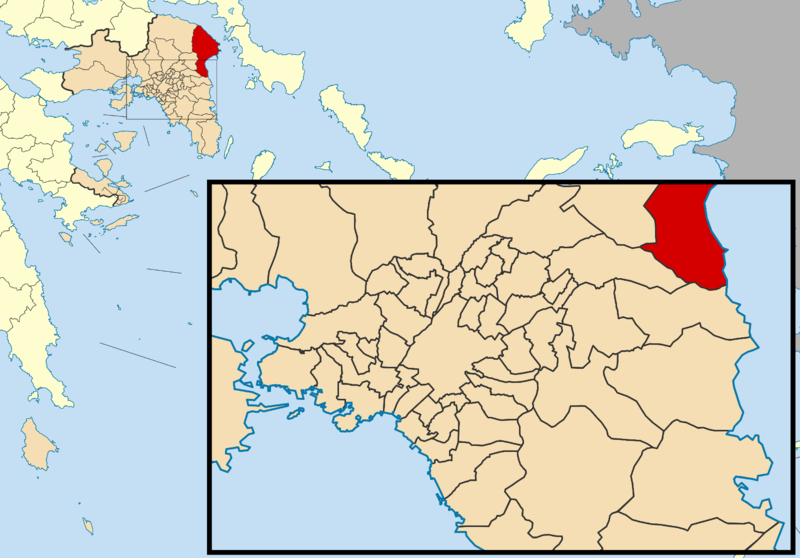
Marathon
modern town in Attica, Greece

deme
thumb|250px|Pinakion|Pinakia, identification tablets (name, father's name, deme) used for tasks like [[jury selection, Museum at the Ancient Agora of Athens]]
In Ancient Greece, a deme or ' (, plural: demoi''''', δῆμοι) was a suburb or a subdivision of Athens and other city-states. Demes as simple subdivisions of land in the countryside existed in the 6th century BC and earlier, but did not acquire particular significance until the reforms of Cleisthenes in 508 BC. In those reforms, enrollment in the citizen-lists of a deme became the requirement for citizenship; prior to that time, citizenshi
Decelea
Decelea (, Dekéleia), was a deme and ancient village in northern Attica serving as a trade route connecting Euboea with Athens, Greece. It was situated near the entrance of the eastern pass across Mount Parnes, which leads from the northeastern part of the Athenian plain to Oropus, and from thence both to Tanagra on the one hand, and to Delium and Chalcis on the other. It was situated about 120 stadia from Athens, and the same distance from the frontiers of Boeotia. It was visible from Athens and from its heights the ships entering the harbour of Piraeus were visible as well.

Rhamnous
Rhamnous (; ), also Ramnous or Rhamnus, was an ancient Greek city in Attica situated on the coast, overlooking the Euboean Strait. Its ruins lie northwest of the modern town of Agia Marina in the municipality of Marathon.

Phaleron
thumb|Phalerum Bay
Phalerum or Phaleron ( '' ; (), ) was a port of Ancient Athens, 5 km southwest of the Acropolis of Athens, on a bay of the Saronic Gulf. The bay is also referred to as "Bay of Phalerum" ( ).''

Thoricus
260px|right|thumb|Archaeological site of Thorikos
Colonus
ancient Athenian deme

Acharnae
Acharnae or Acharnai (; ) was a deme of ancient Athens. It was part of the phyle Oineis.
Kollytos
Collytus or Kollytos () was a deme of ancient Attica, located in the city of Athens. It was located within the walls of Themistocles, south of the Areopagus and southwest of Acropolis. It was famed due to its association with Plato, whose family was from this deme.
Aphidna
Aphidna () or Aphidnae or Aphidnai (Ἀφίδναι) was one of the twelve ancient towns of ancient Attica. It was celebrated in the mythical period as the place where Theseus deposited Helen of Troy, entrusting her to the care of his friend Aphidnus. When the Dioscuri invaded Attica in search of their sister, the inhabitants of Deceleia informed the Lacedaemonians where Helen was concealed, and showed them the way to Aphidna. The Dioscuri thereupon took the town, and carried off their sister. We learn, from a decree quoted by Demosthenes, that Aphidna was, in his time, a fortified town, and at a grea
Alopeke
thumb|Map of classical Attica showing the location of Alopece in Athens.
Alopece (), also spelt as Alopecae, was an asty deme of the city of Athens, but located exterior to the city wall of Athens. Alopece belonged to the tribal group (phyle) of Antiochis. It was situated only eleven or twelve stadia from the city, and not far from Cynosarges. It possessed a temple of Aphrodite, and also apparently one of Hermaphroditus.
Myrrhinous
Myrrhinus or Myrrinous () was a deme of ancient Attica which belonged to the phyle (clan) of Pandionis. It lay to the east of Prasiae. Artemis Colaenis was worshipped at Myrrhinus; and in one of the inscriptions recovered at Merenda mention is made of a temple of Artemis Colaenis.
Steiria
ancient Athenian deme
Skambonidai
Scambonidae or Skambonidai () was a deme of ancient Attica, located in the city of Athens. It was located within the Themistoclean Wall, north of the Acropolis.
Phyle
ancient Athenian deme and fortress
Aixone
Aexone or Aixone () was a deme of ancient Attica situated on the coast south of Halimus. Aixone, along with neighbouring Halai Aixonidai, belonged to the Kekropis tribe. Aexone was celebrated for its fisheries.
Kephisia
Cephisia or Kephisia () was a deme of ancient Attica, of the phyle of Erechtheis, sending six or eight delegates to the Athenian Boule.
Melite
ancient Athenian deme
Ikarion
ancient Athenian deme
Halimous
Halimus or Halimous (, Latin: Halmius) was a deme of ancient Athens, said to have been so called from τὰ ἅλιμα, sea-weeds, was situated on the coast between Phalerum and Aexone, at the distance of 35 stadia from the city of Athens. It had temples of Demeter and Core, and of Heracles. Halimus was the deme of Thucydides the historian.
Phlya
Phlya ( or Φλυά) was a deme of ancient Attica that lay in the Mesogaea. It must have been a place of importance from the number of temples which it contained, and from its frequent mention in inscriptions. It was host to the Phlyan mystery cult of Demeter and Dionysus, funded by the Lycomid family.
Gargettos
Gargettus or Gargettos () was a deme of ancient Attica. From the mythical story of the war of the Pallantidae against Theseus, we learn that the demoi of Pallene, Gargettus, and Agnus were adjacent. When Pallas was marching from Sphettus in the Mesogaea against Athens, he placed a body of his troops in ambush at Gargettus, under the command of his two sons, who were ordered, as soon as he was engaged with the army of Theseus, to march rapidly upon Athens and take the city by surprise, But the stratagem was revealed to Theseus by Leos of Agnus, the herald of Pallas; whereupon Theseus cut to pie
Koile
thumb|The archaeological site of the Deme of Koile (June 2021)
thumb|Remains of Koile road
Lamptrai
Lamptrai (), or Lamptra (Λάμπτρα, in inscriptions; Λάμπρα, in writers), was the name of two demoi or ancient Attica, Upper Lamptrai (Lamptrai Kathyperthen), and Lower or Maritime Lamptrai (Lamptrai Paraloi). These places were between Anagyrus, Thorae, and Aegilia.

Xypete
Xypete (), also Xypeteum or Xypeteon (Ξυπετεών), was said to have been likewise called Troja (Τροία), because Teucrus led from hence an Attic colony into Phrygia, was a deme of ancient Attica. It was apparently near Peiraeeus or Phalerum, since Xypete, Peiraeeus, Phalerum, and Thymoetadae formed the τετράκωμοι, which had a temple of Heracles in common (τετράκωμον Ἡρακλεῖον).
Erchia
Erchia or Erkhia (; also spelled Ἔρχεια and Ἑρχιά) was a deme of ancient Attica, of the phyle of Aegeis, sending six or seven delegates to the Athenian Boule, but eleven delegates after 307/6 BCE. According to Stephanus of Byzantium, in Greek mythology, the name comes from an inhabitant of the deme who hosted Demeter.
Paiania
Paeania or Paiania () were two demoi of ancient Attica, divided into Upper Paeania and Lower Paeania, that were situated on the eastern side of Hymettus, near the modern village of Liopesi renamed to Paiania. It was the deme of Demosthenes.
Prasiai
ancient Athenian deme
Phrearrhioi
Phrearrhii or Phrearrhioi or Phrearroi () was a deme of the coastal (paralia) region of ancient Attica, belonging to the Leontis tribe (phyle), with nine to ten representatives in the Boule.

Trikorythos
Tricorythus or Trikorythos () or Tricorynthus or Trikorynthos (Τρικόρυνθος) or Tricorinthus or Trikorinthos (Τρικόρινθος) was a deme of ancient Athens, in the plain of Marathon in northeast Attica. It along with Oenoe, Marathon, and Probalinthus, formed the Attic Tetrapolis, one of the twelve districts into which Attica was divided before the time of Theseus. The plain near Tricorythus was where the right of the Persian army were forced into the marsh during the Battle of Marathon.
Probalinthos
Probalinthus or Probalinthos () was a deme of ancient Attica, one of the Attic Tetrapolis (along with Marathon, Tricorythus, and Oenoe) located in the plain of Marathon. Probalinthus belonged to the phyle Pandionis.
Antinoeis
Antinoeis () was a deme of ancient Attica, in the part of the city founded by the emperor Hadrian. The deme was established only in 126 or 127, after the death of Antinous, a favourite of Hadrian.
Kydathenaion
Cydathenaeum or Kydathenaion () was one of the demes in ancient Athens. It belonged in the phyle (tribe) Pandionis.
Hagnous
ancient Athenian deme
Deiradiotai
Deiradiotae or Deiradiotai () was a deme of ancient Attica, originally of the phyle of Leontis, but between 307/6 BCE to 201/0 BCE of the phyle of Antigonis, sending two delegates to the Boule.
Angele
ancient Athenian deme
Diomeia
ancient Athenian deme
Sphettos
Sphettus or Sphettos () was one of the twelve cities of ancient Attica, and subsequently a deme. That it was situated either in the Mesogaea or the Paralia is certain from the legend, that Pallas, who had obtained these districts, marched upon Athens from Sphettus by the Sphettian Way. There are good reasons for believing that Pallas must have marched round the northern extremity of Hymettus; and consequently the Sphettian road must have taken that course.
Hysiae
ancient town of Boeotia, Greece
Anaphlystos
Anaphlystus or Anaphlystos () was a coastal (paralia) deme of ancient Athens, belonging to the Antiochis phyle, on the west coast of Attica, opposite the island of Eleussa, and a little north of the promontory of Sunium, between that promontory and that of Astypalaea. It bordered on Aegilia to the west, to Atene in the south-east and to Amphitrope to the east. To the northwest, it was separated from Phrearrhioi by the Astike Hodos.
Athmonon
Athmonum or Athmonon (), also Athmonia (Ἀθμονία), was a deme of ancient Attica, situated on the site of Marousi (Amarousion). The name of the modern village has been derived from Amarysia, a surname of Artemis, who was worshipped under this designation at Athmonum. An inscription found near Marousi, in which the temenos of this goddess is mentioned, puts the matter beyond dispute. Athmonum also possessed a very ancient temple of Aphrodite Urania. The inhabitants of this deme appear to have been considered clever wine-dressers.
Apollonieis
Apollonieis () was a deme of ancient Attica, of the phyle of Attalis, sending five delegates to the Athenian Boule. It was established in 200 BCE and named after Apollonis of Cyzicus, wife of Attalus I.
Hekale
ancient Athenian deme
Halai Aixonides
ancient Athenian deme
Azenia
ancient Athenian deme of uncertain location
Oinoe
ancient Athenian deme near Marathon
Thorai
Thorae or Thorai () was a deme of ancient Attica, located a little south of Anagyrus.
Oa
ancient Athenian deme
Philaidai
ancient Athenian deme
Pallene
ancient deme of Attica
Halai Araphenides
ancient Athenian deme
Oe
ancient Athenian deme
Pithos
Pithus or Pithos () was a deme in ancient Attica of the phyle of Cecropis, sending three, four, or five delegates to the Athenian Boule.
Daidalidai
Daedalidae or Daidalidai () was a deme of ancient Attica, located north of Alopece, southeast of Athens. The name "Daedalidae" was often used to refer to the most skilled sculptors in allusion to Daedalus, the labyrinth builder of Knossos. Socrates, in two dialogues of Plato, claims to descend from Daedalus, most likely exploiting this allusion, in which his ancestors would have been sculptors. In Daedalidae, therefore, a craftsman named Daedalus could have been revered as an eponymous hero, which was most probably not the same as the Daedalus of mythology. Some sources note the presence of a
Prospalta
ancient Athenian deme
Berenikidai
Berenicidae or Berenikidai () was a deme of ancient Attica, of the tribe of Ptolemais, sending one delegate to the Athenian Boule. It was established in 224/3 BCE and named after Berenice II of Egypt, wife of Ptolemy II, after whom the tribe was named.
Araphen
Araphen () was the name of a deme of ancient Athens, situated on the eastern coast to the north of Brauron and Halae Araphenides, on the west of the current village of Rafina, located near the mouth of the river of the same name.
Kytheros
Cytherus or Kytheros ( or Κύθηρος), also known as Cytherum or Kytheron (Κύθηρον), was one of the twelve cities of ancient Attica, and afterwards a deme. Pausanias states that the nymphs of the river Cytherus in Elis were called Ionides from Ion, the son of Gargettus, when he migrated from Athens to Elis.