Category
page 1Demons in Christianity

Satan
thumb|Illustration of the Devil on Codex Gigas, early thirteenth century
Satan, also known as the Devil, is an entity in Abrahamic religions who entices humans into sin or falsehood. In Judaism, Satan is seen as an agent subservient to God, typically regarded as a metaphor for the , or 'evil inclination'. In Christianity and Islam, he is usually seen as a fallen angel or jinn who has rebelled against God, who nevertheless allows him temporary power over the fallen world and a host of demons.

succubus
thumb|upright=1.2|Depiction of a succubus in "My Dream, My Bad Dream" by , 1915
A succubus () is a female demon who is described in various European folklore as appearing in the dreams of male humans in order to seduce them. Repeated interactions between a succubus and a man will lead to sexual activity. The establishment and perpetuation of such a relationship enables the production of a hybrid child known as a cambion, but at the expense of the man, whose mental and physical health will deteriorate rapidly, eventually resulting in his death if the succubus continues courting him for a protra
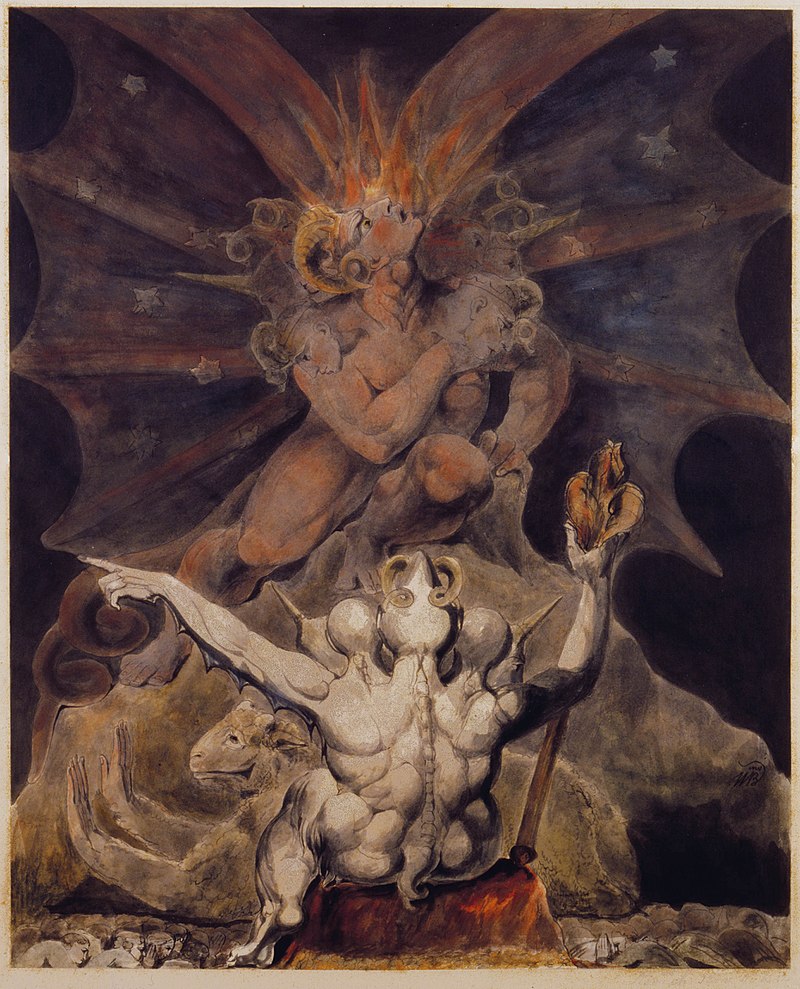
number of the beast
number associated with the beast in the Book of Revelation; either 666 or 616, depending on the manuscript

Jezebel
Jezebel () was the daughter of Ithobaal I of Tyre and the wife of Ahab, King of Israel, according to the Book of Kings of the Hebrew Bible (1 Kings 16).

Mammon
250px|thumb|1909 painting The Worship of Mammon by Evelyn De Morgan
Mammon (Aramaic: מָמוֹנָא, māmōnā) in the New Testament is commonly thought to mean money, material wealth, or any entity that promises wealth, and is associated with the greedy pursuit of gain. The Gospel of Matthew and the Gospel of Luke both quote Jesus using the word in a phrase often rendered in English as "You cannot serve both God and mammon."

Baphomet
thumb|An 1856 depiction of the Sabbatic Goat from by Éliphas Lévi. The arms bear the [[Latin words (dissolve) and (coagulate), reflecting the spiritual alchemy of Lévi's work.]]
%20-%20WGA2572.jpg)
nephilim
The Nephilim (; ) are mysterious beings or humans mentioned in the Bible, traditionally understood as being of great size and strength, or alternatively as beings of great power and authority. The origins of the Nephilim remain unclear. Some writers, including the author of the Book of Enoch, view them as the offspring of rebellious angels and humans. Others view them as descendants of Seth and Cain.

incubus
thumb|Depiction of incubi, Vincenz Georg Kininger, 1879
An Incubus () is a male demon who is described in various folklore as appearing in the dreams of female humans in order to seduce them. Repeated interactions between an incubus and a woman will lead to sexual activity, a bond forming between them, and ultimately sexual intercourse, as he requires vaginal ejaculation discharge to survive. The establishment and perpetuation of such a relationship enables the production of a hybrid child known as a cambion, but at the expense of the woman, whose mental and physical health will deteriorate ra

Asmodeus
thumb|right|220px|Asmodeus as depicted in Collin de Plancy's [[Dictionnaire Infernal]]
Asmodeus (; , Asmodaios) or Ashmedai (; ; ; see below for other variations) is a king of demons in the legends of Solomon and the constructing of Solomon's Temple.
fallen angel
in the Abrahamic religions, angels expelled from heaven

Belial
thumb|300px|A woodcut of Belial and some of his followers from a German edition of Jacobus de Teramo's book [[Consolatio peccatorum, seu Processus Luciferi contra Jesum Christum (1473).]]
Belial (; , Bəlīyyaʿal) is a term occurring in the Hebrew Bible/Old Testament which later became personified as the devil in Christian texts of the New Testament. Alternate spellings include Baalial, Balial, Belhor, Beliall, Beliar, Berial, Bylyl and '''Beliya'al'. Early usage of Belial'' referred to "wickedness" or "worthlessness", occurring several times in the Old Testament. Later, in the Dead Sea Scrolls
Whore of Babylon
New Testament symbol

Belphegor
thumb|Depiction of the demon Belphégor, from J.A.S. Collin de Plancy, Dictionnaire Infernal, 1863
Belphegor (or Baal Peor, ) is, in Christianity, a demon associated with one of the seven deadly sins. According to religious tradition, he helps people make discoveries. He seduces people by proposing incredible inventions that will make them rich. According to some demonologists from the 17th century, his powers are strongest in April. Peter Binsfeld (ca. 1540–ca.1600), the auxiliary bishop of Trier and a witch hunter, wrote that Belphegor tempts through laziness. According to Binsfeld's Classifi

Adramelech
thumb|Depiction of Adrammelech, from Jacques Collin de Plancy|Collin de Plancy's [[Dictionnaire Infernal, 1863]]
Adrammelech (; Adramélekh) is an ancient Semitic god mentioned briefly by name in the Book of Kings, where he is described as a god of "Sepharvaim". Sepharvaim (a word which is grammatically dual) is commonly, but not certainly, identified with the twin cities of Sippar Yahrurum and Sippar Amnanum on the banks of the Euphrates, north of Babylon. The name Adrammelech probably translates to "Magnificent king."
Legion
biblical term for a demon or group of demons said to be exorcised by Jesus

Titivillus
thumb|14th century illustration of Titivillus at a scribe's desk
thumb|Titivillus in a detail of Diego de la Cruz (painter)|Diego de la Cruz's Virgin of Mercy (), [[Burgos, Abbey of Santa María la Real de Las Huelgas.]]
thumb|upright|Saint John the Evangelist on Patmos by Hieronymus Bosch, 1505. It is believed that the devil on the lower right corner of the scene, with a human face and an insect body, is Titivillus. It appears Titivillus tries to grab and steal Saint John's ink bottle using a rake-like tool.
Dancing devils of Corpus Christi
Venezuelan religious festivals
Baby jumping
Spanish festival

Christian demonology
Study of demons from a Christian point of view

Demogorgon
thumb|Late 16th-century Demogorgon woodcut by Hendrick Goltzius
Demogorgon is a deity or demon associated with the underworld. Although often ascribed to Greek mythology, the name probably arises from an unknown copyist's misreading of a commentary by a fourth-century scholar, Lactantius Placidus. The concept itself can be traced back to the original misread term demiurge.
witches' mark
Hypothetical mark on the body indicating a person was a witch

Gello
Gello (), in Greek mythology, is a female demon or revenant who threatens the reproductive cycle by causing infertility, miscarriage, and infant mortality. By the Byzantine era, the () were considered a class of beings. Women believed to be under demonic possession by gelloudes might stand trial or be subjected to exorcism.
spiritual warfare
Christian concept of fighting against the work of preternatural evil forces
witching hour
time of day when the devil, demons or ghosts are supposed to come out
Alastor
Alastor (; ) refers to a number of people and concepts in Greek mythology:
Territorial Spirit
National angels or demons, a concept proposed by certain religions
Dusios
thumb|150px|right|St. Augustine in a 6th-century portrait
In the Gaulish language, Dusios was a divine being among the continental Celts who was identified with the god Pan of ancient Greek religion and with the gods Faunus, Inuus, Silvanus, and Incubus of ancient Roman religion. Like these deities, he might be seen as multiple in nature, and referred to in the plural (dusioi), most commonly in Latin as dusii. Although the Celtic Dusios is not described in late-antique sources independently of Greek and Roman deities, the common functionality of the others lay in their ability to impregnate an