Category
page 1Dhikr
.jpg)
Shahada
The Shahada ( ; , 'the testimony'), also transliterated as Shahadah, is an Islamic oath and creed, and one of the Five Pillars of Islam and part of the adhan. It reads: "I bear witness that there is no god but God, and I bear witness that Muhammad is the Messenger of God." The Shahada declares belief in the oneness () of God and the acceptance of Muhammad as God's messenger. Some Shia Muslims also include a statement of belief in the of Ali, but they do not consider it as an obligatory part for converting to Islam.
adhan
The '''''' (, ) is the Islamic call to prayer, usually recited by a muezzin, traditionally from the minaret of a mosque, shortly before each of the five obligatory daily prayers.

Basmala

Takbir
The ( , ) is the name for the Arabic phrase '''' ( , ).
%20%E2%80%93%20Eug%C3%A8ne%20Baugnies%20(1841%E2%80%931891).jpg)
dhikr
thumb|right|The Dhikr, Eugène Baugnies (1841–1891)
'''' (; ; ) is a form of Islamic worship in which phrases or prayers are repeatedly recited for the purpose of remembering God. It plays a central role in Sufism, and each Sufi order typically adopts a specific dhikr, accompanied by specific posture, breathing, and movement. In Sufism, dhikr refers to both the act of this remembrance as well as the prayers used in these acts of remembrance. Dhikr'' usually includes the names of God or supplication from the Quran or hadith. It may be counted with either one's fingers or prayer beads, and may be
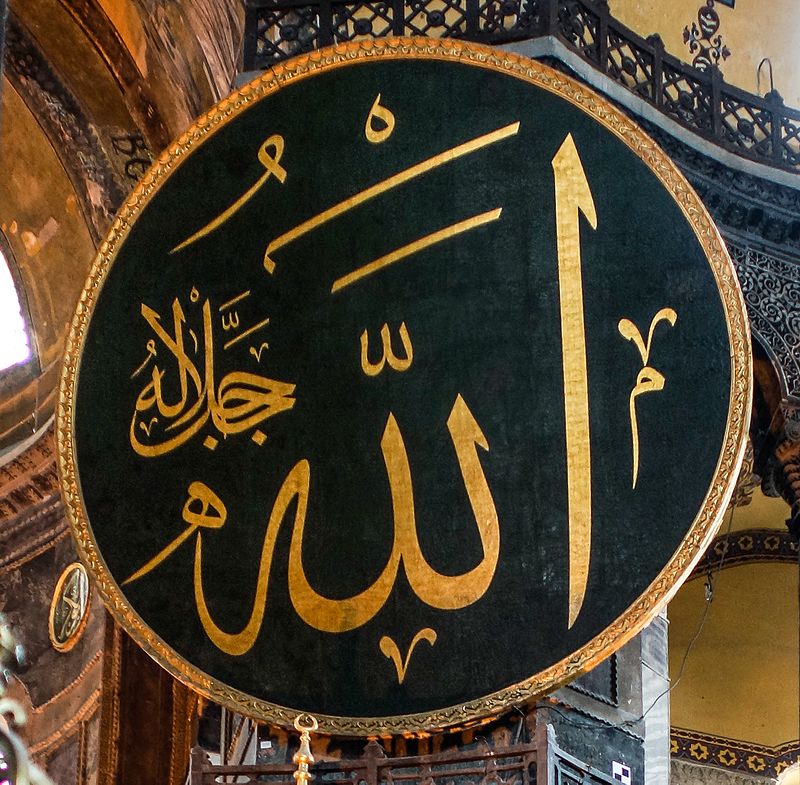
Inshallah
Inshallah, usually called the , is an Arabic-language expression meaning or . It is mentioned in the Quran, surah Al-Kahf (23-24), which requires its use when mentioning intended actions. It signifies that nothing, neither action nor thought, happens without God's permission.

Alhamdulillah
Alhamdulillah (, '') is an Arabic phrase meaning "praise be to God", sometimes translated as "thank God" or "thanks be to the Lord". This phrase is called Tahmid (). A longer variant of the phrase is al-ḥamdu l-illāhi rabbi l-ʿālamīn'' (), meaning "all praise is due to God, Lord of all the universes", the first verse of Surah Al-Fatiha, the opening chapter of the Quran.
Sufi lodge
a building designed specifically for gatherings of a Sufi brotherhood

Dua
In Islam, ''' ( , plural: ' ) is a prayer of invocation, supplication or request, asking help or assistance from God. Duʿāʾ is an integral aspect of Islamic worship and spirituality, serving as a direct line of communication between a believer and Allah. Unlike salat, a formal daily prayer performed five times a day with prescribed motions, postures, and recitations, du'ā' is a more "free prayer", characterized by spontaneity and informality. For this reason, du'ā' most closely corresponds to the English term prayer, a term that originates from the Latin precare, meaning 'to beg' a
Iqama
The iqama () is the second Islamic call to prayer, recited after the adhan. It summons those already in the mosque to line up for prayer (salah).

maktab
thumb|Interior of a 19th-century kuttab in Cairo, Egypt
A kuttab ( kuttāb, plural: kataatiib, ) or maktab () is a type of elementary school in the Muslim world. Though the kuttab was primarily used for teaching children in reading, writing, grammar, and Islamic studies, such as memorizing and reciting the Qur'an (including ''Qira'at''), other practical and theoretical subjects were also often taught. The kuttāb represents an old-fashioned method of education in Muslim majority countries, in which a sheikh teaches a group of students who sit in front of him on the ground. Until the 20th centur

Mashallah
thumb|Mashallah in Arabic calligraphy
Mashallah or Ma Sha Allah or Masha Allah or Ma Shaa Allah () is an Arabic phrase generally used to positively denote something of greatness or beauty and to express a feeling of awe. It is often used to convey a sense of respect and to protect against the evil eye, suggesting that the speaker is acknowledging something positive without invoking jealousy.
Sama
Sufi ceremony performed as dhikr
nasheed
A nasheed (, ) is a work of vocal music, partially coincident with hymns, that is either sung a cappella or with instruments, according to a particular style or tradition within Islam.

tasbih
thumbnail|Glory to Allah "Subhan Allah" in Arabic, Desouk, Egypt
zawiya
Islamic religious school or monastery
Inna Lillahi wa inna ilaihi raji'un
Muslim phrase for receipt of bad news found in Quran 2:156
Istighfar
Istighfar () is the act of seeking forgiveness of Allah in Islam. This is usually done by saying "I seek the forgiveness of Allah" (), or "I seek the forgiveness of Allah, my Lord, and turn to him (in repentance)" ().
Ta'awwudh
The Ta`awwudh (Arabic: تعوذ) is the phrase A`ūdhu billāhi min ash-shaitāni r-rajīmi (أَعُوْذُ بِاللهِ مِنَ الشَّـيْطٰنِ الرَّجِيْمِ). This is an Arabic sentence meaning "I seek refuge in Allah from Shaitan, the accursed one". It is often recited by Muslims before reciting the Qur'an and before beginning a task. It is often followed by the Basmala.
Ta'awwudh and basmalah are pronounced along with the formulation of the niyyah (intention). The recitation of ta`awwudh is considered a subcategory of dua. It is also described in the hadith as a supplication to reduce or remove rage or wrath.
Haḍra
collective supererogatory ritual performed by Sufi orders

La Hawla wa la Quwwata Illa Billah
thumb|200px|Arabic calligraphy of the Hawqala
The Ḥawla () or the LaHawla () is an Arabic term referring to the Arabic statement (''''), which is usually translated as "There is no power nor strength except by God."
Khalwa
Sufi practice of retreat

Madih nabawi
religious genre of Arabic music
Salka
Recitation of the entire Holy Quran
Tilawa
thumb|Man reading the Quran in [[al-Saleh Mosque]]
The Tilawa () is a recitation of the successive verses of the Qur'ān in a standardized and proven manner according to the rules of the ten recitations.
Hizb Rateb
Quran and dhikr recitation
Hadha min fadhle Rabbi
arabic phrase and Quranic expression of gratitude and dhikr