Category
page 1Diagnostic neurology

electroencephalography
Electroencephalography (EEG)
is a method to record an electrogram of the spontaneous electrical activity of the brain. The bio signals detected by EEG have been shown to represent the postsynaptic potentials of pyramidal neurons in the neocortex and allocortex. It is typically non-invasive, with the EEG electrodes placed along the scalp (commonly called "scalp EEG") using the International 10–20 system, or variations of it. Electrocorticography, involving surgical placement of electrodes, is sometimes called "intracranial EEG". EEG is widely used both as a clinical diagnostic tool, particularl
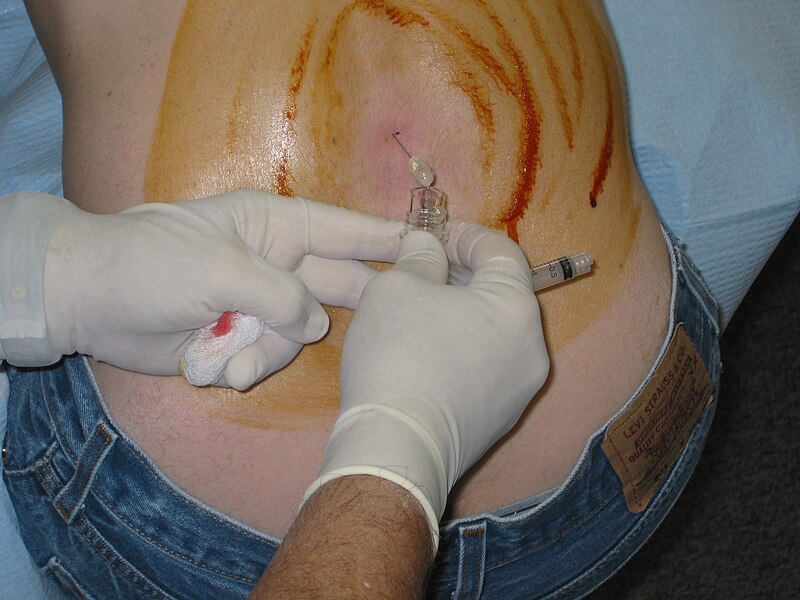
lumbar puncture
procedure to collect cerebrospinal fluid

electromyography
Electromyography (EMG) is a technique for evaluating and recording the electrical activity produced by skeletal muscles. EMG is performed using an instrument called an electromyograph to produce a record called an electromyogram. An electromyograph detects the electric potential generated by muscle cells when these cells are electrically or neurologically activated. The signals can be analyzed to detect abnormalities, activation level, or recruitment order, or to analyze the biomechanics of human or animal movement. Needle EMG is an electrodiagnostic medicine technique commonly used by neurolo
transcranial magnetic stimulation
form of brain stimulation using magnetic fields

polysomnography
Polysomnography (PSG) is a multi-parameter type of sleep study and a diagnostic tool in sleep medicine. The test result is called a polysomnogram, also abbreviated PSG. The name is derived from Greek and Latin roots: the Greek πολύς (polus for "many, much", indicating many channels), the Latin somnus ("sleep"), and the Greek γράφειν (graphein, "to write").
magnetoencephalography
Magnetoencephalography (MEG) is a functional neuroimaging technique for mapping brain activity by recording magnetic fields produced by electrical currents occurring naturally in the brain, using very sensitive magnetometers. Arrays of SQUIDs (superconducting quantum interference devices) are currently the most common magnetometer, while the SERF (spin exchange relaxation-free) magnetometer is being investigated for future machines. Applications of MEG include basic research into perceptual and cognitive brain processes, localizing regions affected by pathology before surgical removal, determi
Romberg's test
test used in an exam of neurological function for balance
myelography
Myelography is a type of radiographic examination that uses a contrast medium (e.g. iodised oil) to detect pathology of the spinal cord, including the location of a spinal cord injury, cysts, and tumors. Historically the procedure involved the injection of a radiocontrast agent into the cervical or lumbar spine, followed by several X-ray projections. Today, myelography has largely been replaced by the use of MRI scans, although the technique is still sometimes used under certain circumstances – though now usually in conjunction with CT rather than X-ray projections.
Enolase 2
mammalian protein found in Homo sapiens

tilt table test
medical procedure often used to diagnose dysautonomia or syncope
Adson's sign
loss of the radial pulse in the arm by rotating head to the ipsilateral side with extended neck following deep inspiration
S-100 protein
family of vertebrate proteins involved in cell division and inflammation
Jendrassik maneuver
medical maneuver to test reflexes
Asymmetrical tonic neck reflex
Temporal reflex action in infants usually for a period of about six months
esthesiometer
thumb|Esthesiometer from C. Lombroso's Criminal man
Multiple Sleep Latency Test
Diagnostic tool used to diagnose sleep disorders
Wada test
diagnostic procedure
auditory brainstem response
process
Chaddock reflex
diagnostic reflex similar to the Babinski reflex
Expanded Disability Status Scale
scale for clinical accesment and outcome for multiple sclerosis ...a nice scale to grasp
posturography
Posturography is the technique used to quantify postural control in upright stance in either static or dynamic conditions. Among them, Computerized dynamic posturography (CDP), also called test of balance (TOB), is a non-invasive specialized clinical assessment technique used to quantify the central nervous system adaptive mechanisms (sensory, motor and central) involved in the control of posture and balance, both in normal (such as in physical education and sports training) and abnormal conditions (particularly in the diagnosis of balance disorders and in physical therapy and postural re-educ
intraoperative neurophysiological monitoring
use of electrophysiological methods
Diadochokinesia
Diadochokinesia or diadochokinesis is the ability to make antagonistic movements in quick succession, alternately bringing a limb into opposite positions, as of flexion and extension or of pronation and supination. Speech-language pathology defines it as the speed necessary to stop a determined motor impulse and substitute it with its opposite. The relative timing of this kind of movements is also called alternate motion rates (AMR) or sequential motor rates (SMR).
ABCD² score
score for determining the risk of stroke after TIA
Durkan's test
medical diagnostic method
Beevor's sign
medical condition
Electroneuronography
Electroneuronography or electroneurography (ENoG) is a neurological non-invasive test used to study the facial nerve in cases of muscle weakness in one side of the face (Bell's palsy). The technique of electroneuronography was first used by Esslen and Fisch in 1979 to describe a technique that examines the integrity and conductivity of peripheral nerves. In modern use, ENoG is used to describe study of the facial nerve, while the term nerve conduction study is employed for other nerves.
Slump test
Frenzel goggles
diagnostic tool used in ophthalmology, otolaryngology and audiovestibular medicine
oligoclonal band
marker in blood or cerebrospinal fluid testing