Category
page 1Docodonta

Castorocauda
Castorocauda is an extinct, semi-aquatic, superficially otter-like genus of docodont mammaliaforms with one species, C. lutrasimilis. It is part of the Yanliao Biota, found in the Daohugou Beds of Inner Mongolia, China dating to the Middle to Late Jurassic. It was part of an explosive Middle Jurassic radiation of Mammaliaformes moving into diverse habitats and niches. Its discovery in 2006, along with the discovery of other unusual mammaliaforms, disproves the previous hypothesis of Mammaliaformes remaining evolutionarily stagnant until the extinction of the non-avian dinosaurs at the end of t

Docodonta
Docodonta is an order of extinct Mesozoic mammaliaforms (advanced cynodonts closely related to true crown-group mammals). They were among the most common mammaliaforms of their time, persisting from the Early Jurassic to the Early Cretaceous across the continent of Laurasia (modern-day North America, Europe, and Asia). They are distinguished from other early mammaliaforms by their relatively complex molar teeth.

Docodon
Docodon (meaning 'beam tooth') is an extinct genus of docodont mammaliaform from the Late Jurassic of Western North America. It was the first docodont to be named.

Agilodocodon
Agilodocodon was a genus of shrew-sized docodont from the Middle Jurassic, believed to be the earliest known tree-climbing mammaliaform. It contains one species, A. scansorius.
Docofossor
Docofossor is an extinct mammaliaform (a docodont) from the Jurassic period. Its remains have been recovered in China from 160-million-year-old rocks. It appears to have been the earliest-known subterranean mammaliaform, with adaptations remarkably similar to the modern Chrysochloridae, the golden moles.
Borealestes
Borealestes is a genus of docodontan from the Middle Jurassic of Britain, first discovered on the Isle of Skye near the village of Elgol. It was the earliest mammaliaform from the Mesozoic found and named in Scotland. A second species and was later found in other Middle Jurassic sites in England, but is now shown to be a different genus. A new species, B. cuillinensis was named in 2021, also from Skye.
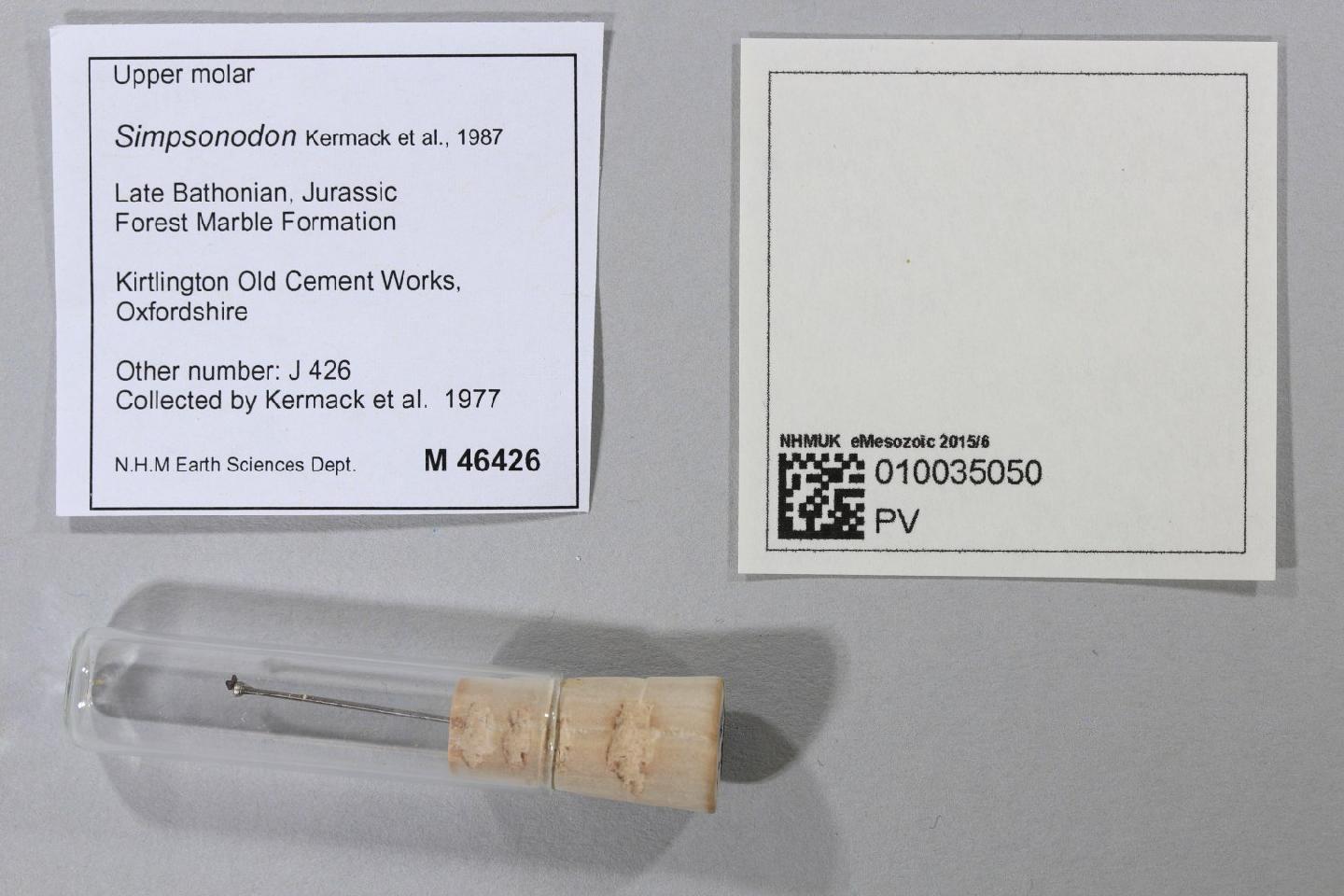
Simpsonodon
Simpsonodon is an extinct genus of docodontan mammaliaform known from the Middle Jurassic of England, Kyrgyzstan and Russia. The type species S. oxfordensis was described from the Kirtlington Mammal Bed and Watton Cliff in the Forest Marble Formation of England. It was named after George Gaylord Simpson, a pioneering mammalologist and contributor to the Modern Evolutionary Synthesis. A second species S. sibiricus is known from the Itat Formation of Russia, and indeterminate species of the genus are also known from the Balabansai Formation in Kyrgyzstan
Haldanodon
Haldanodon is an extinct docodont mammaliaform which lived in the Upper Jurassic (Kimmeridgian, about 145 million years ago). Its fossil remains have been found in Portugal, in the well-known fossil locality of Guimarota, which is in the Alcobaça Formation. It may have been a semi-aquatic burrowing insectivore, similar in habits to desmans and the platypus. Several specimens are known, include a partial skeleton and well-preserved skulls.