Category
page 1Drama

opera
280px|thumb|Macbeth (Verdi)|Macbeth at the [[Savonlinna Opera Festival in St. Olaf's Castle, Savonlinna, Finland, in 2007]]
thumb|280px|La Scala of Milan
thumb|280px|Palais Garnier of the [[Paris Opéra]]
Opera is a form of Western theatre in which music is a fundamental component and dramatic roles are taken by singers. Such a "work" (the literal translation of the Italian word "opera") is typically a collaboration between a composer and a librettist and incorporates a number of the performing arts, such as acting, scenery, costume, and sometimes dance or ballet. The performance is typically g

drama

monologue
thumb|Actor Christopher Walken performing a monologue in the 1984 stage play [[Hurlyburly]]
In theatre, a monologue (also spelled monolog in American English) (in , from μόνος mónos, "alone, solitary" and λόγος lógos, "speech") is a speech presented by a single character, most often to express their thoughts aloud, though sometimes also to directly address another character or the audience. Monologues are common across the range of dramatic media (plays, films, etc.), as well as in non-dramatic media such as poetry, and stand-up comedy. Monologues share much in common with several other litera
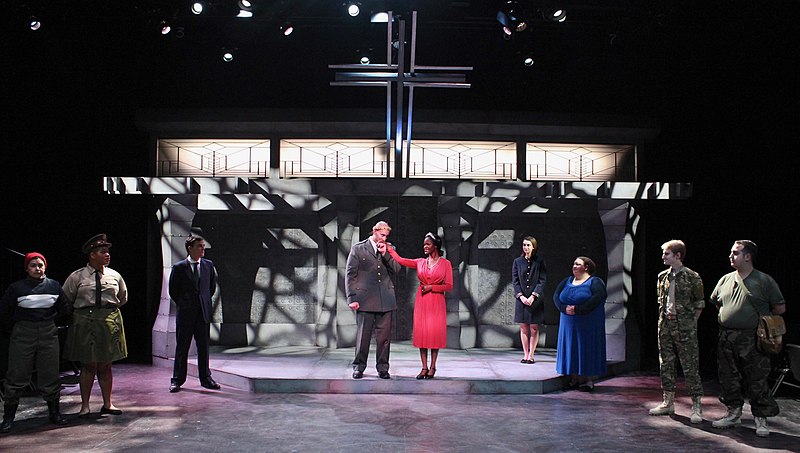
play
theatrical dramatic work intended to be performed by actors (in theatre, radio or recorded for TV)

epilogue
An epilogue or epilog (from Greek ἐπίλογος epílogo, "conclusion" from ἐπί epi, "in addition" and λόγος logos, "word") is a piece of writing at the end of a work of literature, usually used to bring closure to the work. It is presented from the perspective of within the story. When the author steps in and speaks directly to the reader, that is more properly considered an afterword. The opposite is a prologue—a piece of writing at the beginning of a work of literature or drama, usually used to open the story and capture interest. Some genres, for example television programs and video games, call

dramaturgy
Dramaturgy (conventional, text-based) is the study of dramatic composition and the representation of the main elements of drama on the stage. The role of a dramaturg working on text in the field of modern dramaturgy is to help realize the multifaceted world of the play for a production using information from the script, playwright, the context in which the play was written, and the context in which it is staged. It is a dramaturg's job to assist the director and playwright, especially if the culture of the play is not fully experienced by these people.

historical drama
drama fiction work of art set in, or reminiscent of, an earlier time period
act
division or unit of a drama

soliloquy
thumb|Juliet delivers a soliloquy on the balcony, unaware that [[Romeo is listening in act 2, scene 2 of Romeo and Juliet.|alt=painting of a girl in a long dress on a balcony, she is looking to the right]]
A soliloquy (, from Latin 'alone' and 'to speak', ) is a monologue in drama in which a character speaks their thoughts aloud, typically while alone on stage or onscreen. It is used to reveal the character's inner feelings, motivations, or plans directly to the audience, providing information that would not otherwise be accessible through dialogue with other characters. They are used as a nar
talent show
TV genre; event, television or radio program that focuses on the potential audition of singers, dancers, models and the like
stock character
literary or social stereotype used to create characters or determine their role in a story
classical unities
narration theory
comedy of manners
theatrical and literary genre

tritagonist
thumb | right | Marble bust of Aeschines. Greek, 4th - 2nd century BC. Found in ʽHeraclea Lyncestisʼ, today in the Republic of Macedonia. On display in the British Museum, London.
In literature, the tritagonist () or tertiary main character is the third most important character of a narrative, after the protagonist and deuteragonist. In ancient Greek drama, the tritagonist was the third member of the acting troupe.
deuteragonist
In literature, the deuteragonist ( ; ) or secondary main character is the second most important character of a narrative, after the protagonist and before the tritagonist. The deuteragonist often acts as a constant companion to the protagonist or as someone who continues actively aiding a protagonist. The deuteragonist may switch between supporting and opposing the protagonist, depending on their own conflict or plot.
nativity play
Christmas-based theatrical genre
breeches role
stage role representing a male character played by a female actor
aside
An aside is a dramatic device in which a character speaks to the audience. By convention, the audience is to realize that the character's speech is unheard by the other characters on stage. It may be addressed to the audience expressly (in character or out) or represent an unspoken thought. An aside is usually a brief comment rather than a speech, such as a monologue or soliloquy.
Punch and Judy
traditional British puppet show
travesti
performance in clothes of the opposite sex
closet drama
play not intended to be performed onstage, but read by a solitary reader or, sometimes, aloud in a small group

screenwriting
thumb|right|300px|Example of a page from a screenplay formatted for a feature-length film.
Screenwriting or scriptwriting is the art and craft of writing scripts for mass media such as feature films, television productions or video games. It is often a freelance profession.
verse drama
drama written as verse to be spoken

The Thirty-Six Dramatic Situations
essay by Georges Polti
psychological drama
genre combining drama with psychological elements
bourgeois tragedy
Five form of tragedy and comedy
stichomythia
Stichomythia () is a technique in verse drama in which sequences of single alternating lines, or half-lines (hemistichomythia) or two-line speeches (distichomythia) are given to alternating characters. It typically features repetition and antithesis. The term originated in the theatre of Ancient Greece, though many dramatists since have used the technique. Etymologically it derives from the Greek stikhos ("row, line of verse") + muthos ("speech, talk").

intermedio
thumb|Setting designed by Bernardo Buontalenti for the third intermedio from the 1589 Medici wedding: Apollo defeats the monster terrorizing [[Delos.]]
thumb|Another of the 1589 intermedi: number 4: the demons lament that with the coming of the Golden Age there will be no more souls to torment.
procedural television drama
genre of television programming
Burra katha
oral storytelling technique in the Katha tradition
performance studies
interdisciplinary academic field
trial film
film genre
dramatic monologue
type of poetry written in the form of a speech of an individual character
comedy of intrigue
genre of comedy
theatrical genre
division and subdivisions of various forms of theater

Hamburgische Dramaturgie
literary work by Gotthold Ephraim Lessing
realism
movement in 19th-century theatre
dramatic theory
formation of theories about theatre and drama
dramatization
thumb|Illustration from a 1909 dramatization of Master Skylark.
A dramatization is the creation of a dramatic performance of material depicting real or fictional events. Dramatization may occur in any media, and can play a role in education and the psychological development of children. The production of a dramatization presents potential legal issues, arising both from the use of elements of fictional works created by others, and with the depiction of real persons and events.
Well-made play
Dramatic genre
Teichoscopy
alt=Helen walking along a city walls, alone: two women stand in the background, looking down over the wall |thumb|Helen on the Walls of Troy (1865) by Frederic Leighton
applied drama
umbrella type of theatre
Epitasis
In classical drama, the epitasis () is the main action of a play, in which the trials and tribulations of the main character increase and build toward a climax and dénouement. It is the third and central part when a play is analyzed into five separate parts: prologue, protasis, epitasis, catastasis and catastrophe.
problem play
theater with debate on social issues