Category
page 1Dynamics of the Solar System

equinox
A solar equinox is a moment in time when the Sun appears directly above the equator, rather than to its north or south. On the day of the equinox, the Sun appears to rise directly east and set directly west. This occurs twice each year, around 20 March and 23 September.

solstice
A solstice is the time when the Sun reaches its most northerly or southerly excursion relative to the celestial equator on the celestial sphere. Two solstices occur annually, around 20–22 June and 20–22 December. In many countries, the seasons of the year are defined by reference to the solstices and the equinoxes.

ecliptic
thumb|upright=1.3|As seen from the orbiting Earth, the [[Sun appears to move with respect to the fixed stars, and the ecliptic is the yearly path the Sun follows on the celestial sphere. This process repeats itself in a cycle lasting a little over 365 days.]]

celestial equator
projection of the Earth's equator out into space
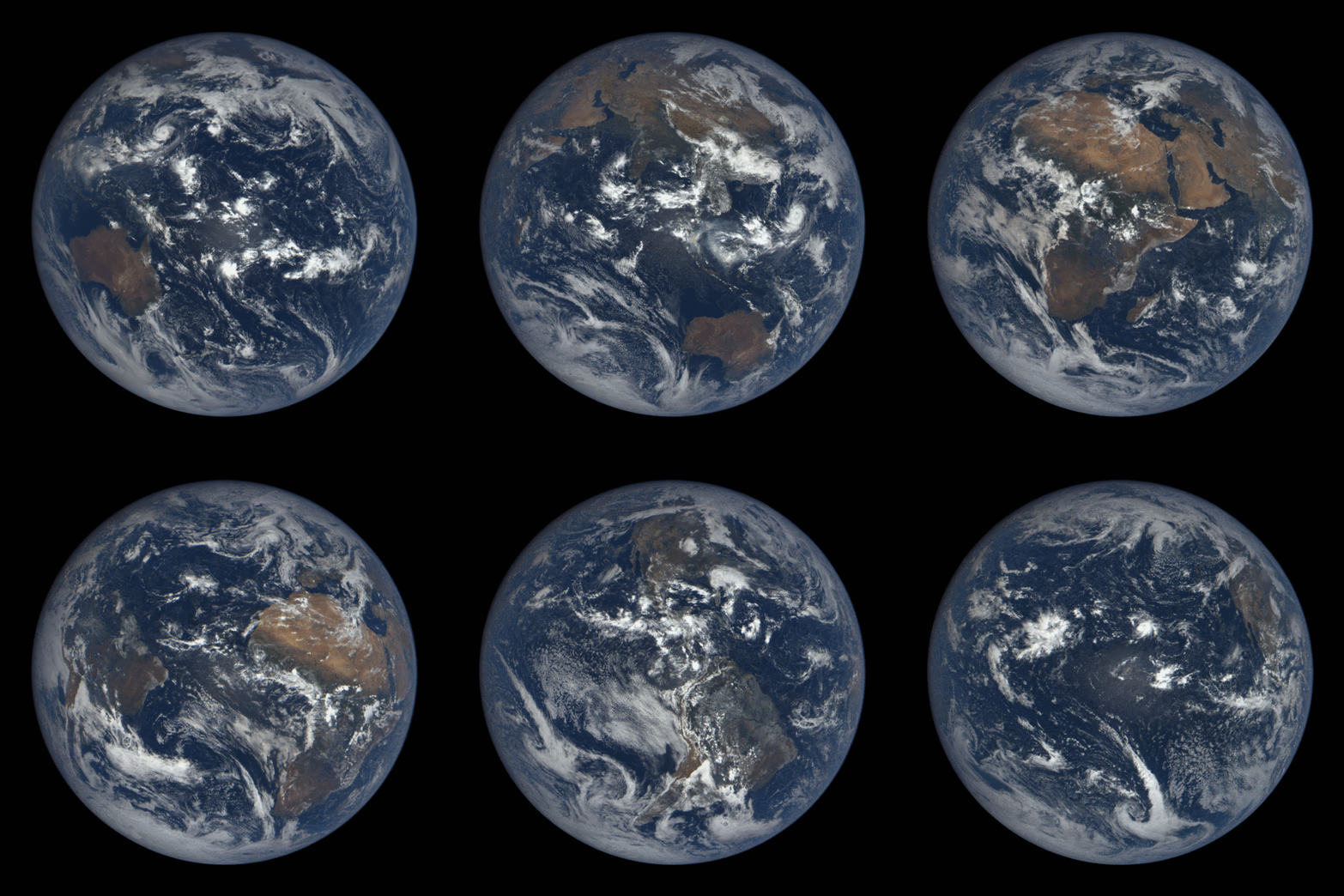
Earth's rotation
rotation of Earth around its axis
libration
thumb|The lunar phases and librations in 2019 in the Northern Hemisphere at hourly intervals, with music, titles, and supplemental graphics
alt=Over one lunar month more than half of the Moon's surface can be seen from the surface of the Earth.|thumbtime=0:02|thumb|Simulated views of the Moon over one month, demonstrating librations in latitude and [[longitude. Also visible are the different phases, and the variation in visual size caused by the variable distance from the Earth.]]
thumb|Theoretical extent of visible lunar surface (in green) due to libration, compared to the extent of the visib
orbit of Earth
gravitationally curved trajectory Earth travels around the Sun
analemma
thumb|Afternoon analemma photo taken in 1998–99 in Murray Hill, New Jersey|Murray Hill, [[New Jersey, U.S., by Jack Fishburn. The Bell Laboratories building is in the foreground.]]
perturbation
complex motion of a massive astronomical body
first point of Aries
point on the celestial sphere
equation of time
apparent solar time minus mean solar time
March equinox
the equinox on the earth when the Sun appears to leave the southern hemisphere and cross the celestial equator
solar apex
apparent direction of motion of the sun
September equinox
the equinox on the earth when the Sun appears to leave the nothern hemisphere and cross the celestial equator
Harmonices Mundi
book by Johannes Kepler
apparent retrograde motion
the illusion of reversing trajectories in relation to specific vantage points
invariable plane
plane passing through the barycenter of a planetary system, perpendicular to its angular momentum vector
clearing the neighbourhood
criterion for a celestial body to be considered a planet
peak of eternal light
Hypothetical permanently sunlit point on an astronomical body
heliospheric current sheet
surface which separates the heliosphere into positively and negatively charged components
Position of the Sun
Apparent location of the Sun in the sky
stability of the Solar System
long term dynamical interactions that disrupt the Solar System
permanently shadowed crater
permanently shadowed region of a body in the Solar System

orbit of Mars
gravitationally curved trajectory Mars travels around the Sun
orbit of Venus
gravitationally curved trajectory Venus travels around the Sun
Sunrise equation
equation to derive time of sunset and sunrise