Category
page 1Early Cretaceous plants

Monocots
Monocotyledons (), commonly referred to as monocots, (Lilianae sensu Chase & Reveal) are flowering plants whose seeds contain only one embryonic leaf, or cotyledon. A monocot taxon has been in use for several decades, but with various ranks and under several different names. The APG IV system recognises its monophyly but does not assign it to a taxonomic rank, and instead uses the term "monocots" to refer to the group.

Eudicots
thumb|right|Arabis pollen has three colpi.
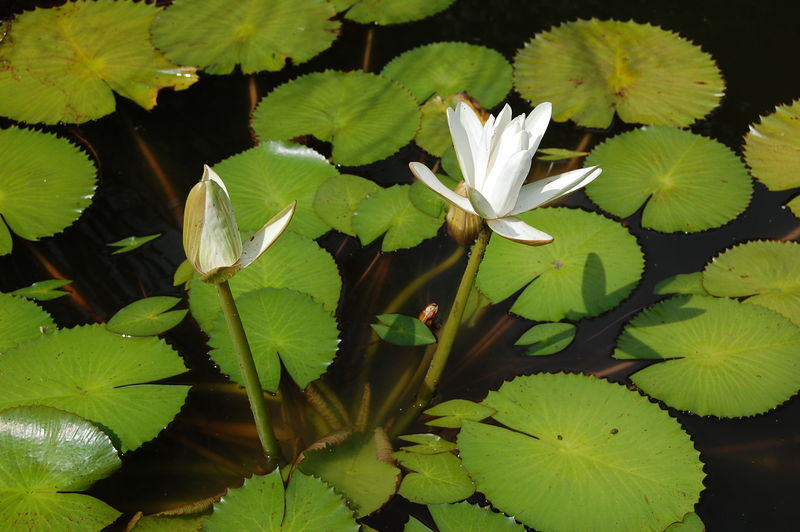
Nymphaeales
The Nymphaeales are an order of flowering plants, consisting of three families of aquatic plants, the Hydatellaceae, the Cabombaceae, and the Nymphaeaceae (water lilies). It is one of the three orders of basal angiosperms, an early-diverging grade of flowering plants. At least 10 morphological characters unite the Nymphaeales. One of the traits is the absence of a vascular cambium, which is required to produce both xylem (wood) and phloem, which therefore are missing. Molecular synapomorphies are also known.

Archaefructus
left|thumb|Fossil cast of A. liaoningensis
Archaefructus is an extinct genus of herbaceous aquatic seed plants with three known species. Fossil material assigned to this genus originates from the Yixian Formation in northeastern China, originally dated as late Jurassic but now understood to be approximately 125 million years old, or early Cretaceous in age. Even with its revised age, Archaefructus has been proposed to be one of the earliest known genera of flowering plants.
thumb
Because of its age, lack of sepals and petals, and the fact that its reproductive organs (carpels and stamens), are

Archaeamphora longicervia
Archaeamphora longicervia is a fossil plant species, the only member of the hypothetical genus Archaeamphora. Fossil material assigned to this taxon originates from the Yixian Formation of northeastern China, dated to the Early Cretaceous (around ).
Sphenopteris
Sphenopteris is a genus of seed ferns containing the foliage of various extinct plants, ranging from the Devonian to Late Cretaceous. One species, S. höninghausi, was transferred to the genus Crossotheca in 1911.
Zamites
Zamites is an extinct genus of plants in the family Williamsoniaceae that lived from the Triassic to the Eocene. This plant is reported in the Mesozoic from North and South America, Europe, Asia, Africa, and Antarctica, and in the Cenozoic only in North America.
Montsechia
Montsechia is an extinct genus of aquatic plants containing the species Montsechia vidalii, described from Spain. M. vidalii lived about 130 million years ago, during the Barremian age, and appears to be the earliest known flowering plant macrofossil. It has affinities with the modern genus Ceratophyllum. It has been placed in the ceratophyllalean family Montsechiaceae.