Category
page 1Early Cretaceous taxonomic orders

Ichthyosauria
Ichthyosauria is an order of large extinct marine reptiles sometimes referred to as "ichthyosaurs", although the term is also used for wider clades in which the order resides.

Plesiosauria
The Plesiosauria or plesiosaurs are an order or clade of extinct Mesozoic marine reptiles, belonging to the Sauropterygia.

Therapsida
Therapsida is a clade comprising a major group of eupelycosaurian synapsids that includes mammals and their ancestors and close relatives. Many of the traits today seen as unique to mammals had their origin within early therapsids, including limbs that were oriented more underneath the body, resulting in a more "standing" quadrupedal posture, as opposed to the lower sprawling posture of many reptiles and amphibians.
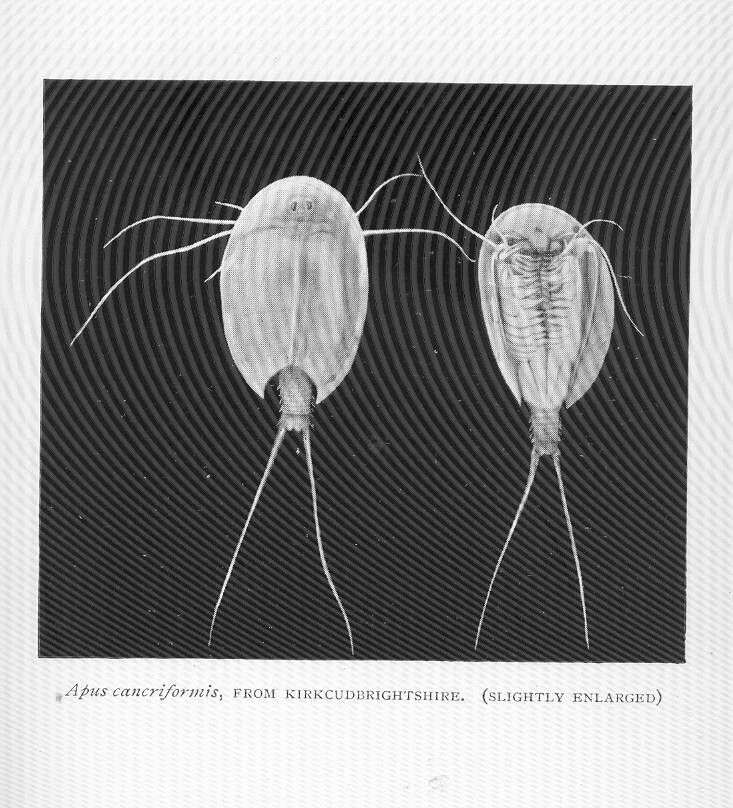
Notostraca
The order Notostraca, containing the single family Triopsidae, is a group of crustaceans known as tadpole shrimp or shield shrimp. The two genera, Triops and Lepidurus, are considered living fossils, with similar forms having existed since the end of the Devonian, around 360 million years ago. They have a broad, flat carapace, which conceals the head and bears a single pair of compound eyes. The abdomen is long, appears to be segmented and bears numerous pairs of flattened legs. The telson is flanked by a pair of long, thin caudal rami. Phenotypic plasticity within taxa makes species-level ide

Choristodera
Choristodera (from the Greek χωριστός chōristos + δέρη dérē, 'separated neck') is an extinct order of semiaquatic diapsid reptiles that ranged from the Middle Jurassic, or possibly Triassic, to the Miocene (168 to 20 or possibly 11.6 million years ago). Choristoderes are morphologically diverse, with the best known members being the crocodile-like neochoristoderes such as Champsosaurus. Other choristoderans had lizard-like or long necked morphologies. Choristoderes appear to have been confined to the Northern Hemisphere, having been found in North America, Asia, and Europe, and possibly also N

Hybodontiformes
Hybodontiformes, commonly called hybodonts, are an extinct group of shark-like cartilaginous fish (chondrichthyans) which existed from the late Devonian to the Late Cretaceous. Hybodonts share a close common ancestry with modern sharks and rays (Neoselachii) as part of the clade Euselachii. They are distinguished from other chondrichthyans by their distinctive fin spines and cephalic spines present on the heads of males. An ecologically diverse group, they were abundant in marine and freshwater environments during the late Paleozoic and early Mesozoic, but were rare in open marine environments
Synechodontiformes
Synechodontiformes is an extinct order of prehistoric shark-like cartilaginous fish, known from the Permian to the Paleogene. They are considered to be members of Neoselachii, the group that contains modern sharks and rays.