Category
page 1East Asian religions

Taoism
Taoism or Daoism (, ) is a philosophical and religious tradition indigenous to China, emphasizing harmony with the Tao . With a range of meaning in Chinese philosophy, translations of Tao include 'way', 'road', 'path', or 'technique', generally understood in the Taoist sense as an enigmatic process of transforming ultimately underlying reality. Taoist thought has informed the development of various practices within the Taoist tradition, including forms of meditation, astrology, qigong, feng shui, and internal alchemy. A common goal of Taoist practice is self-cultivation, a deeper appreciation

Confucianism
thumb|upright=1.15|Temple of Confucius of [[Jiangyin, Wuxi, Jiangsu. It is a wenmiao (), a temple where Confucius is worshipped as Wendi, "God of Culture" ().]]
thumb|upright=1.15|Gates of the wenmiao of Datong, [[Shanxi]]
Confucianism, also known as Ruism or Ru classicism, is a system of thought and behavior originating in ancient China, and is variously described as a tradition, philosophy, religion, theory of government, or way of life. Founded by Confucius in the Hundred Schools of Thought era (c. 500 BCE), Confucianism integrates philosophy, ethics, and social governance, with a core focu

Shinto
The torii gateway to the [[Itsukushima Shrine in Hiroshima Prefecture, Japan, one of the most famous examples in the country. Torii mark the entrance to Shinto shrines and are recognizable symbols of the religion.|right|thumb|upright=1.1]]
, also called Shintoism, is the native religion and former ethnic cult of Japan. Classified as an East Asian religion by scholars of religion, it is often regarded by its practitioners as Japan's indigenous religion and as a nature religion. Scholars sometimes call its practitioners Shintoists, although adherents rarely use that term themselves. With no cent
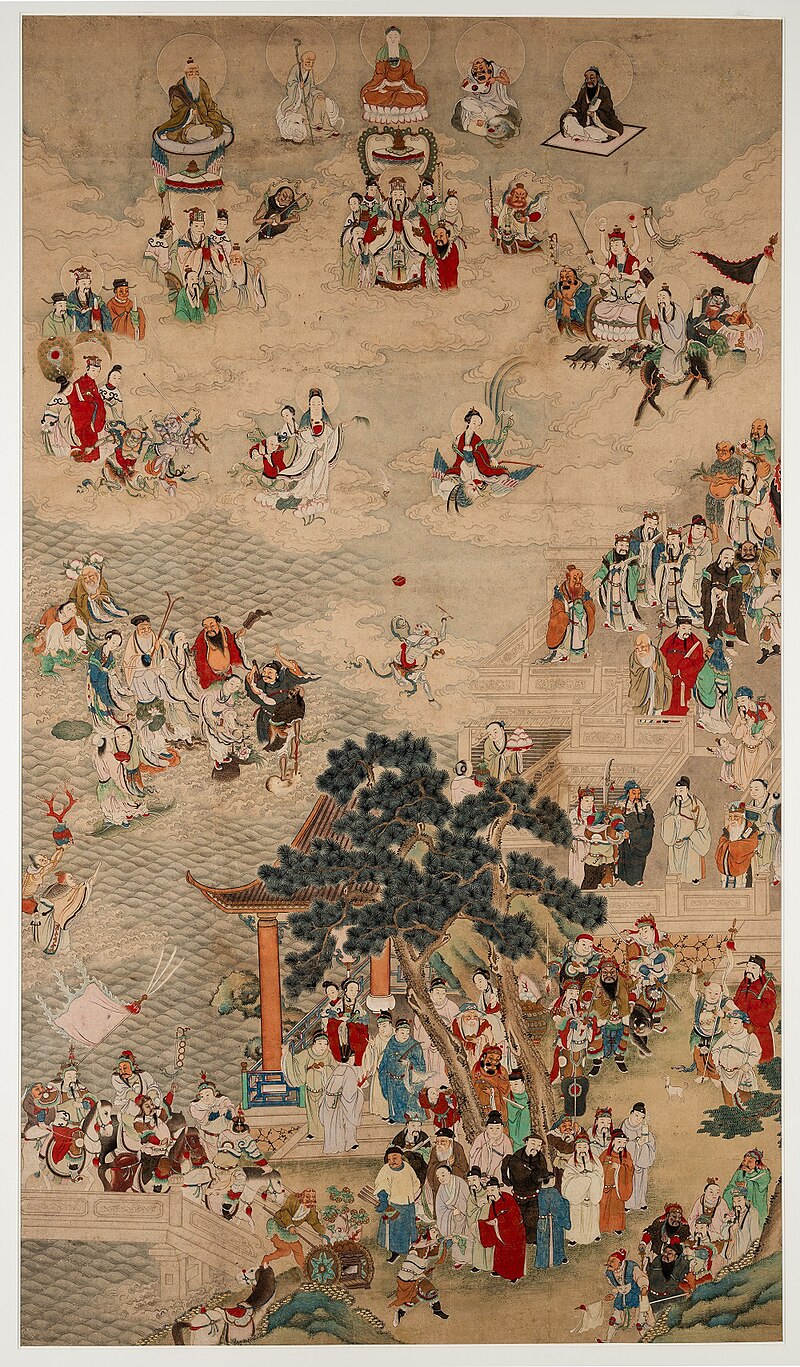
Chinese folk religion
traditional Han Chinese religious belief systems

Cheondoism
Cheondoism (spelled Chondoism in North Korea; ) is a 20th-century Korean pantheistic religion, based on the 19th-century Donghak religious movement founded by Choe Je-u and codified under Son Byong-hi. Cheondoism has its origins in the peasant rebellions which arose starting in 1812 during the Joseon.
Korean shamanism
folk religion of the Korean Peninsula
shinshūkyō
new religious movement founded in Japan since the mid-19th century
East Asian Yogācāra
East Asian Yogācāra in China and Japan
East Asian religions
subset of the Eastern religions
%E9%BD%8B%E5%A0%82%E5%85%A7%E9%83%A8.jpg)
Xiantiandao
The Xiantiandao (, or "Way of the Primordial"; Vietnamese: ', Japanese: '), or known as Blue/Green Lotus sect (), also simply Tiandao (; Vietnamese: ', Japanese: '), is one of the most productive currents of Chinese folk religious sects such as the White Lotus Sect, characterised by representing the principle of divinity as feminine and by a concern for salvation (moral completion) of mankind.
Qingtan
Qingtan () was a Chinese philosophical movement and social practice among political and intellectual elites which developed during the Wei-Jin () period and continued on through the Southern and Northern dynasties. Originating among Daoist scholars, particularly those belonging to the syncretic Xuanxue school, qingtan involved "pure conversation" concerning metaphysics and philosophy in the form of informal gatherings for discourse and debate. These gatherings originated as politically impartial continuations of the more explicitly politically "pure criticism" () protests of the later Han dyna
Ryukyuan religion
Indigenous Ryukuan Religion
Cheonbuin
three legendary treasures of Korea

Chinese salvationist religions
Chinese religious tradition characterised by a concern for salvation of the person and the society
Jeungsanism
Jeungsanism () is an English word with two different uses: as a synonym of Jeung San Do (증산도), a Korean new religious movement, or to designate a family of more than 100 Korean new religious movements that recognize Kang Jeungsan (Gang Il-Sun) as the incarnation of the Supreme God of the Universe, Sangje.
religious Confucianism
ethical and philosophical doctrine of Chinese civilization as a system of beliefs in the supernatural
Manchu Shamanism
practiced in northeast China
Shengdao
Shengdao (圣道 "Holy Way" or "Way of the Hallows"), best known by its corporate name Tongshanshe () is a Confucian salvation sect part of the Xiantiandao ("Way of Former Heaven") lineage.
Chen Tao
religious group that originated in 20th-century Taiwan
Ainu mythology and religion