Category
page 1Eastern Bloc

Cuba
Cuba, officially the Republic of Cuba, is an island country in the Caribbean. It comprises the eponymous main island as well as 4,195 islands, islets, and cays. Situated at the convergence of the Caribbean Sea, Gulf of Mexico, and Atlantic Ocean, Cuba is located east of the Yucatán Peninsula, south of both Florida and the Bahamas, west of Hispaniola, and north of Jamaica and the Cayman Islands. Havana is the largest city and capital. Cuba is the third-most populous country in the Caribbean after Haiti and Dominican Republic, with about 10 million inhabitants. It is the largest country in the C

Czechoslovakia
Czechoslovakia ( ; Czech and , Česko-Slovensko) was a country in Central Europe created in 1918, as Czecho-Slovakia (until 1920), when it declared its independence from Austria-Hungary. In 1938, after the Munich Agreement, the Sudetenland became part of Nazi Germany. Between 1939 and 1945, the state ceased to exist, as Slovakia proclaimed its independence and Carpathian Ruthenia became part of Hungary, while the German Protectorate of Bohemia and Moravia was proclaimed in the remainder of the Czech Lands. In 1939, after the outbreak of World War II, former Czechoslovak president Edvard Beneš f

German Democratic Republic
1949–1990 country in central Europe, unified into modern Germany

Berlin Wall
barrier constructed by the German Democratic Republic, enclosing West Berlin (1961–1989)
Warsaw Pact
European Eastern Military Alliance (1954 – 1991)

Russian Soviet Federative Socialist Republic
constituent republic of the Soviet Union (1922–1991)
Communist Party of the Soviet Union
Marxist–Leninist founding and ruling party of the Soviet Union
Ukrainian Soviet Socialist Republic
sovereign state (1919–1922) and a republic of the Soviet Union (1922–1991); one of the founding members of the UN in 1945

Iron Curtain
term symbolizing the ideological-political conflict and physical boundary dividing Europe during the Cold War

Byelorussian Soviet Socialist Republic
one of fifteen constituent republics of the Soviet Union (USSR); founding member of the United Nations Organization in 1945; now Belarus
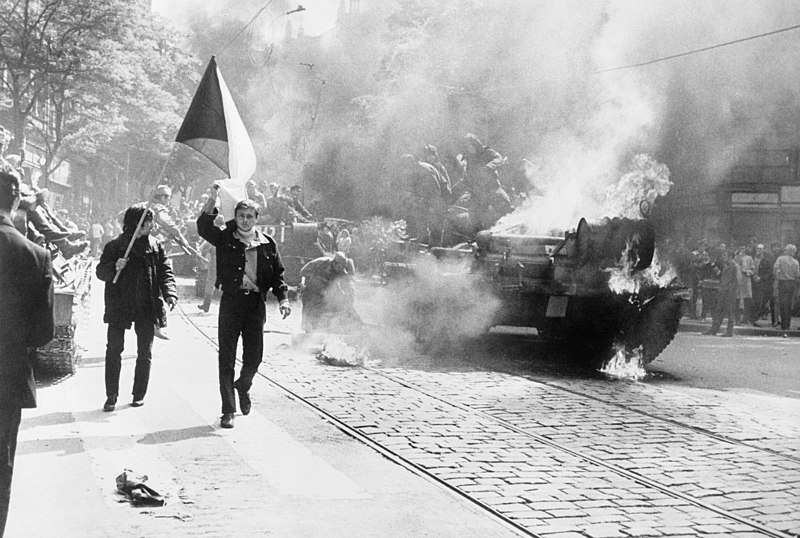
Prague Spring
period of liberalisation in Czechoslovakia from 5 January to 21 August 1968

Hungarian Revolution of 1956
1956 revolution in Hungary

Estonian Soviet Socialist Republic
republic of the Soviet Union (1940–1991)

Lithuanian Soviet Socialist Republic
republic of the Soviet Union (1940-1991)

Latvian Soviet Socialist Republic
republic of the Soviet Union (1940-1991)

Moldavian Soviet Socialist Republic
republic of the Soviet Union (1940-1991)
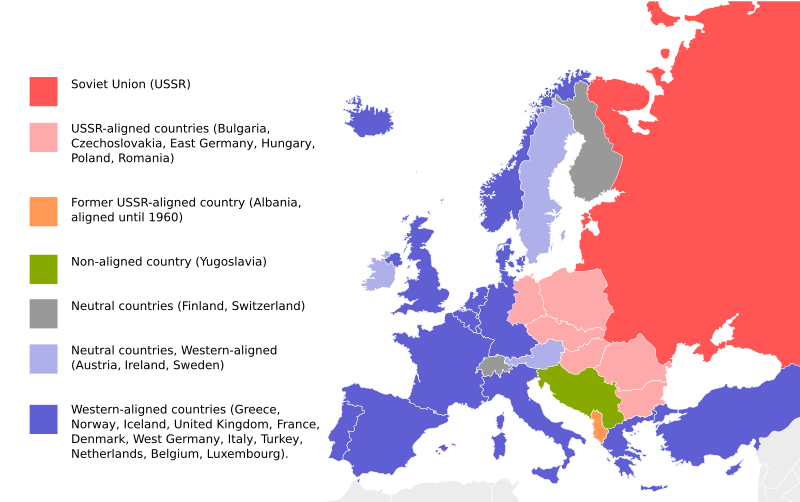
Eastern Bloc
group of socialist states of Central and Eastern Europe

Solidarity
Polish trade union federation evolved into broad anti-authoritarian social movement

Polish People's Republic
country of the Warsaw Pact and Eastern Bloc from 1947 to 1989

Revolutions of 1989
series of protests during 1989 overthrowing communist governments in Eastern Europe
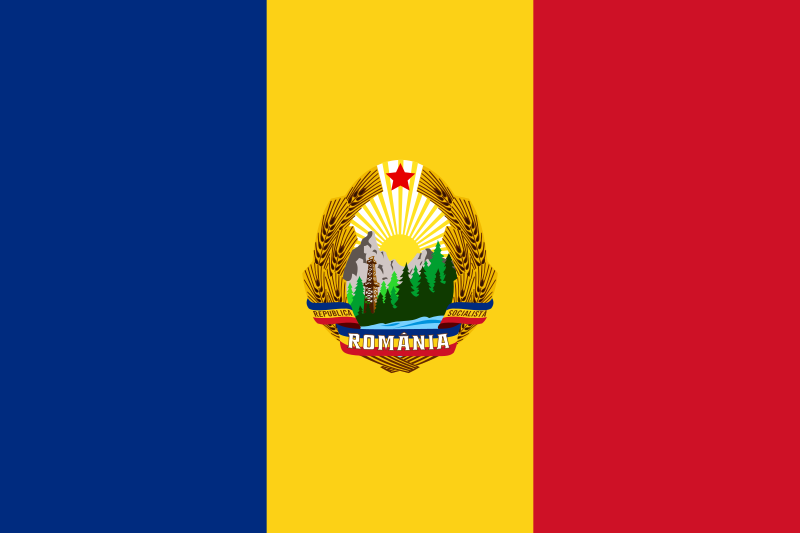
Socialist Republic of Romania
1965–1989 republic in Southeastern Europe

COMECON
The Council for Mutual Economic Assistance, often abbreviated as Comecon ( ) or CMEA, was an economic organization from 1949 to 1991 under the leadership of the Soviet Union that comprised the countries of the Eastern Bloc along with a number of communist states elsewhere in the world.

Berlin Blockade
blockade on Berlin imposed by the USSR from 1948 to 1949

Karelo-Finnish Soviet Socialist Republic
union republic of the Soviet Union

Democratic Republic of Afghanistan
Central Asian Republic (1978–1992)

People's Socialist Republic of Albania
Marxist-Leninist government of Albania (1946–1992)
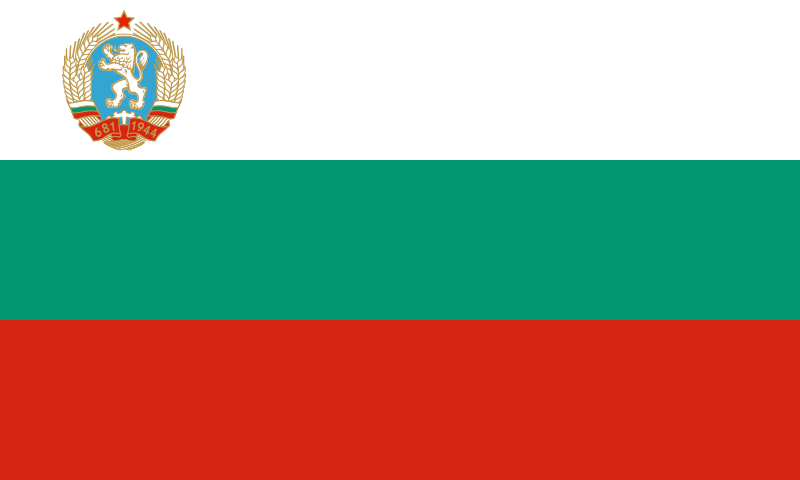
People's Republic of Bulgaria
Socialist republic ruled by the Bulgarian Communist Party (1946–1990)
Socialist Unity Party of Germany
communist political party and ruling state party of the GDR
satellite state

Hungarian People's Republic
1949–1989 socialist republic in Central Europe

Brezhnev Doctrine
Soviet foreign policy
Czechoslovak Socialist Republic
republic in Central/Eastern Europe between 1960 and 1990
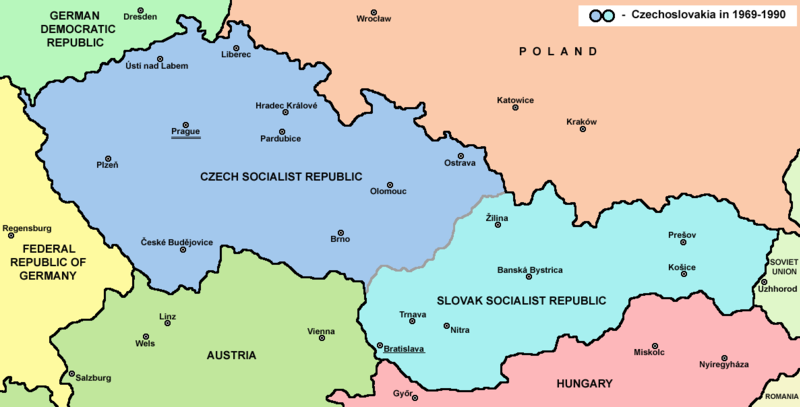
dissolution of Czechoslovakia
process that led to the creation of two independent nations, the Czech Republic and Slovakia
Cominform
The '''Information Bureau of the Communist and Workers' Parties (), commonly known as Cominform''' (), was a co-ordination body of Marxist–Leninist communist parties in Europe which existed from 1947 to 1956. Formed in the wake of the dissolution of the Communist International in 1943, it did not replace that body, but instead mainly served as an expression of solidarity and as a means of disseminating Stalinist propaganda. The Cominform initially included the communist parties of the Soviet Union, Bulgaria, Czechoslovakia, Hungary, Poland, Romania, Yugoslavia (expelled in 1948), France, and I

Party of Labour of Albania
1941-1991 political party in Albania
Singing Revolution
events leading up to the end of Soviet rule in the Baltic nations

East German uprising of 1953
uprising against the German Democratic Republic
Polish United Workers' Party
founding and ruling party of the Polish People's Republic from 1948 to 1989
Warsaw Pact invasion of Czechoslovakia
August 1968 unrest in Czechoslovakia

1948 Czechoslovak coup d'état
1948 coup in Czechoslovakia
Bulgarian Communist Party
political party in Bulgaria between 1919 and 1990

nomenklatura
thumb|Moscow Kremlin, where the highest of the elite Soviet nomenklatura lived
The nomenklatura (; from , system of names) were a category of people within the Soviet Union and other Eastern Bloc countries who held various key administrative positions in the bureaucracy, running all spheres of those countries' activity: government, industry, agriculture, education, etc., whose positions were granted only with approval by the communist party of each country or region. While in the Russian language the term номенклатура has the same generic meaning as "nomenclature", in the context of the politi
January Events
1991 protest in Lithuania
Tito–Stalin split
political split between Josip Broz and Joseph Stalin of year 1948
Druzhba pipeline
oil pipeline in Austria, Belarus, Czech Republic, Germany, Hungary, Poland, Russia, Slovakia, Ukraine

Interkosmos
Interkosmos () was an international Soviet space program designed to promote cooperation among socialist countries in space exploration and research. Formed in April 1967 in Moscow, it was led by the Soviet Union and primarily involved allied or friendly countries from the Eastern Bloc and Non-Aligned Movement, which were provided training and technical support with crewed and uncrewed space missions.
Hungarian Working People's Party
communist party (1948-1956)

Volkspolizei
The ' (DVP; ), commonly known as the or VoPo', was the national uniformed police force of the German Democratic Republic (East Germany) from 1945 to 1990. The Volkspolizei was a highly-centralized agency responsible for most civilian law enforcement in East Germany, maintaining roughly 257,500 personnel at its peak. It worked closely with the Stasi to maintain public order and identify threats to the government.
Intervision Song Contest
an international song contest consisting of both Post-Soviet states and members of the Shanghai Cooperation Organisation
My God, Help Me to Survive This Deadly Love
graffiti painting on the eastern side Berlin wall
Friendship Games
1984 international multi-sport event
International Radio and Television Organisation
alliance of media entities
Zhdanov Doctrine
Soviet cultural doctrine developed by Central Committee secretary Andrei Zhdanov in 1946 that proposed the world was divided into two camps: the "imperialistic", headed by the United States; and "democratic", headed by the Soviet Union

Intersputnik
The Intersputnik International Organization of Space Communications, commonly known as Intersputnik, is an international satellite communications services organization founded on 15 November 1971, in Moscow by the Soviet Union along with a group of seven formerly socialist states (Poland, Czechoslovakia, East Germany, Hungary, Romania, Bulgaria, Mongolia) and Cuba.
Peace Race
stage cycling race
history of Poland (1945–1989)
communist rule in Poland
post-communism
Post-communism is the period of political and economic transformation or transition in post-Soviet states and other formerly communist states located in Central-Eastern Europe and parts of Latin America, Africa, and Asia, in which new governments aimed to create free market-oriented capitalist economies. In 1989–1992, communist party governance collapsed in most communist party-governed states. After severe hardships communist parties retained control in China, Cuba, Laos, North Korea, and Vietnam. SFR Yugoslavia began to disintegrate, which plunged the country into a long complex series of wa

Republikflucht
275px|thumb|A Deutsche Reichsbahn (East Germany)|Deutsche Reichsbahn official inspects the escape tunnel beneath [[Berlin Wollankstraße station in January 1962.]]
275px|thumb|Movement (1977–1986)
Republikflucht (; German for "desertion from the republic", ) was the colloquial term in the German Democratic Republic (East Germany) for illegal emigration to the Federal Republic of Germany (West Germany), West Berlin, and non-Warsaw Pact countries. The official term was Ungesetzlicher Grenzübertritt ("unlawful border crossing"). Republikflucht applied to both the 3.5 million Germans who migrated l
socialist fraternal kiss
greeting between socialist leaders
Ministry for State Security
Soviet state security apparatus, secret police and security service