Category
page 1Eastern Christian liturgical objects

icon
thumb|upright=1.25|The Ladder of Divine Ascent (icon)|Ladder of Divine Ascent depicts monks ascending to [[Jesus in heaven in the top right. 12th century, Saint Catherine's Monastery.]]

holy water
Christian religious item
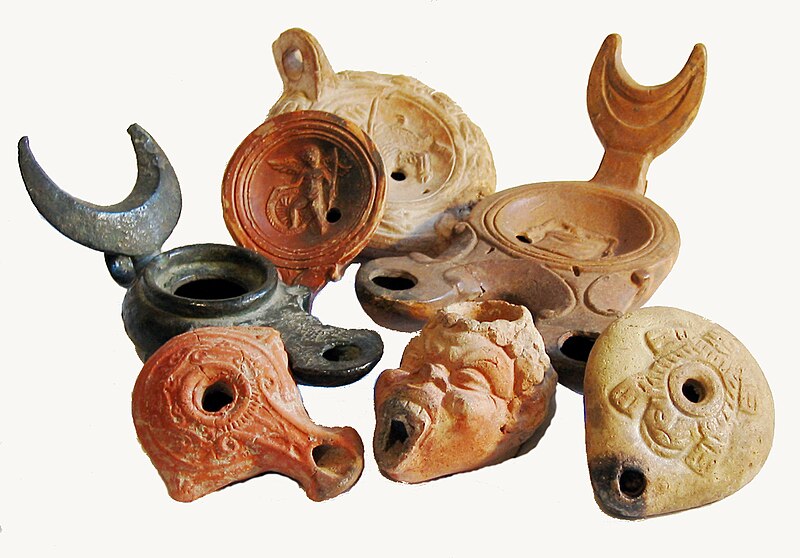
oil lamp
object used to produce light continuously for a period of time using an oil-based fuel source

sacramental bread
communion bread used in the Lord's Supper

iconostasis
thumb|Five-panel Deesis row (center), iconostasis in the Cathedral of the Annunciation in the [[Moscow Kremlin by Theophanes the Greek, 1405|328x328px]]

crosier
thumb|A crozier on the coat of arms of Basel, Switzerland which was ruled by [[Prince-Bishops during the Middle Ages]]

shroud
thumb|Portion of the death shroud of Charlemagne. It represents a [[quadriga and was manufactured in Constantinople.]]
thumb|350px|Detail showing body in a burial shroud, grave of William Carstares, [[Greyfriars Kirkyard, Edinburgh (1720)]]
A shroud is an item, such as a cloth, that covers or protects some other object. The term is most often used in reference to burial sheets, mound shroud, grave clothes, winding-cloths or winding-sheets, such as the Jewish tachrichim or Muslim kaffan, that the body is wrapped in for burial. A famous example of this is the Shroud of Turin.
Gospel Book
shorter collection of Bible verses divided after the Sundays and holidays of the lithurgical calendar

aspergillum
thumb|A Western-style aspergillum
thumb|Aspergillum in a silver aspersorium or situla

prosphora
A prosphora (, offering, or in Demotic Greek πρόσφορον) is a small loaf of leavened bread used in Orthodox Christian, Eastern Lutheran and Greek Catholic (Byzantine) liturgies. The classical plural form is prosphorai (). The term originally meant any offering made to a temple, but in Orthodox Christianity, as well as Byzantine Rite Lutheranism and Catholicism, it has come to mean specifically the bread offered at the Eucharist during Divine Liturgy.

semantron
thumb|333px|A Russian monk playing a semantron
icon corner
small Christian worship space
antimins
The antimins (from the Greek , Antimension: "instead of the table"), is a special corporal required to be on the altar in many Eastern Christian liturgical traditions. It was originally used as a portable version of an altar.
%2C%20poi%20domenico%20atticciati%20(1589-91)%2C%20coro%20della%20certosa%20di%20firenze%2C%20misericordie%2015%2C0.jpg)
misericord
thumb|upright=1.2|Misericord from the Florence Charterhouse|Charterhouse of Florence (Tuscany, Italy), depicting a mascaron (a decorative face)
thumb|upright=1.2|With the seat lifted (as at left), the misericord provides a ledge to support the user.A misericord (sometimes named mercy seat, like the biblical object, sometimes misericordia) is a small wooden structure (a sort of shelf) on the underside of a hinged folding seat in a church which, when the seat (or 'stall') is folded up, is intended to act as a ledge to support a person leaning against it in a partially standing position during lo
liturgical book
Christian prayer book
%20(cropped).jpg)
Asperges
thumb|right|Bishop Steven J. Lopes sprinkling the congregation
-7.JPG)
Analogion
thumb|upright=1.2|Three analogia, covered with gold cloth.(Saint Nicholas monastery, [[Gomel, Belarus)]]

blessed bread
The antidoron (, '''') is ordinary leavened bread which is blessed but not consecrated and distributed in certain Eastern Orthodox Churches and certain Eastern Catholic Churches that use the Byzantine Rite. It comes from the remains of the loaves of bread (prosphora) from which portions are cut for consecration as the Eucharist during the Divine Liturgy. The word Ἀντίδωρον means "instead of gifts", i.e., "instead of the Eucharistic gifts".
Dikirion and trikirion
eastern Orthodox and Catholic liturgical candlesticks
royal doors
central doors of the iconostasis in an Eastern Orthodox or Eastern Catholic church

lavabo
thumb|A 14th-century lavabo as a niche (architecture)|niche recessed into the side wall of a sanctuary in [[Amblie, Normandy]]
A lavabo is a device used to provide water for the washing of hands. It consists normally of a ewer or container of some kind to pour water, and a bowl to catch the water as it falls off the hands. In ecclesiastical usage it refers to all of: the basin in which the priest washes their hands; the ritual that surrounds this action in the Catholic Mass; and the architectural feature or fitting where a basin or place for one is recessed into the side wall of the sanctuary,

kliros
thumb|250px|Chanters singing on the kliros at the Church of St. George, Istanbul|Church of St. George, [[Patriarchate of Constantinople]]
liturgical fan
liturgical object of Orthodox Church
.jpg)
bema
A bema is an elevated platform used as an orator's podium. The term can refer to the raised area in a sanctuary. In Jewish synagogues, where it is used for Torah reading during services, the term used is bima or bimah.
liturgy spoon
liturgical implement

artos
thumb|250px|Paschal Artos, between services during bright Week, in front of opened [[royal doors.]]
asterisk
liturgical object

Soleas
thumb|Marble soleas in front of the iconostasis at [[Moni Arkadiou, Crete]]
The soleas (() = meaning (“bottom, base”, as used in "sole of a shoe", cf. also the "sole" from the resemblance of fish to a flat shoe. Of uncertain origin)) is an extension of the sanctuary platform in an Eastern Orthodox temple (church building). The soleas projects beyond the iconostasis, forming a narrow walkway running the full length of the iconostasis.
holy water in Eastern Christianity
role of holy water in Eastern Christianity

Templon
thumb|upright|A reconstruction of the templon of St. Paul's and Peter's basilica in Jerash (ancient Gerasa)
A templon (from Greek τέμπλον meaning "temple", plural templa) is a feature of Byzantine churches consisting of a barrier separating the nave from the sanctuary near the altar.

Spear
liturgical implement used in Divine Liturgy in the Byzantine Rite

processional standard
thumb|300px|Red banner embroidered with an icon of a saint ([[Church of St. Gabriel, Nazareth).]]
Khorugv (, , , , , , , sometimes translated as gonfalon) is a religious banner used liturgically in the Eastern Orthodox and Eastern Catholic Churches.

Lestovka
thumb|Lestovka with the names of the Apostles the work of the master Jelisaveta Gornitskaya
Lestovka () is a special type of prayer rope made of leather, once in general use in old Russia, and is still used by Russian Old Believers today, such as the Russian Orthodox Christians and Russian Orthodox Oldritualist Church, Pomorian Old-Orthodox Church and Edinoverians, whether Orthodox or Greek Catholic.
icon case
case or shelf for keeping and displaying religious icons
eagle rug
a small rug on which Byzantine-rite bishops stand during divine liturgy and other services
staff of office
symbolic staff that indicates an official's position, rank, etc.
Lamb
the square portion of bread cut from the prosphora in the Liturgy of Preparation at the Divine Liturgy in the Orthodox Church and in the Eastern Rites of the Catholic Church
Blessing cross
instrument of benediction