Category
page 1Economic country classifications

G20
The G20 or Group of 20 is an intergovernmental forum comprising 19 sovereign countries, the European Union (EU), and the African Union (AU). It works to address major issues related to the global economy, such as international financial stability, climate change mitigation and sustainable development, through annual meetings of heads of state and heads of government.

BRICS
BRICS is an intergovernmental organization comprising ten countries: Brazil, China, South Africa, Egypt, Ethiopia, India, Indonesia, Iran, Russia, and the United Arab Emirates. Its conceptual origins were articulated by Russian foreign minister Yevgeny Primakov in 1998, and can be traced to informal forums and dialogue groups such as RIC (Russia, India, and China) and IBSA (India, Brazil, and South Africa). BRIC was originally a term coined by British economist Jim O'Neill, and later championed by his employer Goldman Sachs in 2001, to designate a group of emerging markets.

G8
thumb|280px|Map of G8 member nations and the European Union

developed country
country with a developed industry and infrastructure

developing country
nation with a low living standard relative to other countries

G7
The Group of Seven (G7) is an intergovernmental political and economic forum consisting of Canada, France, Germany, Italy, Japan, the United Kingdom and the United States; additionally, the European Union (EU) is a "non-enumerated member". It is organized around shared values of pluralism, liberal democracy, and representative government. G7 members are major IMF advanced economies.
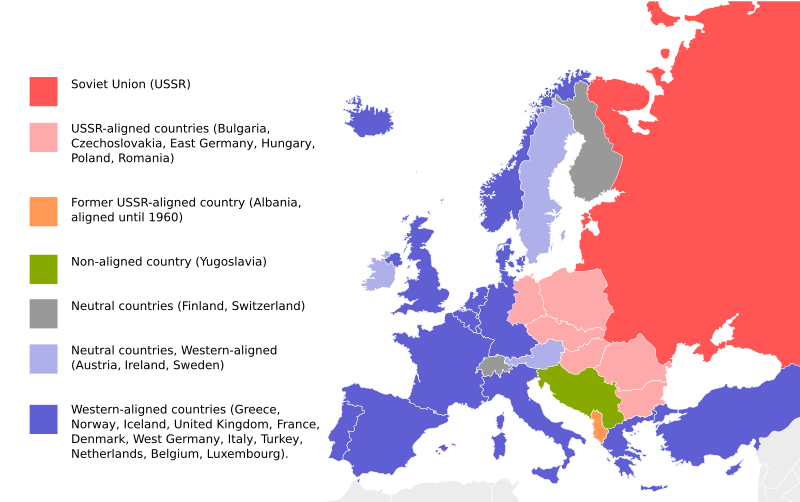
Third World
category of countries on socio economic base
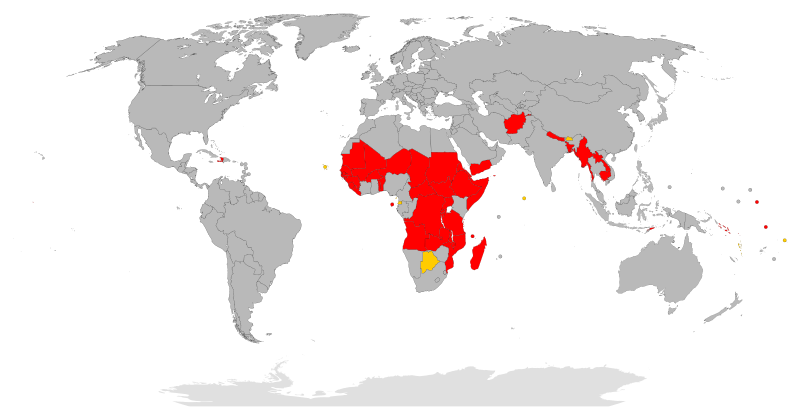
least developed countries
list of countries that exhibits the lowest indicators of socioeconomic development

Group of 77
United Nations coalition
Newly Industrialized Country
developing country with high economic growth and recent industrialization and urbanization

First World
conceptual country classification

Middle East and North Africa
Middle East and North Africa region
Second World
geopolitical classification
BRIC
term for a group of four emerging national economies
Global North and Global South
socio-economic and political divide
emerging market
country's economy that was traditionally small, but is currently expanding rapidly
fourth world
extension of the three-world model
Group of 15
organization
Heavily Indebted Poor Countries
developing countries with high levels of poverty and debt
Group of Ten
group of 11 countries participating in the General Arrangements to Borrow to provide the IMF with additional funds: Japan, UK, France, Belgium, Netherlands, Germany, Switzerland, Italy, Sweden, Canada, US
PIGS
derogatory acronym for the economies of Portugal, Italy, Greece and Spain
World Bank high-income economy
Highly developed high income countries

CIVETS
thumb|350px|CIVETS countries: Colombia, [[Indonesia, Vietnam, Egypt, Turkey, and South Africa]]
International Solar Alliance
international organization
G33
coalition of developing countries
BASIC countries
Brazil, South Africa, India and China in climate change negotiations
ICT Development Index
index
frontier market
type of developing country which is more developed than the least developing countries, but too small, risky, or illiquid to be generally considered an emerging market
Most Affected People and Areas
neologism that means disproportionately affected groups and territories
Trillion dollar club
Wikimedia list article

Latin America and the Caribbean
subregion of the Americas
Asia-Africa Growth Corridor
international economic cooperation agreement
developed market
country that is most developed in terms of its economy and capital markets
Group of Eleven
forum constituted by mostly developing countries aimed at easing their debt burden
Group of Twelve
group of industrially advanced countries whose central banks co-operate to regulate international finance