Category
page 1Effects of gravity

redshift
thumb|upright|Spectral line|Absorption lines in the [[visible spectrum of a supercluster of distant galaxies (right), as compared to absorption lines in the visible spectrum of the Sun (left). Arrows indicate redshift. Wavelength increases up towards the red and beyond (frequency decreases).]]

gravitational wave
propagating spacetime ripple
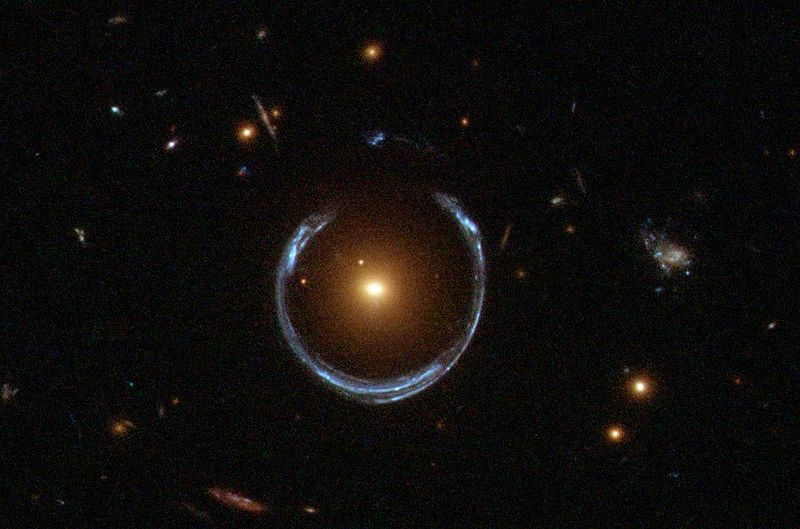
gravitational lens
distribution of matter between a distant light source and a observer

orogeny
thumb|Map of the last orogenies to affect Earth's geologic provinces

gravity assist
space-navigation technique
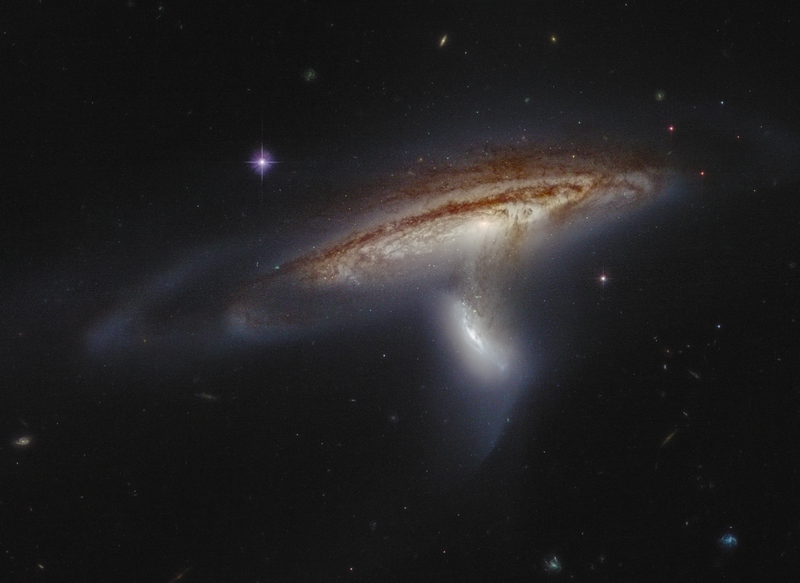
tidal force
secondary effect of the force of gravity of one body on another

gravitational collapse
contraction of an astronomical object due to the influence of its own gravity
Einstein ring
an image of a distant light source (such as a galaxy or star) which has been distorted into a ring through gravitational lensing caused by an object with an extremely large mass (such as another galaxy or a black hole)
gravitational redshift
the shift of the wavelength of a photon to a longer wavelength when traveling out of a gravitational well
.png)
spaghettification
alt=|thumb|Astronaut falling into a black hole (schematic illustration of the spaghettification effect)
thumb|upright=1.3|Tidal forces acting on a spherical body in a non-homogeneous [[gravitational field. In this diagram, the gravitational force originates from a source to the right. It shows both the tidal field (thick red arrows) and the gravity field (thin blue arrows) exerted on the body's surface and center (label O) by a source (label S).]]
Kelvin–Helmholtz mechanism
process of energy release of a contracting star or planet
gravitational time dilation
time dilation due to gravitational potential
Jeans instability
mechanism which causes the collapse of interstellar gas clouds and subsequent star formation

gravitoelectromagnetism
thumb|400 px|Diagram regarding the confirmation of gravitomagnetism by Gravity Probe B
gravitational microlensing
astronomical phenomenon due to the gravitational lens effect
Shapiro delay
time delay caused by space-time distortion near massive objects
orbital decay
process that leads to gradual decrease of the distance between two orbiting bodies
.gif)
frame-dragging
Frame-dragging is an effect on spacetime, predicted by Albert Einstein's general theory of relativity, that is due to non-static stationary distributions of mass–energy. A stationary field is one that is in a steady state, but the masses causing that field may be non-static — rotating, for instance. More generally, the subject that deals with the effects caused by mass–energy currents is known as gravitoelectromagnetism, which is analogous to the magnetism of classical electromagnetism.
speed of gravity
physical constant equal to the speed of light
Gravitational wave background
random gravitational-wave signal potentially detectable by gravitational wave experiments
dynamical friction
loss of momentum and kinetic energy of moving bodies through gravitational interactions with surrounding matter in space
chain fountain
scientific demonstration
lunar theory
theoretical description of motion of Earth's moon
orogenic belt
zone affected by mountain formation
Mass segregation
process by which heavier members of a gravitationally bound system tend to move toward the center, while lighter members tend to move away from the center
high-G training
training done by aviators and astronauts
Maclaurin spheroid
oblate spheroid that arises when a self-gravitating fluid body of uniform density rotates with a constant angular velocity
Nordtvedt effect
effect in theoretical astrophysics