Category
page 1Egyptian gods

Ra
Ra (; ; also transliterated , ; cuneiform: ri-a or ri-ia; Phoenician: 𐤓𐤏, romanized: rʿ) or Re () was the ancient Egyptian deity of the Sun. By the Fifth Dynasty, in the 25th and 24th centuries BC, Ra had become one of the most important gods in ancient Egyptian religion, identified primarily with the noon-day Sun. Ra ruled in all parts of the created world: the sky, the Earth, and the underworld. He was believed to have ruled as the first pharaoh of Ancient Egypt. He was the god of the Sun, order, kings and the sky.
.jpg)
Horus
Horus (), also known as Heru, Har, Her, or Hor () Ϩⲱⲣ (Coptic), in Ancient Egyptian, is one of the most significant ancient Egyptian deities who served many functions, most notably as the god of kingship, healing, protection, the sun, and the sky. He was worshipped from at least the late prehistoric Egypt until the Ptolemaic Kingdom and Roman Egypt. Different forms of Horus are recorded in history, and these are treated as distinct gods by Egyptologists. These various forms may be different manifestations of the same multi-layered deity in which certain attributes or syncretic relationships ar

Amun
Amun was a major ancient Egyptian deity who appears as a member of the Hermopolitan Ogdoad. Amun was attested from the Old Kingdom together with his wife Amunet. His oracle in Siwa Oasis, located in Western Egypt near the Libyan Desert, remained the only oracle of Amun throughout. With the 11th Dynasty ( BC), Amun rose to the position of patron deity of Thebes by replacing Montu.

Aten
Aten, also Aton, Atonu, or Itn (, reconstructed ) was the focus of Atenism, the religious system formally established in ancient Egypt by the late Eighteenth Dynasty pharaoh Akhenaten. Exact dating for the Eighteenth Dynasty is contested, though a general date range places the dynasty in the years 1550 to 1292 BCE. The worship of Aten and the coinciding rule of Akhenaten are major identifying characteristics of a period within the Eighteenth Dynasty referred to as the Amarna Period (1336 BCE).

Seth
God of the desert, storms, and foreigners in ancient Egyptian religion

Thoth
Thoth (from , borrowed from , , the reflex of "[he] is like the ibis") is an ancient Egyptian deity. In art, he was often depicted as a man with the head of an ibis or a baboon, animals sacred to him. His feminine counterpart is Seshat, and his wife is Ma'at. He is the god of the Moon, wisdom, knowledge, writing, hieroglyphs, science, magic, art, and judgment.

Imhotep
Imhotep (; "(the one who) comes in peace"; ) was an Egyptian chancellor to the King Djoser, possible architect of Djoser's step pyramid, and high priest of the sun god Ra at Heliopolis. Very little is known of Imhotep as a historical figure, but in the 3,000 years following his death, he was gradually glorified and deified.

Sobek
Sobek (), also known as Suchus (), was an ancient Egyptian deity with a complex history and nature. He is associated with the Nile crocodile and is usually represented as a crocodile or crocodile-headed humanoid. Sobek was also associated with pharaonic power, fertility, and military prowess, but served additionally as a protective deity with apotropaic qualities, invoked especially for protecting others from the dangers presented by the Nile.

Ptah
Ptah ( ; , ; ; ; ) is an ancient Egyptian deity, a creator god, and a patron deity of craftsmen and architects. In the triad of Memphis, he is the husband of Sekhmet and the father of Nefertem. He was also regarded as the father of the sage Imhotep.
.jpg)
Atum
Atum (, Egyptian: jtm(w) or tm(w), reconstructed ; Coptic Atoum), sometimes rendered as Atem, Temu, or Tem, is the primordial God in Egyptian mythology from whom all else arose. He created himself and is the father of Shu and Tefnut, the divine couple, who are the ancestors of the other Egyptian deities. Atum is also closely associated with the evening sun. As a primordial god and as the evening sun, Atum has chthonic and underworld connections. Atum was relevant to the ancient Egyptians throughout most of Egypt's history. He is believed to have been present in ideology as early as predynastic

Geb
Geb (, Egyptological pronunciation: Gebeb), also known as Ceb, ), was the Egyptian god of the Earth and a mythological member of the Ennead of Heliopolis. He could also be considered a father of snakes. It was believed in ancient Egypt that Geb's laughter created earthquakes and that he allowed crops to grow.
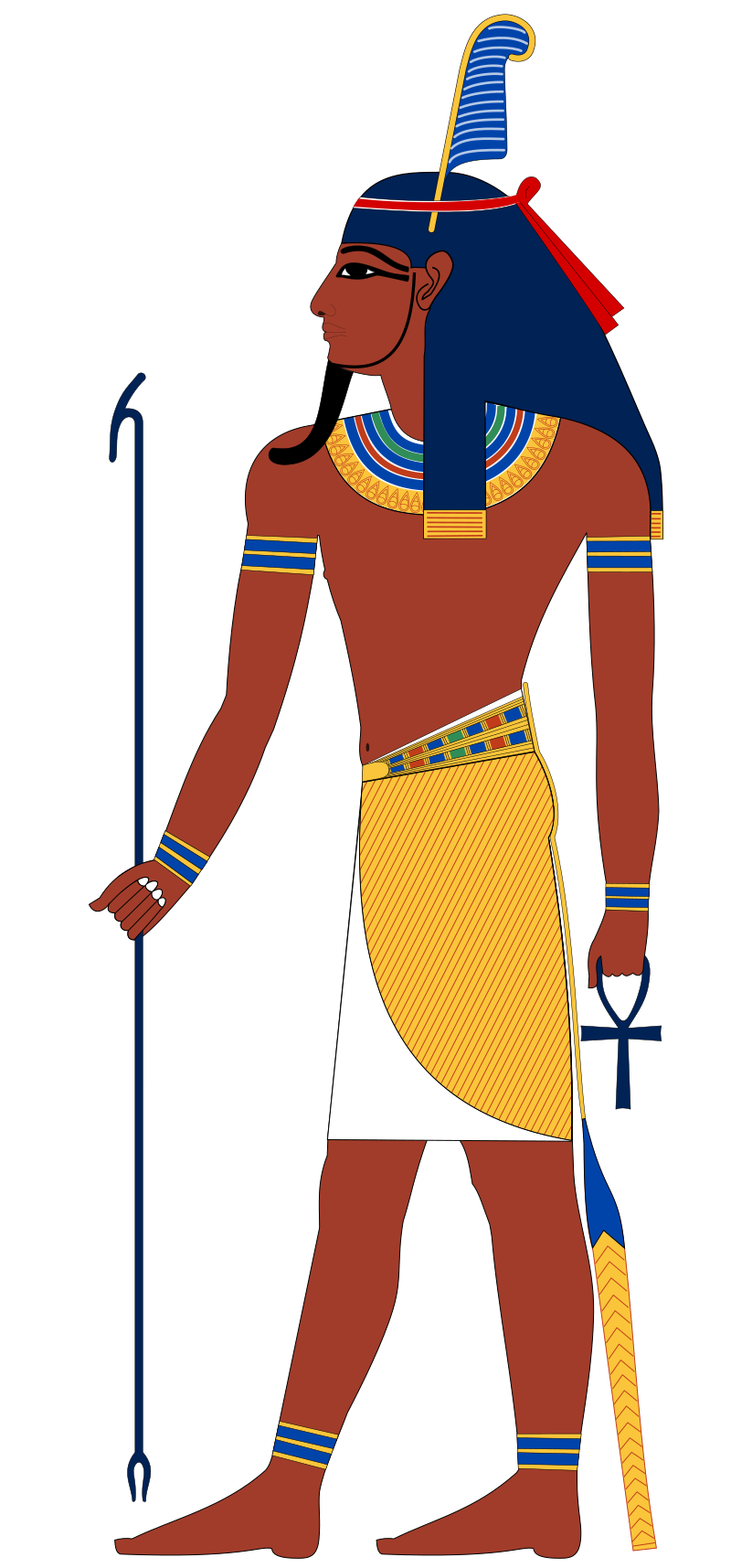
Shu
primordial Egyptian god, a personification of dry air, spouse and counterpart to goddess Tefnut

Hermes Trismegistus
purported author of the Hermetic Corpus

Khonsu
Khonsu (; also transliterated Chonsu, Khensu, Khons, Chons, Khonshu, or Konshu; ) is an ancient Egyptian god of the Moon. His name means 'traveller', and this may relate to the perceived nightly travel of the Moon across the sky. Along with Thoth, he marked the passage of time and is associated with baboons. Khonsu was instrumental in the creation of new life in all living creatures. At Thebes, he formed part of a family triad (the "Theban Triad") with Mut his mother and Amun his father.

Khnum
Khnum, also romanised Khnemu (; , ), was one of the earliest-known Egyptian deities in Upper Egypt, originally associated with the Nile cataract. He held the responsibility of regulating the annual inundation of the river, emanating from the caverns of Hapi, the deity embodying the flood. Since the annual flooding of the Nile brought with it silt and clay, and its water brought life to its surroundings, he eventually became known as the creator of human bodies and the life force kꜣ ("ka"). Using a potter's wheel and clay, he fashioned these entities and placed them within their mothers' wombs.

Apis
sacred bull in Egyptian mythology
.jpg)
Khepri
Khepri (Egyptian: ḫprj, also transliterated Khepera, Kheper, Khepra, Chepri) is a scarab-faced god in ancient Egyptian religion who represents the rising or morning sun. By extension, he can also represent creation and the renewal of life.
.jpg)
Bes
Bes (; also spelled as Bisu, , ), together with his feminine counterpart Beset, is an ancient Egyptian deity, of Nubian or C-Group culture origin worshipped as a protector of households and, in particular, of mothers, children, and childbirth. Bes later came to be regarded as the defender of everything good and the enemy of all that is bad. According to Donald Mackenzie in 1907, Bes may have been a Middle Kingdom import from Nubia and his cult did not become widespread until the beginning of the New Kingdom, but more recently several Bes-like figurines have been found in deposits from the Naqa

Hapi
god of the annual flooding of the Nile in ancient Egyptian religion
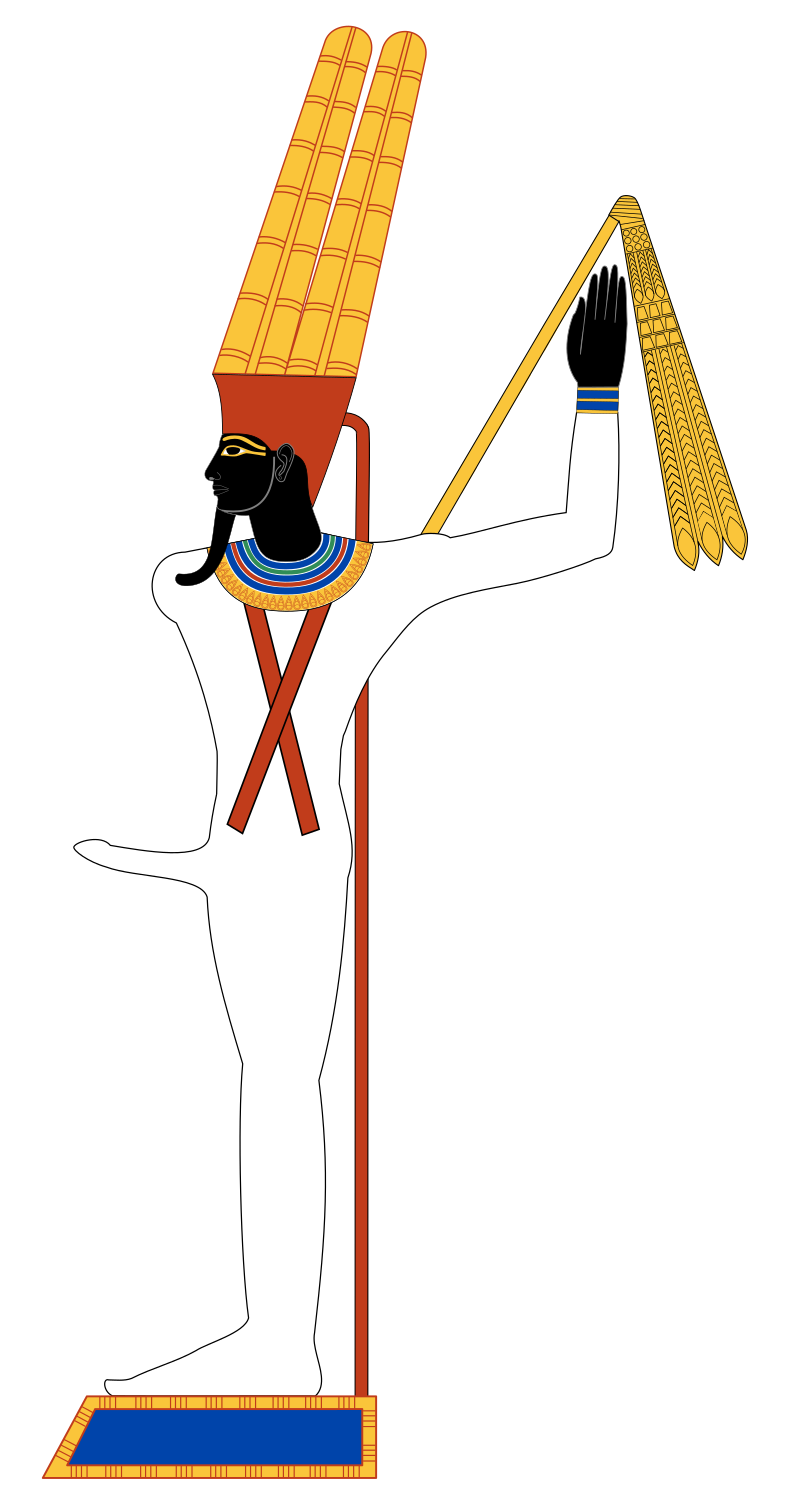
Min
Egyptian deity

Serapis
thumb|Antoninianus of Postumus with Serapis on the reverse.
Serapis or Sarapis is a Graeco-Egyptian god. A syncretic deity derived from the worship of the Egyptian Osiris and Apis, Serapis was extensively popularized in the third century BC on the orders of Greek Pharaoh Ptolemy I Soter, as a means to unify the Greek and Egyptian subjects of the Ptolemaic Kingdom.

Nun
Egyptian deity

Nefertem
Nefertem (; possibly "beautiful one who closes" or "one who does not close"; also spelled Nefertum or Nefer-temu) was, in Egyptian mythology, originally a lotus flower at the creation of the world, who had arisen from the primal waters.
Nefertem represented both the first sunlight and the delightful smell of the Egyptian blue lotus flower, having arisen from the primal waters within an Egyptian blue water-lily, Nymphaea caerulea. Some of the titles of Nefertem were "He Who is Beautiful" and "Water-Lily of the Sun", and a version of the Book of the Dead says:

Monthu
Montu was a falcon-god of war in the ancient Egyptian religion, an embodiment of the conquering vitality of the pharaoh. He was particularly worshipped in Upper Egypt and in the district of Thebes.
Kek
ancient Egyptian deity
Onuris
In Ancient Egyptian mythology, Onuris (also known as Onouris, Anhur, Anhuret, Han-Her, Inhert) was a god of war who was worshipped in the Egyptian area of Abydos, and particularly in Thinis. Myths told that he had brought his wife, Mehit, who was his female counterpart, from Nubia, and his name reflects this—it means '(one who) leads back the distant one'.

Maahes
Maahes (also spelled in Greek: Maches, Michos, Miysis, Mios, and Maeches) (Greek: Μαχές, Μιχός, Μίυσις, Μίος, or Μάιχες) was an ancient Egyptian lion-headed god of war, whose name means "he who is true beside her". He was seen as the son of the Creator god Ptah, as well as the feline goddess (Bast in Lower Egypt or Sekhmet in Upper Egypt) whose nature he shared. Maahes was a deity associated with war, protection, and weather, as well as that of knives, lotuses, and devouring captives. His cult was centred in Taremu and Per-Bast, the cult centres of Sekhmet and Bast respectively.
Heh
ancient Egyptian deity
Sopdu
Sopdu (also rendered Septu or Sopedu) was a god of the sky and of eastern border regions in the religion of Ancient Egypt.
He was Khensit's husband.
Heka
Egyptian deity

Ihy
Ihy is a young god in Egypt usually portrayed with the sistrum. This is in allusion to his mother Hathor who was associated with the instrument. Ihy's symbols are the sistrum and a necklace. The name Ihy depicts the joy of playing the hand instrument by Hathor, or "calf." The Egyptians themselves associated the name with the noisemaker.
Iah
Iah (; 𓇋𓂝𓎛𓇹, Coptic wikt:ⲟⲟϩ|) is a lunar deity in ancient Egyptian religion. The word jꜥḥ simply means "Moon". It is also transcribed as Yah, Jah, Aa, or Aah.
Osiris myth
story in ancient Egyptian mythology

Tatenen
Tatenen (also Ta-tenen, Tatjenen, Tathenen, Tanen, Tenen, Tanenu, and Tanuu) was the deity of the primordial mound in ancient Egyptian religion. His name means "risen land" or "exalted earth", as well as referring to the silt of the Nile. As a primeval chthonic deity, Tatenen was identified with creation. Both feminine and masculine, he was an androgynous protector of nature from the Memphis area (then known as Men-nefer), the ancient capital of the Inebu-hedj nome in Lower Egypt.

Apedemak
Apedemak or Apademak (originally, due to the absence of the /p/ phoneme in Meroitic, it was probably pronounced 'abademak' (Father king, Aba meaning father and mak meaning king) ) was a major deity in the ancient Nubian and Kushite pantheon. Often depicted as a figure with a male human torso and a lion head, and at the temple of Naqa with a snakes body and a lion's head. Apedemak also appears as a three-headed leonine god with four arms., Apedemak was a war god worshiped by the Meroitic peoples inhabiting Kush. There are no counterparts of him in Ancient Egyptian religion, As a war god, Apedem

Resheph
Resheph (also Reshef and many other variants, see below; Eblaite , Rašap, , ršp, Egyptian '', , ršp, Rešep̄'') was a god associated with war and plague, originally worshiped in Ebla in the third millennium BCE. He was one of the main members of the local pantheon, and was worshiped in numerous hypostases, some of which were associated with other nearby settlements, such as Tunip. He was associated with the goddess Adamma, who was his spouse in Eblaite tradition. Eblaites considered him and the Mesopotamian god Nergal to be equivalents, most likely based on their shared role as war deities.
Mnevis
Mnevis (, ) is the Hellenized name of an ancient Egyptian bull god which had its centre of worship at Heliopolis, and was known to the ancient Egyptians as Mer-wer or Nem-wer.
Shai
Shai (also spelt Sai, occasionally Shay, and in Greek, Psais) was the deification of the concept of fate in Egyptian mythology. As a concept, with no particular reason for associating one gender over another, Shai was sometimes considered female, rather than the more usual understanding of being male, in which circumstance Shai was referred to as Shait (simply the feminine form of the name). His name reflects his function, as it means "(that which is) ordained."
Wadj-wer
Wadj-wer, also spelled Uatch-ur is an Egyptian god of fertility and the personification of the Mediterranean Sea, whose name means the "great green". He also symbolizes the richness of the waters of the Nile Delta.
Yam
Canaanite sea, rivers and water god
Heryshaf
In Egyptian mythology, Heryshaf, or Hershef ( "He who is on His Lake"), transcribed in Greek as Harsaphes or Arsaphes () was an ancient ram deity whose cult was centered in ancient Heracleopolis Magna. He was identified with Ra and Osiris in ancient Egyptian religion, as well as Dionysus or Heracles in the interpretatio graeca. The identification with Heracles may be related to the fact that in later times his name was sometimes reanalysed as ḥrj-šf.t "He who is over strength". One of his titles was "Ruler of the Riverbanks". Heryshaf was a creator and fertility god who was born from the primo
Nemty
In Egyptian mythology, Nemty (Antaeus in Greek, but probably not connected to the Antaeus in Greek mythology) was a god whose worship centered at Antaeopolis in the northern part of Upper Egypt.
Hu
Egyptian deity
Neper
Egyptian god of grain
Banebdjedet
Banebdjedet also spelled Banebdjed or Banebdjetet is an Ancient Egyptian ram god with a cult centre at Mendes. Khnum was the equivalent god in Upper Egypt. He is most notable for appearing in the myth of Horus and Set.
Sia
deification of perception in the Heliopolitan Ennead cosmogony
.jpg)
Dedun
Dedun (or Dedwen) was a Kushite or Nehasi (C-Group culture) god worshipped during ancient times in ancient Egypt and Sudan and attested as early as 2400 BC. There is much uncertainty about their original nature, especially since he was depicted as a lion, a role that usually was assigned to the son of another deity. Additionally, nothing is known of the earlier Kushite mythology from which the deity arose. The earliest known information in Egyptian writings about Dedun indicates that he already had become a god of incense by the time of the writings. Since at that historical point, incense was
Ash
ancient Egyptian god

Hermanubis
thumb|Hermanubis marble statue, 1st–2nd century AD (Vatican Museums)
Theban Triad

Mandulis
Mandulis (also Merul and Melul) was a god of ancient Nubia also worshipped in Egypt. The name Mandulis () is the Greek form of Merul or Melul, a non-Egyptian name. The centre of his cult was the Temple of Kalabsha at Talmis, but he also had a temple dedicated to him at Ajuala.
Medjed
In Ancient Egyptian religion, Medjed (Egyptological: ), also known as Medjedu (Egyptological: ) is a minor deity mentioned in certain copies of the Book of the Dead. While not much is known about the deity, his ghost-like depiction in the Greenfield papyrus has earned him popularity in modern Japanese culture, and he has appeared as a character in video games and anime.
%2C%20100-50%20BCE.%20Sandstone.%20National%20Museum%20of%20Scotland%2C%20Edinburgh%2C%20Scotland%2C%20UK.jpg)
Arensnuphis
Arensnuphis (in Egyptian: Iryhemesnefer, ỉrỉ-ḥms-nfr, "the good companion") is a deity from the Kingdom of Kush, first attested at Musawwarat el-Sufra in the 3rd century BC. His worship spread to the Egyptian-controlled portion of Kush in the Ptolemaic Period (305–30 BC). His mythological role is unknown; he was depicted as a lion and as a human with a crown of feathers and sometimes a spear.
thumb|left|Temple statue of god Arensnuphis, from Meroe, Nubia (modern-day Sudan), 100-50 BCE. National Museum of Scotland, Edinburgh
Arensnuphis was worshipped at Philae, where he was called the "compani

Ra-Horakhty
Re-Hor-achti is one of the ancient Egyptian gods in whom the ancient Egyptians combined the god Ra represented by the sun disk and Horus on the horizons.

Shezmu
Shezmu (alternatively Schesmu and Shesmu) is an ancient Egyptian deity with a contradictory character. He is an Underworld judge of the damned. He was worshiped from the early Old Kingdom period.
Babi
deity

Mehen
In Egyptian mythology, the name Mehen (), meaning 'coiled one', referred to a mythological snake-god and to a board game.
==Snake god==
The earliest known references to Mehen occur in the Coffin Texts. Mehen is a protective deity who is depicted as a snake which coils around the sun god Ra during his journey through the night, for instance in the Amduat.

Nehebkau
Nehebkau (also spelled Nehebu-Kau) was the primordial snake god in ancient Egyptian mythology. Although originally considered an evil spirit, he later functions as a funerary god associated with the afterlife. As one of the forty-two assessors of Ma'at, Nehebkau was believed to judge the deceased after death and provide their souls with ka – the part of the soul that distinguished the living from the dead.
Am-heh
In Egyptian mythology, Am-heh was a minor god from the underworld, whose name means either "devourer of millions" or "eater of eternity". He was depicted as a man with the head of a hunting dog who lived in a lake of fire. He is sometimes seen as an aspect of Ammit, the personification of divine retribution. Am-heh could only be repelled by the god Atum.
Ba-Pef
Ba-Pef was a minor underworld god in Egyptian mythology. The name literally means that Ba, meaning that soul (ba). Ba-Pef is commonly portrayed as an obscure malevolent deity known from the Old Kingdom. During the Old and Middle Kingdom the priesthood of Ba-Pef was held by queens.