Category
page 1Egyptian mythology
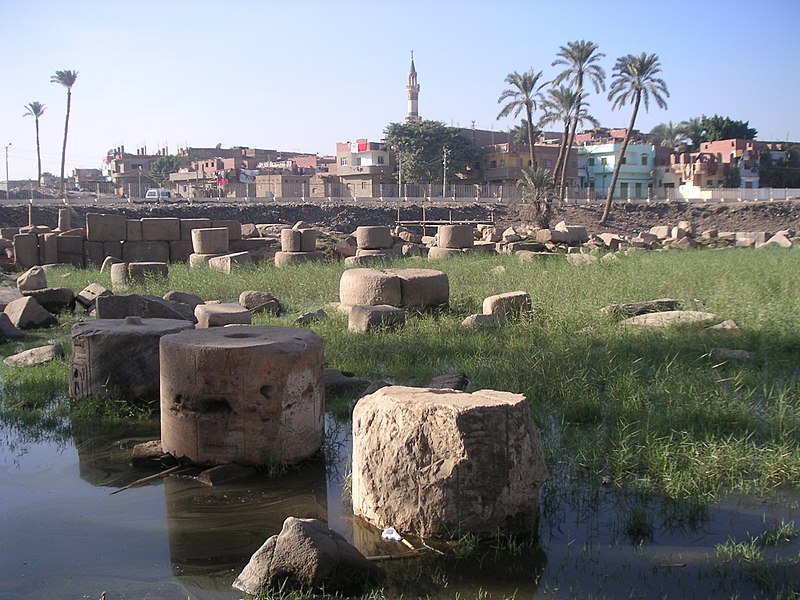
Memphis
ancient capital of Inebu-hedj, Egypt
%2001.svg)
ankh
thumb|upright=0.5|The ankh has a T-shape topped by a droplet-shaped loop.
The ankh or key of life is an ancient Egyptian hieroglyphic symbol used to represent the word for "life" and, by extension, as a symbol of life itself.

Menes
Menes ( ; ; , probably pronounced *; and ) was a pharaoh of the Early Dynastic Period of ancient Egypt, credited by classical tradition with having united Upper and Lower Egypt, and as the founder of the First Dynasty.

Egyptian mythology
myths of the Ancient Egyptians

Book of the Dead
ancient Egyptian funerary text

ouroboros
thumb|right|A dragon-like ouroboros in a 1478 drawing in an alchemical tract
.svg)
Ennead
The Ennead or Great Ennead was a group of nine deities in Egyptian mythology worshipped at Heliopolis: the sun god Atum; his children Shu and Tefnut; their children Geb and Nut; and their children Osiris, Isis, Set, and Nephthys. The Ennead sometimes includes Horus the Elder; an ancient form of the falcon god, not the son of Osiris and Isis.

Thinis
Thinis (Greek: Θίνις Thinis, Θίς This ; Egyptian: Tjenu; ;
) was the capital city of pre-unification Upper Egypt. Thinis remains undiscovered but is well attested by ancient writers, including the classical historian Manetho, who cites it as the centre of the Thinite Confederacy, a tribal confederation whose leader, Menes (or Narmer), united Egypt and was its first pharaoh. Thinis began a steep decline in importance when the capital was relocated to Memphis, which was thought to be the first true and stable capital after the unification of Egypt by Menes. Thinis's location on the border of th
Ancient Egyptian conception of the soul
ancient Egyptian religious concept

cynocephaly
thumb|250px|right|A cynocephalus. From the Nuremberg Chronicle (1493).
The characteristic of cynocephaly, or cynocephalus (), having the head of a canid, typically that of a dog or jackal, is a widely attested mythical phenomenon existing in many different forms and contexts. The literal meaning of cynocephaly is "dog-headedness"; however, that this refers to a human body with a dog head is implied. Such cynocephalics are known in mythology and legend from many parts of the world, including ancient Egypt, Libya, Greece, India and China. Further mentions come from the medieval East and Europe.
.svg)
Buto
Buto (, , Butu), Bouto, Butus (, Boutos) or Butosus was a city that the Ancient Egyptians called Per-Wadjet. It was located 95 km east of Alexandria in the Nile Delta of Egypt. What in classical times the Greeks called Buto, stood about midway between the Taly (Bolbitine) and Thermuthiac (Sebennytic) branches of the Nile, a few kilometers north of the east-west Butic River and on the southern shore of the Butic Lake (, Boutikē limnē).
Horus name
oldest known crest of ancient Egyptian rulers
Osiris myth
story in ancient Egyptian mythology

Book of Gates
ancient Egyptian funerary text
Serabit el-Khadim
Archaeological site in southwestern Sinai
Prenomen
ancient Egyptian regnal name
Nomen
part of Ancient Egyptian royal titulary; one of the pharaoh's five names
Ancient Egyptian creation myths
ancient Egyptian accounts of the creation of the world
solar barque
representation of the sun riding in a boat in Egyptian mythology (ancient Egyptian cultic vessel)
Buchis
In Egyptian mythology, Buchis (, ) (also spelt Bakh and Bakha) was the deification of the kꜣ ("power, life-force", Egyptological pronunciation ka) of the war god Montu as a sacred bull that was worshipped in the region of Hermonthis. In order to being chosen as the Buchis incarnation of Montu, a bull was required to have a white body and black face. When these bulls – and in later times also their mothers – died, they were mummified, and placed in a special cemetery known as the Bucheum.
flooding of the Nile
Famous natural phenomenon
Book of Caverns
ancient Egyptian Netherworld Book
Two Ladies
Egyptian hieroglyph
Nebty name
one of the 'Great five names' used by Egyptian pharaohs
Isfet
ancient Egyptian term

Tyet
thumb|upright|right|A tyet

Book of the Earth
ancient Egyptian funerary text
Shen ring
ancient Egyptian symbol
Atef
Atef () is the specific feathered white crown of the ancient Egyptian deity Osiris. It combines the Hedjet, the white crown of Upper Egypt, with curly ostrich feathers on each side of the crown for the Osiris cult. The feathers are identified as ostrich from their curl or curve at the upper ends, with a slight flare toward the base. They are the same feather as (singly) worn by Maat. They may be compared with the falcon tail feathers in two-feather crowns such as those of Amun, which are more narrow and straight without curve.
adder stone
a naturally occurring stone with a hole through it
The Book of Thoth
name given to many ancient Egyptian texts supposed to have been written by the god Thoth
Enigmatic Book of the Netherworld
two-part ancient Egyptian funerary text inscribed on the second shrine of the sarcophagus of Tutankhamun
numbers in Egyptian mythology
Abtu
Abtu () is the name of a sacred fish, according to Egyptian mythology, and of the city of Abydos, the place where Osiris and the early rulers of Egypt were buried.
mummy
undead monster
Historiola
The historiola is a modern term for a kind of incantation incorporating a short mythic story that provides the paradigm for the desired magical action. It can be found in ancient Mesopotamian,
Egyptian and Greek mythology, in the Aramaic Uruk incantation, incorporated in Mandaean incantations, as well as in Jewish kabbalah. There are also Christian examples evoking Christian legends.