Category
page 1Egyptology

Rosetta Stone
ancient Egyptian stele with inscriptions in three writing systems
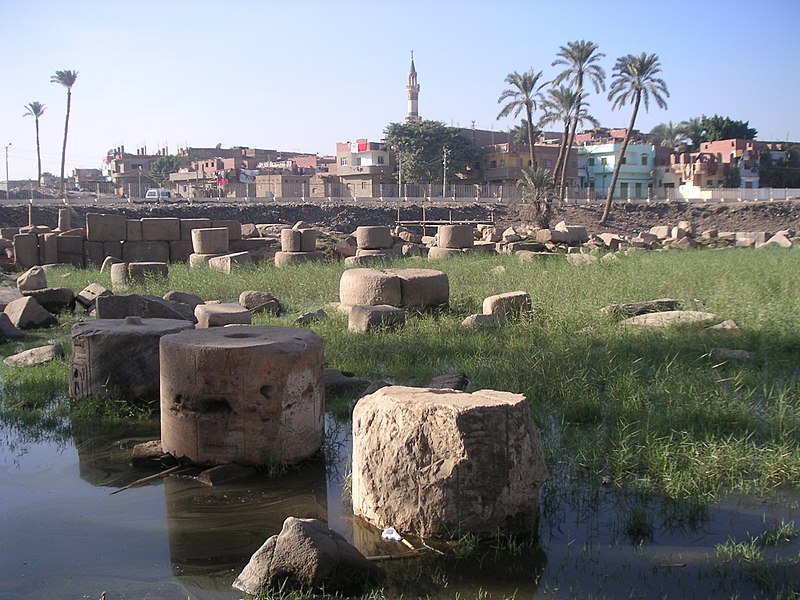
Memphis
ancient capital of Inebu-hedj, Egypt

Egyptology
thumb|Howard Carter examines the opened coffin of the Eighteenth Dynasty pharaoh [[Tutankhamun with a local assistant in Luxor, Egypt, 1925]]
ancient Egyptian architecture
aspect of architecture

Pyramid Texts
corpus of ancient Egyptian religious texts dating to the Old Kingdom in Old Egyptian, carved onto the subterranean walls and sarcophagi of pyramids at Saqqara

Thinis
Thinis (Greek: Θίνις Thinis, Θίς This ; Egyptian: Tjenu; ;
) was the capital city of pre-unification Upper Egypt. Thinis remains undiscovered but is well attested by ancient writers, including the classical historian Manetho, who cites it as the centre of the Thinite Confederacy, a tribal confederation whose leader, Menes (or Narmer), united Egypt and was its first pharaoh. Thinis began a steep decline in importance when the capital was relocated to Memphis, which was thought to be the first true and stable capital after the unification of Egypt by Menes. Thinis's location on the border of th
Portal:Egypt
Wikimedia portal
.svg)
Buto
Buto (, , Butu), Bouto, Butus (, Boutos) or Butosus was a city that the Ancient Egyptians called Per-Wadjet. It was located 95 km east of Alexandria in the Nile Delta of Egypt. What in classical times the Greeks called Buto, stood about midway between the Taly (Bolbitine) and Thermuthiac (Sebennytic) branches of the Nile, a few kilometers north of the east-west Butic River and on the southern shore of the Butic Lake (, Boutikē limnē).
Portal:Ancient Egypt
Wikimedia portal
Horapollon
Horapollo (from Horus Apollo; ) (5th century AD?) is the supposed author of a treatise, titled Hieroglyphica, on Egyptian hieroglyphs, extant in a Greek translation by a Philippus (also dating to 5th century).
Egyptian chronology
timeline

serapeum
thumb|Remains of the Serapeum of Alexandria
thumb|Marble bust of Serapis, Roman copy after a Greek original from the 4th century BC
A serapeum is a temple or other religious institution dedicated to the syncretic Greco-Egyptian deity Serapis, who combined aspects of Osiris and Apis in a humanized form that was accepted by the Ptolemaic Greeks of Alexandria. There were several such religious centers, each of which was called a serapeion/serapeum () or poserapi (), coming from an Egyptian name for the temple of Osiris-Apis ().
Serapeum of Alexandria
temple in Alexandria
Serabit el-Khadim
Archaeological site in southwestern Sinai
Dendera light
supposed ancient Egyptian electrical lighting technology
Ancient Egyptian burial customs
elaborate set of funerary practices
decipherment of ancient Egyptian scripts
overview about the decipherment of ancient Egyptian scripts
solar barque
representation of the sun riding in a boat in Egyptian mythology (ancient Egyptian cultic vessel)
Supreme Council of Antiquities
branch of the Egyptian Ministry of Culture
Saqqara Bird
bird-shaped artifact made of sycamore wood
%20of%20the%20Temple%20of%20Hathor%20-%20Lehnert%20%26%20Landrock%2C%20Cairo.%20LCCN2003690040.jpg)
Mammisi
A mammisi (mamisi) is an ancient Egyptian small chapel attached to a larger temple (usually in front of the pylons), built from the Late Period, and associated with the nativity of a god. The word is derived from Coptic – the last phase of the ancient Egyptian language – meaning "birth place". Its usage is attributed to the French egyptologist Jean-François Champollion (1790–1832).
list of obelisks in Rome
Wikimedia list article
Sothic cycle
1460 year calendar cycle of ancient Egypt

The Night of Counting the Years
1969 Egyptian film directed by Shadi Abdel Salam

Book of Abraham
religious text of some Latter Day Saint churches
Transliteration of Ancient Egyptian
Institut d'Égypte
library in Egypt
Serapeum of Saqqara
Burial place of Apis bulls in Saqqara
Egypt Exploration Society
British non-profit archeological organization
Institut Français d'Archéologie Orientale
French research institute based in Cairo, Egypt
Commission des Sciences et des Arts
French science expedition in the Egypt
Lettre à M. Dacier
book by Jean-François Champollion

cartonnage
thumb|upright|Rear of a cartonnage Anubis mask, Ptolemaic dynasty|Ptolemaic era
thumb|upright|This mummy of an unknown girl has a cartonnage composed of layers of linen and plaster. The Walters Art Museum.
Cartonnage or cartonage is a type of material used in ancient Egyptian funerary masks from the First Intermediate Period to the Roman era. It was made of layers of linen or papyrus covered with plaster. Some of the Fayum mummy portraits are also painted on panels made of cartonnage.
Theban Mapping Project
archaeological expedition devoted to Ancient Egypt
Standard Alphabet by Lepsius
transcription system developed by Lepsius for Egyptian hieroglyphs and other African and Asian languages
New Chronology
alternative chronology of the ancient Near East developed by David Rohl

Abū Ṣīr el-Malaq
village in Beni Suef Governorate, Egypt
discovery of Tutankhamun's grave
excavation of Egyptian tomb in 1922
Dynastic race theory
theory of the origins of Dynastic Egypt
Will of Naunakhte
ancient Egyptian legal document
list of DNA-tested mummies
Wikimedia list article
Glasgow Chronology
Proposed Revision of Ancient Egyptian Chronology
British Museum Department of Ancient Egypt and Sudan
ancient Egyptian And Sudanese Museum Department