Category
page 1Elasticity (physics)

elasticity
physical property when materials or objects return to original shape after deformation

Hooke's law
empirical physical law of mechanics that the force on a spring is proportional to its displacement

Poisson's ratio
parameter of elastic materials: ratio of transverse strain to axial strain

Young's modulus
mechanical property that measures stiffness of a solid material
elastic modulus
physical property that measures the stiffness of an elastic material

ultimate tensile strength
capacity of a material or structure to withstand loads tending to elongate; resists tension (being pulled apart); measured by the maximum stress that a material can withstand while being stretched or pulled before breaking
torsion
twisting of an object due to an applied torque

stiffness
thumb|right|Extension of a coil spring, \delta, caused by an axial force, F.
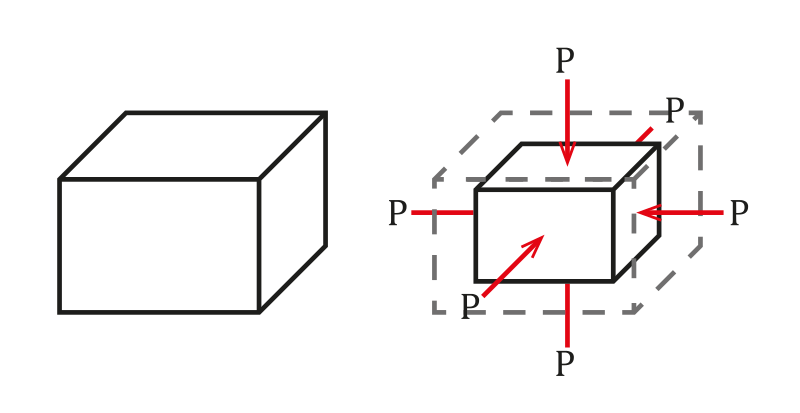
bulk modulus
measure of how incompressible / resistant to compressibility a substance is
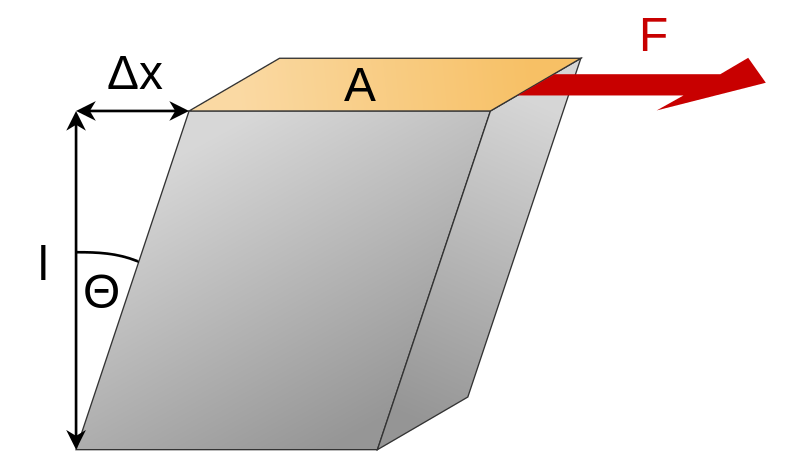
shear modulus
ratio of shear stress to the shear strain

creep
the tendency of a solid material to move slowly or deform permanently

fracture
thumb|Ductile failure of a metallic specimen strained axially

bending
thumb|right|Bending of an -beam

buckling
thumb|Buckled skin panels on a Boeing B-52 Stratofortress|B-52 aircraft. Thin skin panels buckle at very low loads. In the case shown here, the weight of the forward fuselage structure ahead of the nose undercarriage is sufficient to cause the panels to buckle. Buckled panels are still effective in carrying shear by diagonal tension.
thumb|On the front of a new Siemens Venture railway coach made of stainless steel, unevenness caused by buckling becomes apparent because of the reflection on the polished surface.
In structural engineering, buckling is the sudden change in shape (deformation) of
stress–strain curve
curve which represents the deformation caused by a force
strain gauge
electronic component
Mohr's circle
geometric engineering calculation technique

viscoelasticity
Viscoelasticity is a material property that combines both viscous and elastic characteristics. Many materials have such viscoelastic properties, especially materials that consist of large molecules. Polymers are viscoelastic because their macromolecules can make temporary entanglements with neighbouring molecules which causes elastic properties. After some time these entanglements will disappear again and the macromolecules will flow into other positions where new entanglements will be made (viscous properties).
yield
phenomenon of deformation due to structural stress
Euler–Bernoulli beam theory
Method for load calculation in construction
stress concentration

aeroelasticity
thumb|NASA testing a scale model Lockheed L-188 Electra|Lockheed Electra in a wind tunnel for flutter
Lamé parameters
two material-dependent quantities that arise in strain-stress relationships
fatigue limit
mechanical property of materials
Saint-Venant's principle
principle that the difference between the effects of two different but statically equivalent loads becomes very small at sufficiently large distances from load
constitutive equation
relation between two physical quantities that is specific to a material or substance
resilience of materials
ability of a material to absorb energy when it is deformed elastically
Lamb waves
elastic waves propagating in solid plates or spheres
finite strain theory
theory
hyperelastic material
material for which the stress–strain relationship derives from a strain energy density function
Love number
parameters describing a planet's rigidity
infinitesimal strain theory
mathematical approach to the description of the deformation of a solid body in which the displacements of the material particles are assumed to be much smaller than any relevant dimension of the body
Lame's stress ellipsoid
graphical representation of stress
transverse isotropy
Geological concept
Rainflow-counting algorithm
materials science algorithm
Euler's critical load
compressive load at which a slender column will suddenly bend or buckle