Category
page 1Electronics work tools

pliers
thumb|A blacksmith using pliers
thumb|Slip joint pliers
thumb|Cutting wire with diagonal pliers/side cutters
Pliers are a hand tool used to hold objects firmly, possibly developed from tongs used to handle hot metal in Bronze Age Europe. They are also useful for bending and physically compressing a wide range of materials. Generally, pliers consist of a pair of metal first-class levers joined at a fulcrum positioned closer to one end of the levers, creating short jaws on one side of the fulcrum, and longer handles on the other side. This arrangement creates a mechanical advantage, allowing the

oscilloscope
thumb|A Tektronix model 475A portable analog oscilloscope, a typical instrument of the late 1970s
thumb|Oscilloscope cathode-ray tube, the left square-shaped end would be the blue screen in the upper device when built in.
thumb|Typical display of an analog oscilloscope measuring a sine wave signal with 10 kHz. From the grid inherent to the screen together with the user-set parameters of the device shown at the upper display rim, the user may calculate the frequency and the voltage of the measured signal. Modern digital oscilloscopes set the measurement parameters and calculate/display the

tweezers
thumb|upright=1.35|Two types of modern-day conventional metal tweezers with pointed tips
thumb|upright=1.35|A pair of bronze tweezers attributed to the Minoan civilization,
Tweezers are small hand tools used for grasping objects too small to be easily handled with the human fingers. Tweezers are thumb-driven forceps most likely derived from tongs used to grab or hold hot objects since the dawn of recorded history. In a scientific or medical context, they are normally referred to as just "forceps", a name that is used together with other grasping surgical instruments that resemble pliers, pinc

multimeter
thumb|Analog multimeter
thumb|Digital multimeter
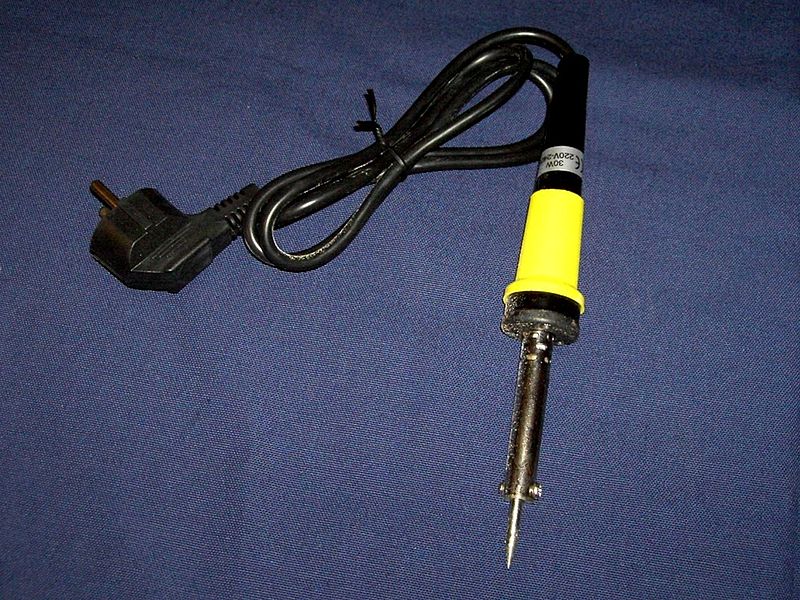
soldering iron
hand tool used in soldering

breadboard
A breadboard, solderless breadboard, or protoboard is a construction base used to build semi-permanent prototypes of electronic circuits. Unlike a perfboard or stripboard, breadboards do not require soldering or destruction of tracks and are hence reusable. For this reason, breadboards are also popular with students and in technological education.
heat-shrink tubing
shrinkable plastic tube used to insulate wires
perfboard
right|thumb|Top of a copper clad Perfboard with solder pads for each hole.
wiring pencil
tool for making electrical connections

semiconductor curve tracer
test equipment