Category
page 1Elementary algebra

equation
thumb|right|300px|The first use of an equals sign, equivalent to 14x + 15 = 71 in modern notation. From The Whetstone of Witte by [[Robert Recorde of Wales (1557).]]

quadratic equation
polynomial equation in a single variable where the highest exponent of the variable is 2

linear equation
equation that does not involve powers or products of variables

formula
thumb|upright|One of the most influential figures of computing science's founding generation, [[Edsger Dijkstra at the blackboard during a conference at ETH Zurich in 1994. In Dijkstra's own words, "A picture may be worth a thousand words, a formula is worth a thousand pictures."]]

nth root
function

inequality
mathematical relation comparing two different values
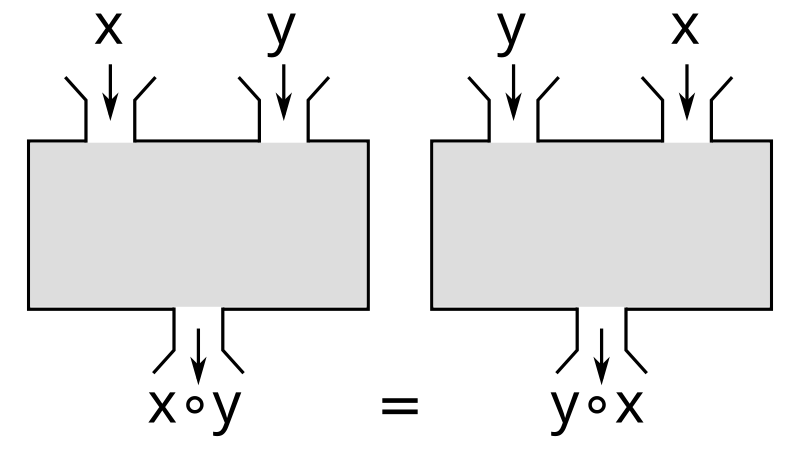
commutative property
property of binary operations, for which changing the order of the operands does not change the result

associativity
property of binary operations allowing sequences of operations to be regrouped without changing their value

factorization
thumb|right|The polynomial x2 + cx + d, where a + b = c and ab = d, can be factorized into (x + a)(x + b).
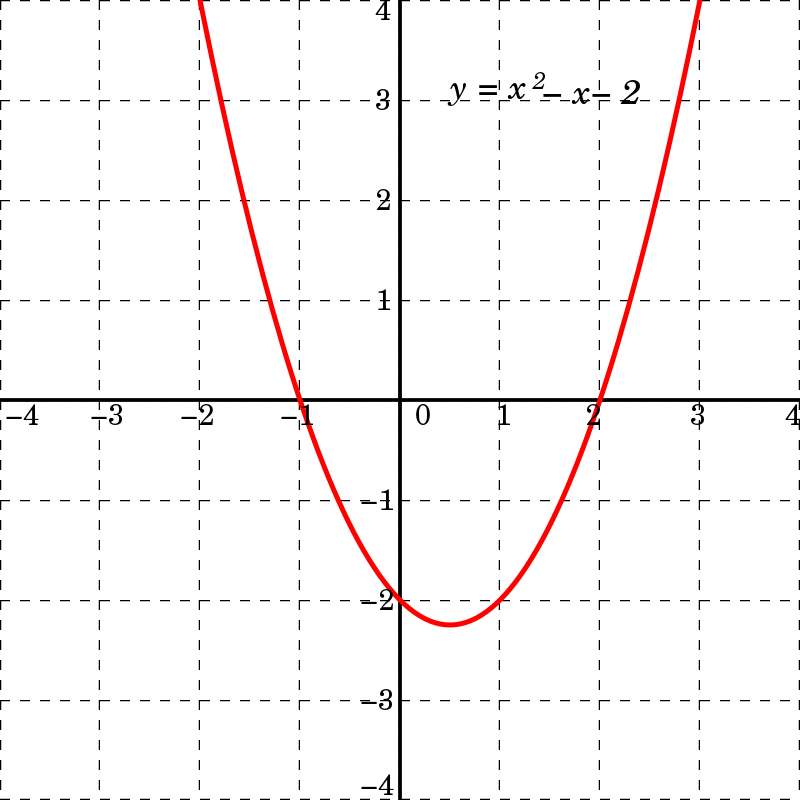
elementary algebra
basic concepts of algebra of the real and complex numbers

multiplicative inverse
of a number x, 1 divided by x

distributive property
property involving two mathematical operations

cube root
number which produces a given number when cubed

opposite number
number that, when added to the original number, yields zero
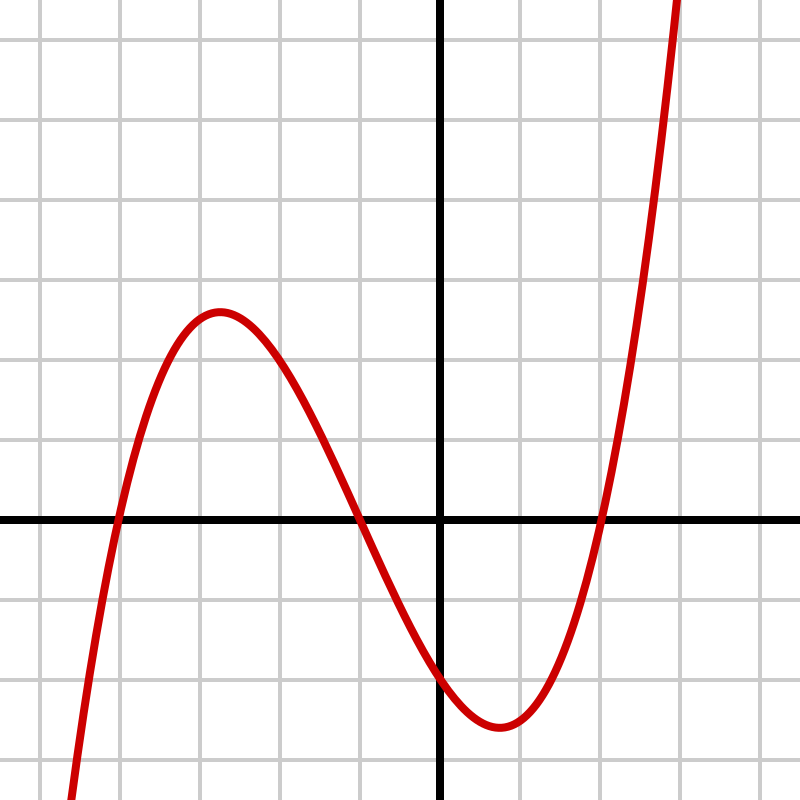
cubic equation
a polynomial equation in a single variable where the highest exponent of the variable is 3.

mathematical expression
formula that represents a mathematical object
identity
equation that is satisfied for all values of the variables

transitive relation
binary relation R with the property that xRy and yRz implies xRz
Vieta's formulas
relations between the coefficients and the roots of a polynomial
unary operation
mathematical operation with only one operand
quartic equation
polynomial equation of degree four
completing the square
method for solving quadratic equations
quadratic formula
formula that provides the solution(s) to a quadratic equation
partial fraction decomposition
Decomposition or partial fraction expansion of a mathematical function
algebraic expression
mathematical expression built up from integer constants, variables, and the algebraic operations

trinomial
thumb|upright=2|Layers of Pascal's pyramid derived from [[coefficients in an upside-down ternary plot of the terms in the expansions of the powers of a trinomial ]]
In elementary algebra, a trinomial is a polynomial consisting of three terms or monomials.

inequation
In mathematics, an inequation is a statement that either an inequality (relations "greater than" and "less than", ) or a relation "not equal to" (≠) holds between two values. It is usually written in the form of a pair of expressions denoting the values in question, with a relational sign between the two sides, indicating the specific inequality relation. Some examples of inequations are:
quartic function
function defined by a polynomial of degree four
change of variables
technique in algebra in which the original variables are replaced with functions of other variables
additive identity
an element which, when added to any element x in the set, yields x
rationalization
removal of square roots from denominators
algebraic operation
mathematical operation
algebraic fraction
sort of mathematical expression
constant term
term in an algebraic expression which does not contain any variables
Carlyle circle
circle in a coordinate plane associated with a quadratic equation
conjugate
for square roots
zero-product property
mathematical property shared by many number systems, that a product cannot be zero unless one of its factors is zero
Extraneous and missing solutions
Types of solutions in mathematics
Unitary method
problem-solving technique
equating coefficients
Light's associativity test
algorithm in mathematics
two-element Boolean algebra
boolean algebra