Category
page 1Elementary particles

electron

photon
A photon () is an elementary particle that is a quantum of the electromagnetic field, including electromagnetic radiation such as light and radio waves, and the force carrier for the electromagnetic force. Photons are massless particles that can only move at one speed, the speed of light measured in a vacuum. The photon belongs to the class of boson particles.

elementary particle
quantum particle having no known substructure; quark, electron, photon, etc.

quark
A quark () is a type of elementary particle and a fundamental constituent of matter. Quarks combine to form composite particles called hadrons, the most stable of which are protons and neutrons, the components of atomic nuclei. All commonly observable matter is composed of up quarks, down quarks and electrons. Owing to a phenomenon known as color confinement, quarks are never found in isolation; they can be found only within hadrons, which include baryons (such as protons and neutrons) and mesons, or in quark–gluon plasmas. For this reason, much of what is known about quarks has been drawn fro

neutrino
A neutrino ( ; denoted by the Greek letter Nu (letter)|) is an elementary particle that interacts via the weak interaction and gravity. The neutrino is so named because it is electrically neutral and because its rest mass is so small (-ino) that it was long thought to be zero. The rest mass of the neutrino is much smaller than that of the other known elementary particles (excluding massless particles).

Higgs boson
elementary particle transmitting the Higgs field giving particles mass

positron
The positron or antielectron is the particle with an electric charge of +1e, a spin of 1/2 ħ (the same as the electron), and the same mass as an electron. It is the antiparticle (antimatter counterpart) of the electron. When a positron collides with an electron, annihilation occurs. If this collision occurs at low energies, it results in the production of two or more photons.

lepton
In particle physics, a lepton is an elementary particle of half-integer spin (spin ) that does not undergo strong interactions. Two main classes of leptons exist: charged leptons (also known as the electron-like leptons or muons), including the electron, muon, and tauon, and neutral leptons, better known as neutrinos. Charged leptons can combine with other particles to form various composite particles such as atoms and positronium, while neutrinos rarely interact with anything, and are consequently rarely observed. The best known of all leptons is the electron.

gluon

tau
heavy, negatively charged subatomic particle
up quark
up type of quark

charm quark
type of quark

top quark
the heaviest of the six known flavors of quarks

down quark
down type of quark

strange quark
strange type of quark
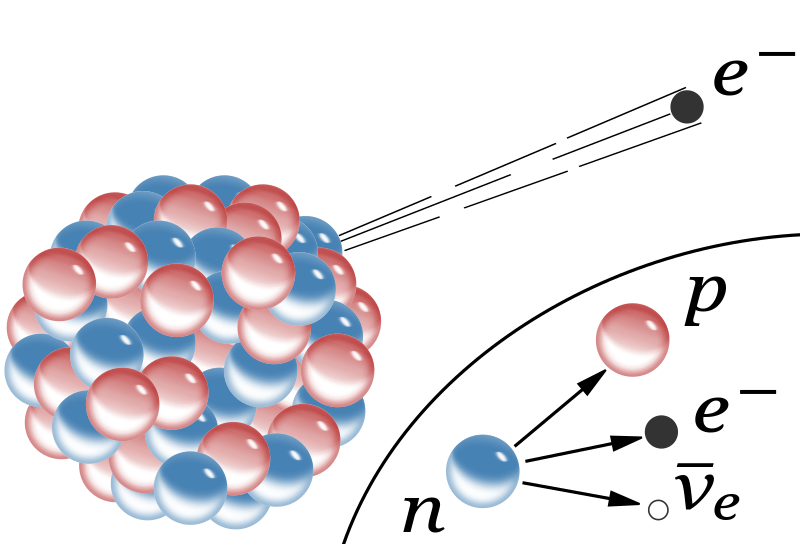
W or Z boson
massive gauge bosons that mediate the weak nuclear interaction
bottom quark
bottom type of quark
electron neutrino
neutral subatomic elementary particle of first generation of leptons

muon neutrino
neutral subatomic elementary particle
tau neutrino
neutral subatomic elementary particle