Category
page 1Empiricism

scientific method
techniques used in the construction and testing of scientific hypotheses; in particular mathematical and experimental techniques employed in the natural sciences

experience
Experience refers to conscious events in general, more specifically to perceptions, or to the practical knowledge and familiarity that is produced by these processes. Understood as a conscious event in the widest sense, experience involves a subject to which various items are presented. In this sense, seeing a yellow bird on a branch presents the subject with the objects "bird" and "branch", the relation between them and the property "yellow". Unreal items may be included as well, which happens when experiencing hallucinations or dreams. When understood in a more restricted sense, only sensory
experiment
thumb|Apollo 15 astronaut [[David Scott performs a gravity test on the Moon with a hammer and feather (1971).]]
thumb|right|160px|Even very young children perform rudimentary experiments to learn about the world and how things work.

empiricism
In philosophy, empiricism is an epistemological view which holds that true knowledge or justification comes either only or primarily from sensory experience and empirical evidence. It is one of several competing views within epistemology, along with rationalism and skepticism.

logical positivism
assertion that only statements verifiable through empirical observation are meaningful

analysis
thumb|Adriaen van Ostade, "Analysis" (1666)
scientism
Scientism is the belief that science and the scientific method are the best or only way to render truth about the world and reality.
sensationism
In epistemology, sensualism (also sensationalism or sensationism) is a doctrine whereby sensations and perception are the basic and most important form of true cognition. It may oppose abstract ideas.
instrumentalism
In philosophy of science and in epistemology, instrumentalism is a methodological view that ideas are useful instruments, and that the worth of an idea is based on how effective it is in explaining and predicting natural phenomena.
According to instrumentalists, a successful scientific theory reveals nothing known either true or false about nature's unobservable objects, properties or processes.*Anjan Chakravartty, , §4 "Antirealism: Foils for scientific realism: §4.1: "Empiricism", in Edward N. Zalta, ed, The Stanford Encyclopedia of Philosophy, Summer 2013 edn: "Traditionally, instrumentalis
empirical evidence
knowledge based on sense experience or experimentation
phenomenalism
In metaphysics, phenomenalism is the view that physical objects cannot justifiably be said to exist as "things-in-themselves", but only as perceptual phenomena or sensory stimuli (e.g. redness, hardness, softness, sweetness, etc.) situated in time and in space. In particular, some forms of phenomenalism reduce all talk about physical objects in the external world to talk about bundles of sense data.
empirical research
research using empirical evidence
An Essay Concerning Human Understanding
book by John Locke
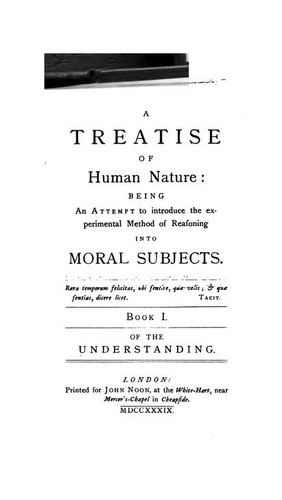
A Treatise of Human Nature
work by David Hume

verificationism
Verificationism, also known as the verification principle or the verifiability criterion of meaning, is a doctrine in philosophy which asserts that a statement is cognitively meaningful only if it is empirically verifiable (can be confirmed through experience) or an analytic truth (true by virtue of its definition or logical form). Typically expressed as a criterion of meaning, it rejects traditional statements of metaphysics, theology, ethics and aesthetics as meaningless in terms of conveying truth value or factual content, reducing them to emotive expressions or "pseudostatements" that are
Duhem–Quine thesis
thesis that it is impossible to test a scientific hypothesis in isolation, because such an empirical test of it requires other assumptions
Molyneux's problem
philosophical thought experiment: “if a man born blind, who can feel the differences between shapes, is given the ability to see, could he distinguish those objects by sight?”
Two Dogmas of Empiricism
1951 philosophy article by Willard Van Orman Quine
testability
Testability is a primary aspect of science and the scientific method. There are two components to testability:
Falsifiability or defeasibility, which means that counterexamples to the hypothesis are logically possible.
The practical feasibility of observing a reproducible series of such counterexamples if they do exist.
sense data
theory in the philosophy of perception
empiric school
school of medicine in ancient Greece and Rome

Pseudodoxia Epidemica
non-fiction work by Thomas Browne
Peripatetic axiom
Greek principle quoted by Thomas Aquinas
empirical relationship
phenomenology inferred from observation
Constructive empiricism
form of empiricism in philosophy of science
Humeanism
Humeanism refers to the philosophy of David Hume and to the tradition of thought inspired by him. Hume was an influential eighteenth century Scottish philosopher well known for his empirical approach, which he applied to various fields in philosophy. In the philosophy of science, he is notable for developing the regularity theory of causation, which in its strongest form states that causation is nothing but constant conjunction of certain types of events without any underlying forces responsible for this regularity of conjunction. This is closely connected to his metaphysical thesis that there

Radical empiricism
philosophical doctrine
empirical sociology