Category
page 1Entoprocta

Entoprocta
Entoprocta (), or Kamptozoa , commonly called goblet worms, is a phylum of mostly-sessile aquatic animals, ranging from long. Mature individuals are goblet-shaped, on relatively long stalks. They have a "crown" of solid tentacles whose cilia generate water currents that draw food particles towards the mouth, and both the mouth and anus lie inside the "crown". The superficially similar Bryozoa (Ectoprocta) have the anus outside a "crown" of hollow tentacles. Most families of entoprocts are colonial, and all but 2 of the 150 species are marine. A few solitary species can move slowly.

Loxosomatidae
Loxosomatidae is a family of Entoprocta, sometimes classified in the order Coloniales.
Pedicellinidae
Pedicellinidae is a family of Entoprocta, sometimes included in the order Solitaria.
Barentsiidae
Barentsiidae is a family of Entoprocta, sometimes classified in the order Solitaria.

Loxosomella
Loxosomella is a genus of Entoprocta. Individuals are solitary, not colonial, as is typically the case in this phylum. They are sessile, attaching to a variety of substrates including sipunculan worms. They can reproduce asexually, by budding.

Barentsia discreta
species of entoprocts
Barentsia
Barentsia is a genus of Entoprocta belonging to the family Barentsiidae. They are sessile colonial organisms composed of many individual cup shaped "heads" at the end of long thin stalks, ringed with small cilia. Like all members of Entoprocta (lit. 'inside rectum/anus'), both their mouth and anus are found in at the end of their stalks. The genus was first described in 1880.
Pedicellina
Pedicellina is a genus of the family Pedicellinidae in the phylum Entoprocta.
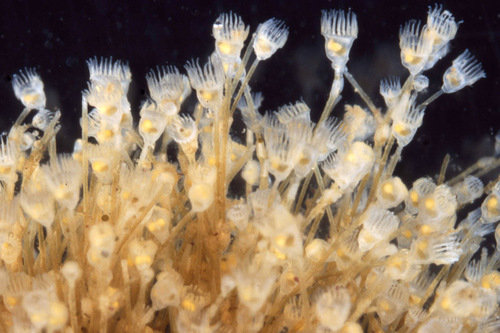
Barentsia ramosa
species of entoprocts
Loxokalypodidae
Loxokalypodidae is a family of Entoprocta, sometimes classified in the order Coloniales. It contains only the genus Loxokalypus Emschermann, 1972.