Category
page 1Epic poems in English
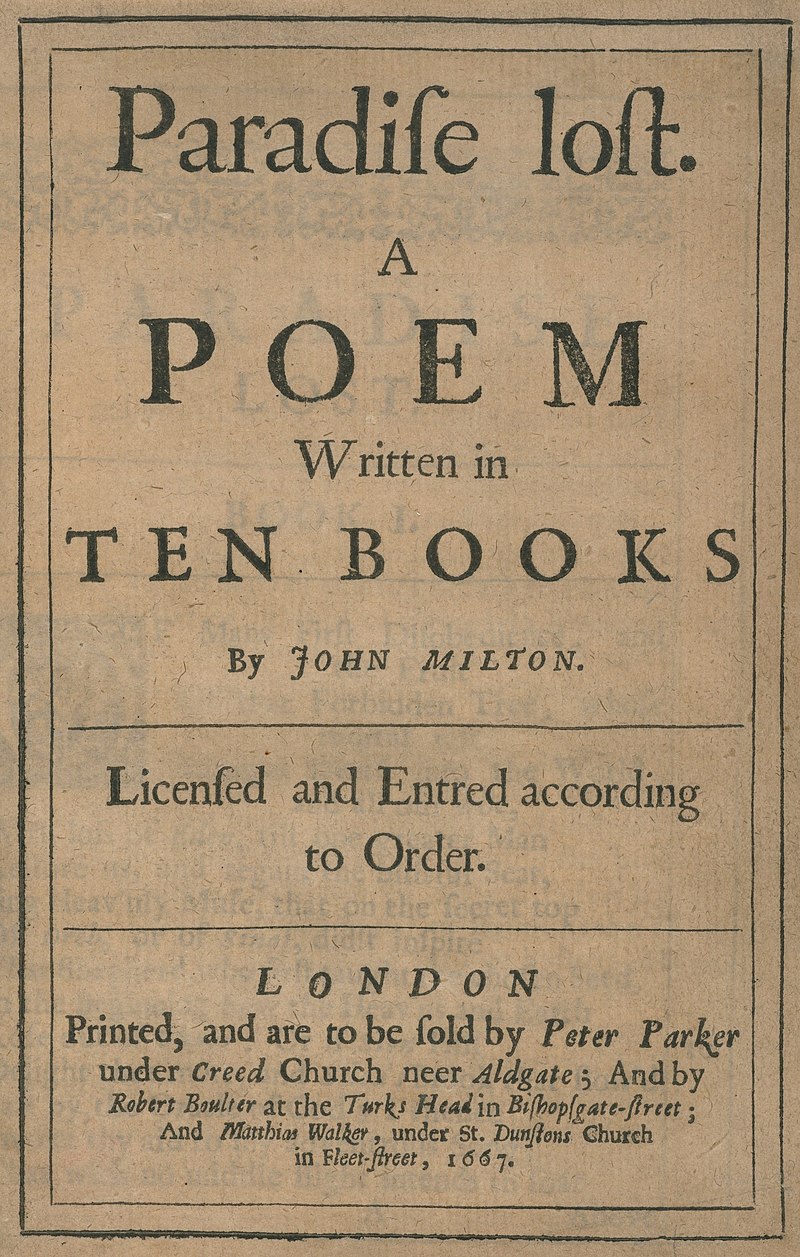
Paradise Lost
epic poem by John Milton

Ossian
thumb|upright=1.2|Ossian Singing, Nicolai Abildgaard, 1787
The Faerie Queene
English epic poem by Edmund Spenser
Don Juan
satiric poem by Lord Byron

The Song of Hiawatha
epic poem by Henry Wadsworth Longfellow
Paradise Regained
poem by John Milton

The Light of Asia
book

Troilus and Criseyde
poem by Geoffrey Chaucer
The Legend of Sigurd and Gudrún
Tolkien

Evangeline
thumb|Monument to Acadians, [[St. Martinville, Louisiana]]
Evangeline, A Tale of Acadie is an epic poem by the American poet Henry Wadsworth Longfellow, written in English and published in 1847. The poem follows an Acadian girl named Evangeline and her search for her lost love Gabriel during the expulsion of the Acadians (1755–1764).

Hyperion
unfinished poem by John Keats

Song of Myself
poem by Walt Whitman
Savitri
Sri Aurobindo's major poetic work, an epic in blank verse, describing his vision of existence and explores the reason for ignorance, darkness, suffering and pain, the purpose of life on earth and the prospect of a glorious future for humanity.

Waldere
"Waldere" or "Waldhere" is the conventional title given to two Old English fragments, of around 32 and 31 lines, from a lost epic poem, discovered in 1860 by E. C. Werlauff, Librarian, in the Danish Royal Library at Copenhagen, where it is still preserved. The parchment pages had been reused as stiffening in the binding of an Elizabethan prayer book, which had presumably come to Europe following the Dissolution of the Monasteries in England in the 16th century.

The Fall of Arthur
unfinished poem by J. R. R. Tolkien

Brut
poem compiled and recast by Layamon
Marmion
1808 poem by Walter Scott with 1811, 1885, and 1889 reprints

The Ballad of the White Horse
poem
Clarel
Clarel: A Poem and Pilgrimage in the Holy Land is an epic poem by American writer Herman Melville, originally published in two volumes in 1876. It is a poetic fiction about a young American man named Clarel, on pilgrimage through the Holy Land with a cluster of companions who question each other as they pass through Biblical sites. Melville uses this situation to explore his own spiritual dilemma, his inability to either accept or reject inherited Christian doctrine in the face of Darwin's challenge, and to represent the general theological crisis in the Victorian era.

Omeros
Omeros is an epic poem by Saint Lucian writer Derek Walcott, first published in 1990. The work is divided into seven "books" containing a total of sixty-four chapters. Many critics view Omeros as Walcott's finest work.

Milton
poem by William Blake
Aurora Leigh
epic novel/poem by Elizabeth Barrett Browning
Female epic
Gondibert
Gondibert is an epic poem by William Davenant. In it he attempts to combine the five-act structure of English Renaissance drama with the Homeric and Virgilian epic literary tradition. Davenant also sought to incorporate modern philosophical theories about government and passion, based primarily in the work of Thomas Hobbes, to whom Davenant sent drafts of the poem for review.

In Parenthesis
epic poem by David Jones

John Brown's Body
poem by Stephen Vincent Benét