Category
page 1Equations of astronomy

Kepler's laws of planetary motion
scientific laws describing motion of planets around the Sun

Hubble–Lemaître law
observation in physical cosmology

Roche limit
astronomical concept
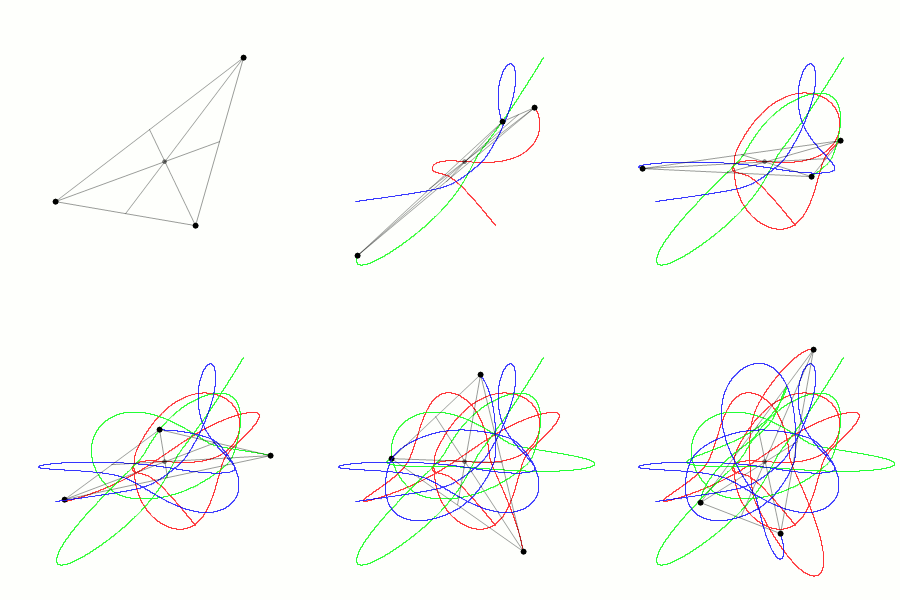
three-body problem
classical mechanics problem of three massive point particles interacting via Newtonian gravity; special case of the 𝑛‐body problem for 𝑛=3
angular diameter
angular measurement describing how large a sphere or circle appears from a given point of view
Hill sphere
with regards to an astronomical body, the region in which it dominates the attraction of satellites
virial theorem
general equation that relates the time-averaged total kinetic energy of a stable system consisting of N particles, bound by potential forces, with that of the time-averaged total potential energy
true anomaly
angular parameter of Keplerian orbits
Tisserand's parameter
named after Félix Tisserand
relaxation
return of a perturbed system into equilibrium
small-angle approximation
Simplification of the basic trigonometric functions
de Sitter space
maximally symmetric Lorentzian manifold with positive cosmological constant
initial mass function
empirical function that describes the initial distribution of masses for a population of stars
stellar dynamics
branch of astrophysics that statistically models the collective movement of stars
luminosity distance
astronomical measurand
planetary equilibrium temperature
theoretical temperatures
luminosity function
astronomical measure of the number of stars or galaxies per luminosity interval
effective radius
of a galaxy
De Vaucouleurs' law
Surface brightness model in astronomy
vis-viva equation
physical law that describes the motion of objects in a Keplerian orbit around a body
velocity dispersion
in astronomy, the statistical dispersion of velocities about the mean velocity for a cluster of stars or galaxies
mean motion
angular speed required for a body to complete one orbit, assuming constant speed in a circular orbit which completes in the same time as the variable speed, elliptical orbit of the actual body

Faber–Jackson relation
empirical power-law relation between the luminosity and the central stellar velocity dispersion of elliptical galaxy
Sersic profile
mathematical function
spectral index
measure of the dependence of radiative flux density on frequency (astronomical term)
true longitude
ecliptic longitude at which an orbiting body could actually be found if its inclination were zero
Dermott's law
formula to determine satellite orbital period
Bondi accretion
accretion of matter within the interstellar medium
Einasto profile
mathematical function that describes how the density of a spherical stellar system varies with distance
Plummer model
mathematical model in dynamical systems

M-sigma relation
Relationship between the stellar mass dispersion of a galaxy bulge and the mass of the supermassive black hole at its center
Bonnor–Ebert mass
largest mass that an isothermal gas sphere embedded in a pressurized medium can have while still remaining in hydrostatic equilibrium
Jacobi ellipsoid
oblate ellipsoid under equilibrium
Epicyclic frequency
characteristic of accretion discs
Umov effect
Von Zeipel theorem
astrophysical theory relating the radiative flux of a star to the local effective gravity
Angular diameter distance
astronomical concept