Category
page 1Ethnic groups in Bolivia

mestizo
'''''' is a term primarily used to denote people of mixed Spanish and Indigenous ancestry in the former Spanish Empire. In certain regions such as Latin America, it may also refer to people who are culturally European, even though their ancestors were Indigenous Americans. The term was used as an ethno-racial exonym for mixed-race that evolved during the Spanish Empire. It was a formal label for individuals in official documents, such as censuses, parish registers, Inquisition trials, and others. Priests and royal officials might have classified persons as mestizos, but individuals also used t
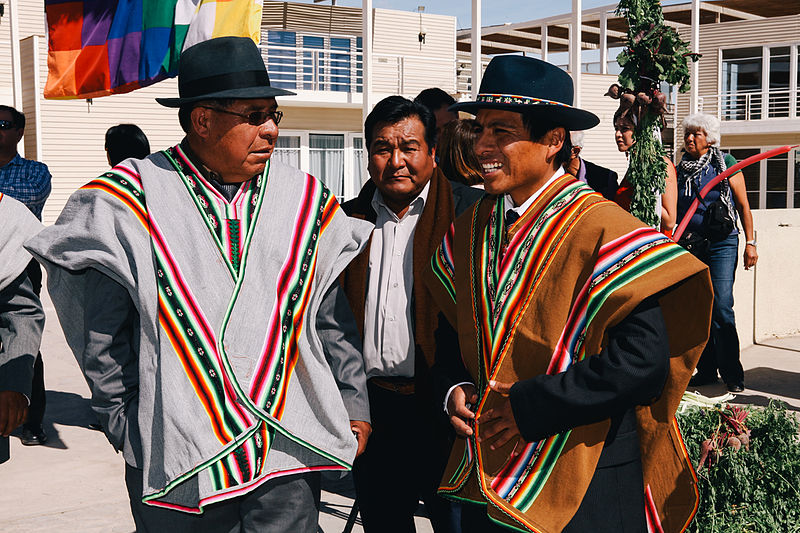
Aymara
indigenous people in the Andes and Altiplano regions of South America
Urus
indigenous group of the Andes of South America of the arahuaco bias (arawak)

Bororo people (Brazil)
The Bororo are indigenous people of Brazil, living in the state of Mato Grosso. They also extended into Bolivia and the Brazilian state of Goiás. The Western Bororo live around the Jauru and Cabaçal rivers. The Eastern Bororo (Orarimogodoge) live in the region of the São Lourenço, Garças, and Vermelho Rivers. The Bororo live in eight villages. The Bororo (or even Coroados, Boe, Orarimogodo) are an ethnic group in Brazil that has an estimated population of just under two thousand. They speak the Borôro language (code ISO 639 : BOR) and are mainly of animistic belief. They live in eight villages

Chanés
Chané is the collective name for the southernmost Arawakan-speaking peoples. They lived in the plains of the northern Gran Chaco and in the foothills of the Andes in Paraguay, Brazil, Bolivia, and Argentina. The historical Chané are divided into two principal groups: the Chané proper who lived in eastern Bolivia, and the Guaná who lived in Paraguay and adjacent Brazil. Twenty-first century survivors of the Chané are the Izoceno people of Bolivia and 3,034 descendants reported in Argentina by the 2010 census. Survivors of the Guaná are the Tereno and the Kinikinao both of Mato Grosso do Sul pro
Ava guaraníes
Denomination to the Guarani warriors
Yuracaré people
indigenous people of Bolivia

Guarayos
thumb|The Guarayos Providence in Santa Cruz, Bolivia
The Guarayos are an indigenous group living in their ancestral land in eastern Bolivia. They are located north of the department of Santa Cruz. The current population of the Guarayo group in Bolivia is 12,000. They primarily speak Guarayu, and 70% of the population is Roman Catholic with the remaining 30% practicing ethnic religions. Guarayu comes from the language of Guaraní as it belongs in the Tupí Family. They are known to be predominantly agricultural as much of their culture and lifestyle relies on their land.
Moxo people
The Mojeños, also known as Moxeños, Moxos, or Mojos, are an indigenous people of Bolivia. They live in south central Beni Department, on both banks of the Mamore River, and on the marshy plains to its west, known as the Llanos de Mojos. The Mamore is a tributary to the Madeira River in northern Bolivia.

Afro-Bolivians
Afro-Bolivians (), also known as Black Bolivians (), are Bolivians who have predominantly or total Sub-Saharan African ancestry and therefore the descriptive "Afro-Bolivian" may refer to historical or cultural elements in Bolivia thought to emanate from their community. It can also refer to the combining of African and other cultural elements found in Bolivian society such as religion, music, language, the arts, and class culture. The Afro-Bolivians are recognized as one of the constituent ethnic groups of Bolivia by the country's government, and are ceremonially led by a king who traces his d
Araona people
ethnic group in Bolivia
Movima people
Bolivian ethnic group
Canichana people
ethnic group of Bolivia
Bauré people
Indigenous group of South America of arahuacos (arawak) origin
Lupaca
The Lupaca, Lupaka, or Lupaqa people were one of the divisions of the ancestral Aymaras. The Lupaca lived for many centuries near Lake Titicaca in Peru and their lands possibly extended into Bolivia. The Lupacas and other Aymara peoples formed powerful kingdoms after the collapse of the Tiwanaku Empire in the 11th century. In the mid 15th century they were conquered by the Inca Empire and in the 1530s came under the control of the Spanish Empire.
Guarasu’wes
The Pauserna are an indigenous people in Bolivia and Brazil who live along the upper Río Guaporé. Most of them live in the southeastern part of the department of Beni, in Bolivia. The people derive their name from the fact that the pao cerne tree is abundant in their area. Only a few of the older people speak the Pauserna language, which is closely related to Guaraní and is a member of the Tupí language family.
Cavineño
ethnic group from the Bolivian Amazon
Camba
Camba is a word historically used in Bolivia to refer to the indigenous population in the eastern tropical region of the country, or to those born in the area of Santa Cruz, Beni, and Pando. Nowadays, the term "Camba" is used predominantly to refer to eastern Bolivian populations of mixed Spanish, Chane, and other indigenous Amazonian descent born in the eastern lowlands in and around Santa Cruz de la Sierra.
indigenous peoples in Bolivia
Native Bolivians constitute approximately 62% of Bolivia's population
Itonama
indigenous people of Bolivia