Category
page 1Ethnic groups in Chile

Mapuche
The Mapuche ( , ), also known as Araucanians, are a group of Indigenous inhabitants of south-central Chile and southwestern Argentina, including parts of Patagonia. The collective term refers to a wide-ranging ethnicity composed of various groups who share a common social, religious, and economic structure, as well as a common linguistic heritage as Mapudungun speakers. Their homelands once extended from Choapa Valley to the Chiloé Archipelago and later spread eastward to Puelmapu, a land comprising part of the Argentine pampa and Patagonia. Today, the Mapuche represent 77.16% of Chile’s indig

mestizo
'''''' is a term primarily used to denote people of mixed Spanish and Indigenous ancestry in the former Spanish Empire. In certain regions such as Latin America, it may also refer to people who are culturally European, even though their ancestors were Indigenous Americans. The term was used as an ethno-racial exonym for mixed-race that evolved during the Spanish Empire. It was a formal label for individuals in official documents, such as censuses, parish registers, Inquisition trials, and others. Priests and royal officials might have classified persons as mestizos, but individuals also used t

Chileans
Chileans (, ) are an ethnic group and nation native to the country of Chile and its neighboring insular territories. Most Chileans share a common culture, history, ancestry and language. The overwhelming majority of Chileans are the product of varying degrees of admixture between white ethnic groups (predominantly Basques and Spaniards) with peoples indigenous to Chile's modern territory (predominantly Mapuche). Chile is a multilingual and multicultural society, but an overwhelming majority of Chileans have Spanish as their first language and either are Christians (mainly Catholic) or have a C
Aymara
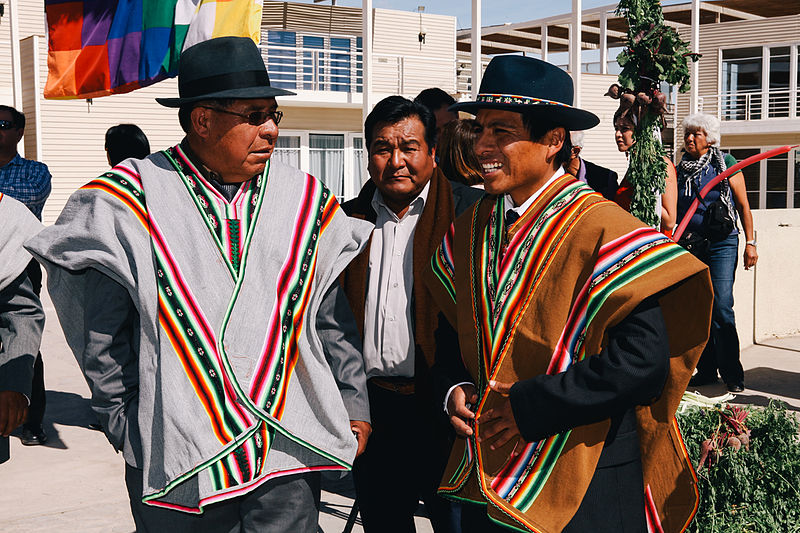
indigenous people in the Andes and Altiplano regions of South America

Galicians
Galicians ( or pobo galego; ) are an ethnic group primarily residing in Galicia, northwest Iberian Peninsula. Historical emigration resulted in populations in other parts of Spain, Europe, and the Americas. Galicians possess distinct customs, culture, language, music, dance, sports, art, cuisine, and mythology. Galician, a Romance language derived from the Latin of ancient Roman Gallaecia, is their native language and a primary cultural expression. It shares a common origin with Portuguese, exhibiting 85% intelligibility, and similarities with other Iberian Romance languages like Asturian and
Rapa Nui people
native Polynesian inhabitants of Easter Island, Chile

Kawésqar
thumb|right|220px|A Kawésqar woman selling handicrafts to tourists in Villa Puerto Edén, Chile.
The Kawésqar, also known as the Kaweskar, Alacaluf, Alacalufe or Halakwulup, are an Indigenous people who live in Chilean Patagonia, specifically in the Brunswick Peninsula, and Wellington, Santa Inés, and Desolación islands northwest of the Strait of Magellan and south of the Gulf of Penas. Their traditional language is known as Kawésqar, a word that means “person” or “human being”; it is endangered as few native speakers survive.

Diaguitas
The Diaguita people are a group of South American Indigenous people native to the Chilean Norte Chico and the Argentine Northwest. Western or Chilean Diaguitas lived mainly in the Transverse Valleys that incise semi-arid mountains. Eastern or Argentine Diaguitas lived in the provinces of La Rioja and Catamarca and part of the provinces of Salta, San Juan and Tucumán. The term Diaguita was first applied to peoples and archaeological cultures by Ricardo E. Latcham in the early 20th century.
Cunco people
ethnic subgroup native to southern Chile
Capayán
The Capayán were an Indigenous people, now extinct, that lived in Argentine territory.
Palestinian community in Chile
Chilean part of the Palestinian diaspora
Caucahue
Caucahue is an ethnonym used by the Chono, the Huilliche and Spanish of Chiloé for a group of canoe-faring people that inhabited the archipelagoes south of the Gulf of Penas. The term is one of the various ethnonyms recorded by the Spanish in the 18th century in the fjords and channels of Patagonia. The Caucahue spoke a different language from the Chono. Archaeologist Ricardo Alvarez posits that the Caucahue and other groups appeared relatively late in colonial records because this was the time when contact became more common. Alvarez also posits the Caucahue disappeared from the historical re
Afro-Chilean
Afro-Chileans or Black Chileans are Chilean people of Black African descent. They may be descendants of slaves who were brought to Chile via the trans-Atlantic slave trade, or recent migrants from other parts of Latin America, the Caribbean or Africa.