Category
page 1Ethnic groups in Peru

mestizo
'''''' is a term primarily used to denote people of mixed Spanish and Indigenous ancestry in the former Spanish Empire. In certain regions such as Latin America, it may also refer to people who are culturally European, even though their ancestors were Indigenous Americans. The term was used as an ethno-racial exonym for mixed-race that evolved during the Spanish Empire. It was a formal label for individuals in official documents, such as censuses, parish registers, Inquisition trials, and others. Priests and royal officials might have classified persons as mestizos, but individuals also used t
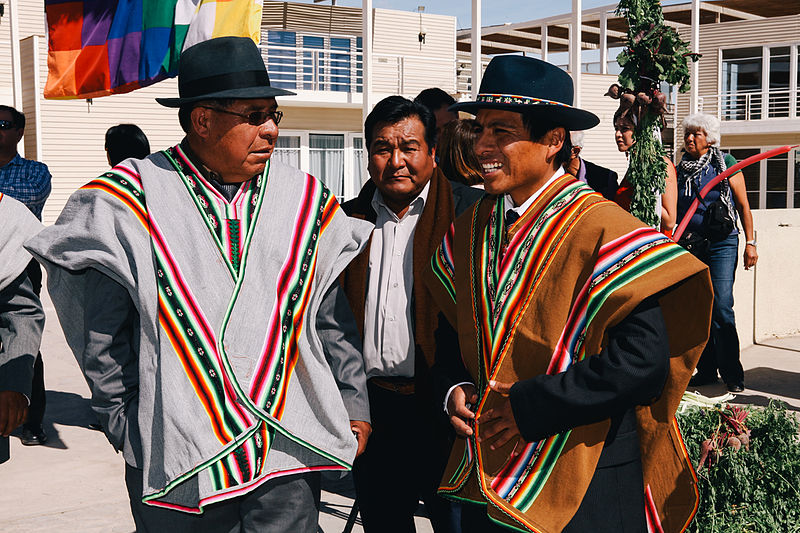
Aymara
indigenous people in the Andes and Altiplano regions of South America

Asháninka people
The Asháninka or Asháninca are an Indigenous people living in the rainforests in the regions of Junín, Pasco, Huánuco, and Ucayali in Peru, and in the State of Acre in Brazil. Their ancestral lands are in the forests of Junín, Pasco, Huánuco and part of Ucayali in Peru.

Huanca people
The Huancas, Wancas, or Wankas are a Quechua people living in the Junín Region of central Peru, in and around the Mantaro Valley.

Shipibo-Conibo people
thumb|Shipibo pottery in the Museo de América, Madrid, Spain
Jivaroan peoples
groups of indigenous peoples in the headwaters of the Marañon River and its tributaries, Peru and Ecuador

Yagua people
Yagua are an indigenous people in Colombia and northeastern Peru, numbering approximately 6,000. Currently, they live near the Amazon, Napo, Putumayo and Yavari rivers and their tributaries. As of 2005, some Yagua have migrated northward to Colombia, near the town of Leticia.
Aguaruna people
ethnic group
Yanesha people
Ethnic group in the rainforests of Peru
indigenous people in Peru
distinct ethnic groups who have inhabited the country of Peru's territory since before the arrival of Europeans
Aguano people
The Aguano (also Awano, Ahuano, Hilaca, Uguano, Aguanu, Santacrucino, Tibilo) are a people of Peru. In 1959, they consisted of 40 families. They inhabit the lower Huallaga and upper Samiria Rivers, and the right bank tributary of the Marañon River.
Lupaca
The Lupaca, Lupaka, or Lupaqa people were one of the divisions of the ancestral Aymaras. The Lupaca lived for many centuries near Lake Titicaca in Peru and their lands possibly extended into Bolivia. The Lupacas and other Aymara peoples formed powerful kingdoms after the collapse of the Tiwanaku Empire in the 11th century. In the mid 15th century they were conquered by the Inca Empire and in the 1530s came under the control of the Spanish Empire.

Huambisa people
thumb | right | alt=Huambisa, member of the Peruvian army | Huambisa, member of the Peruvian army
The Huambisa, also known as the Wampis, are an indigenous people of Peru and Ecuador. One of the Jivaroan peoples, they speak the Huambisa language and live on the upper Marañón and Santiago rivers. They numbered about 5,000 people in the 1980s.
Afro-Peruvian
Racial or ethnic group in Peru with African ancestry
Llacuash
Quechuan people
Canelos-Quichua
The Canelos-Quichua, also known as the Quichua of Pastaza, is an Indigenous people of Ecuador. They are a Lowland Quichua (Runa Shimi) people, inhabiting the province of Pastaza on the banks of the Curaray, Bonbonaza, and Pastaza rivers, in Peru and eastern Ecuador.

Quijos-Quichua
The Quijos-Quichua (Napo-Quichua) are a Lowland Quechua (Runa Shimi) people, living in the basins of the Napo, Aguarico, San Miguel, and Putumayo river basins of Ecuador and Peru. In Ecuador they inhabit in the Napo Alto as well as the rivers Ansuy and Jatun Yacu, where they are also known as Quijos Quechua. The Quijos Original Nation (NAOKI) has an extension of community territory of approximately 13,986, 78 hectares. It was recognized as such on March 13, 2013, by Codenpe (Council of Development of Nationalities and Peoples of Ecuador). It is made up of dozens of groups, communities and orga
Pozuzo
Pozuzo is a village and district in the Oxapampa Province and Pasco Region of Peru. The village, at an elevation of , is situated near the left bank of the Huancabamba River which is renamed the Pozuzo River after it passes by the village. The population of the village in 2017 was 1,366. Pozuzo was established in 1859 by Austrian and German immigrants to Peru and traces of German culture and architecture survived into the 21st century. Pozuzo was isolated and difficult to access until 1976 when a vehicle road was completed linking the village with the town of Oxapampa, north.
Peruvians of European descent
Peruvians of European Descent
Croatian Peruvians
Peruvian people of Croatian descent