Category
page 1Eubacteriales
Heliobacteriaceae
Heliobacteria are a unique subset of bacteria that process light for energy. Distinguishable from other phototrophic bacteria, they utilize a unique photosynthetic pigment, bacteriochlorophyll g and are the only known Gram-positive phototroph. They are a key player in symbiotic nitrogen fixation alongside plants, and use a type I reaction center like green-sulfur bacteria.

Epulopiscium fishelsoni
Candidatus Epulopiscium is a genus of Gram-positive bacteria that have a symbiotic relationship with surgeonfish. These bacteria are known for their unusually large size, many ranging from 0.2 - 0.7 mm (200–700 μm) in length. Until the discovery of Thiomargarita namibiensis in 1999, Epulonipiscium species were thought to be the largest bacteria. They are still the largest known heterotrophic bacteria.
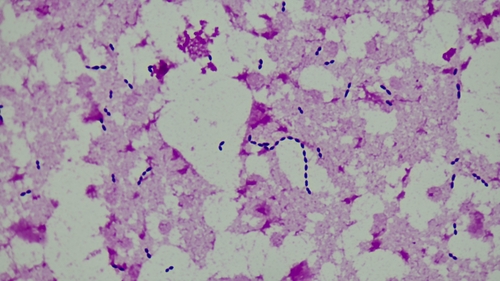
Ruminococcus
Ruminococcus is a genus of bacteria in the class Clostridia. They are anaerobic, Gram-positive gut microbes. One or more species in this genus are found in significant numbers in the human gut microbiota. The type species is R. flavefaciens. As usual, bacteria taxonomy is in flux, with Clostridia being paraphyletic, and some erroneous members of Ruminococcus being reassigned to a new genus Blautia on the basis of 16S rRNA gene sequences.
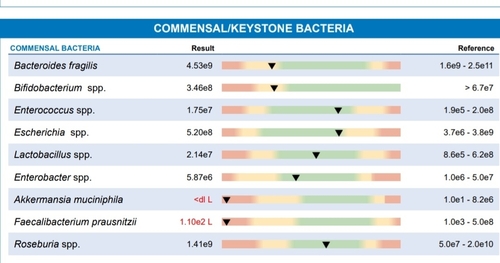
Faecalibacterium
Faecalibacterium is a genus of bacteria. The genus contains several species including Faecalibacterium prausnitzii, Faecalibacterium butyricigenerans, Faecalibacterium longum, Faecalibacterium duncaniae, Faecalibacterium hattorii, and Faecalibacterium gallinarum. Its first known species, Faecalibacterium prausnitzii is gram-positive, mesophilic, rod-shaped, and anaerobic, and is one of the most abundant and important commensal bacteria of the human gut microbiota. It is non-spore forming and non-motile. These bacteria produce butyrate and other short-chain fatty acids through the fermentation
Eubacteriales
The Eubacteriales are an order of bacteria placed within the class Clostridia.
Oscillospiraceae
Oscillospiraceae, also commonly called Ruminococcaceae, is a family of bacteria in the class Clostridia. All Oscillospiraceae are obligate anaerobes. However, members of the family have diverse shapes, with some rod-shaped and others cocci.
Peptoniphilus
Peptoniphilus is a genus of bacteria in the phylum Bacillota (Bacteria).
Finegoldia
Finegoldia is a genus of Gram-positive bacteria. They are anaerobic cocci of the class Clostridia, with Finegoldia magna being the type species. F. magna was formerly known, along with several other Gram-positive anaerobic cocci (GPACs), as Peptostreptococcus magnus, but was moved into its own genus in 1999. The name is in honor of Sydney M. Finegold, an American microbiologist, while magna is Latin for large. It is an opportunistic human pathogen that normally colonizes skin and mucous membranes. It is often seen in biofilms on chronic ulcers such as in diabetic foot or decubitus ulcers. Most
Desulfosporosinus
Desulfosporosinus is a genus of strictly anaerobic, sulfate-reducing bacteria, often found in soil.
Desulfitobacterium
Desulfitobacterium is a genus of Gram-positive, strictly anaerobic, rod-shaped, spore-forming bacteria from the family Desulfitobacteriaceae. Desulfitobacterium species have low GC-contents.