Category
page 1Exoplanet search projects

James Webb Space Telescope
NASA/ESA/CSA space telescope launched in 2021

Kepler Space Telescope
defunct NASA space telescope

Gaia
European Space Agency astrometric mission
Hayabusa2
is an asteroid sample-return mission operated by the Japanese state space agency JAXA. It is a successor to the Hayabusa mission, which returned asteroid samples for the first time in June 2010. Hayabusa2 was launched on 3 December 2014 and rendezvoused in space with near-Earth asteroid 162173 Ryugu on 27 June 2018. It surveyed the asteroid for a year and a half and took samples. It left the asteroid in November 2019 and returned the samples to Earth on 5 December 2020 UTC. Its mission has now been extended through at least 2031, when it will rendezvous with the small, rapidly-rotating asteroi
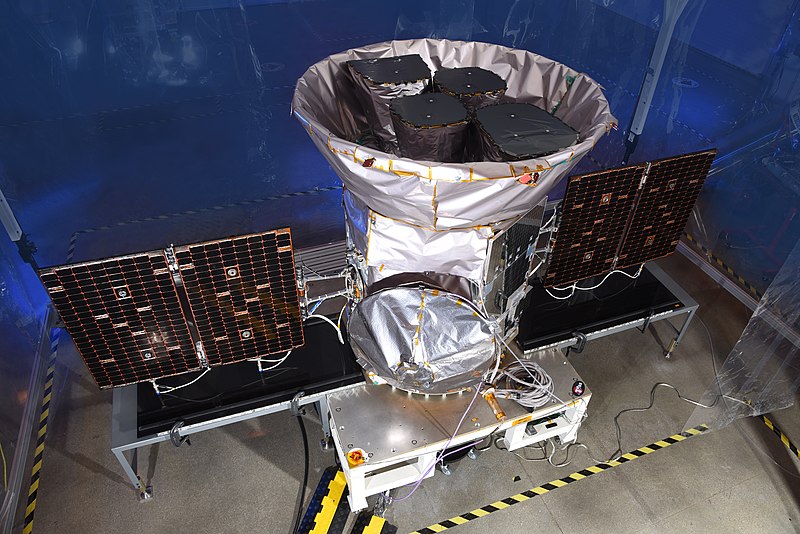
Transiting Exoplanet Survey Satellite
NASA satellite of the Explorer program

COROT
CoRoT (French: ; English: Convection, Rotation and planetary Transits) was a space telescope mission which operated from 2006 to 2013. The mission's two objectives were to search for extrasolar planets with short orbital periods, particularly those of large terrestrial size, and to perform asteroseismology by measuring solar-like oscillations in stars. The mission was led by the French Space Agency (CNES) in conjunction with the European Space Agency (ESA) and other international partners.
Sloan Digital Sky Survey
multi-spectral imaging and spectroscopic redshift survey
Subaru Telescope
Japanese telescope and observatory
Nancy Grace Roman Space Telescope
planned NASA infrared space observatory
PLATO
space telescope

CHEOPS
CHEOPS (CHaracterising ExOPlanets Satellite) is a European space telescope. Its objective is to determine the size of known extrasolar planets, which will allow the estimation of their mass, density, composition and their formation. Launched on 18 December 2019, it is the first Small-class mission in ESA's Cosmic Vision science programme. The small satellite features an optical Ritchey–Chrétien telescope with an aperture of 30 cm, mounted on a standard small satellite platform. It was placed into a Sun-synchronous orbit of about 700 km altitude.
High Accuracy Radial Velocity Planet Searcher
high-precision echelle spectrograph
Terrestrial Planet Finder
proposed project by NASA to construct a system of space telescopes for detecting extrasolar terrestrial planets; postponed several times and finally cancelled in 2011
Optical Gravitational Lensing Experiment
long-term variability sky survey
SIM Lite Astrometric Observatory
cancelled NASA space telescope
Darwin
suggested ESA Cornerstone mission
Microvariability and Oscillations of Stars
smallsat space telescope
Large Ultraviolet Optical Infrared Surveyor
proposed space telescope project

EPOXI
EPOXI was a compilation of NASA Discovery program missions led by the University of Maryland and principal investigator Michael A'Hearn, with co-operation from the Jet Propulsion Laboratory and Ball Aerospace. EPOXI uses the Deep Impact spacecraft in a campaign consisting of two missions: the Deep Impact Extended Investigation (DIXI) and Extrasolar Planet Observation and Characterization (EPOCh). DIXI aimed to send the Deep Impact spacecraft on a flyby of another comet, after its primary mission was completed in July 2005, while EPOCh saw the spacecraft's photographic instruments as a space ob
Leonhard Euler Telescope
reflecting telescope in Chile

ARIEL
thumb|305x305px|ESA's exoplanet missions
Ariel (Atmospheric Remote-sensing Infrared Exoplanet Large-survey) is a planned space telescope and the fourth medium-class mission of the European Space Agency's Cosmic Vision programme. The mission is aimed at observing at least 1,000 known exoplanets using the transit method, studying and characterising the planets' chemical composition and thermal structures. Compared to the James Webb Space Telescope, Ariel will be a much smaller telescope with more observing time available for planet characterisation. Ariel was expected to be launched in 2029 aboa
Automated Planet Finder
automated telescope searching exoplanets currently under construction
MEarth Project
robotic observatory to monitor the brightness of thousands of red dwarf stars with the goal of finding transiting planets
New Worlds Mission
proposed project comprising a large occulter flying in formation designed to block the light of nearby stars in order to observe their orbiting exoplanets
Microlensing Observations in Astrophysics
astronomical research project
Planet Hunters
citizen science project to find exoplanets
ESPRESSO
thumb|ESPRESSO spectrograph concept at the Preliminary Design Review
thumb|ESPRESSO spectrograph optical design at the Preliminary Design Review
thumb|ESPRESSO successfully made its first observations in November 2017.
Search for habitable Planets EClipsing ULtra-cOOl Stars
SPECULOOS (Search for habitable Planets EClipsing ULtra-cOOl Stars) is a project consisting of SPECULOOS Southern Observatory (SSO) at the Paranal Observatory in Chile and SPECULOOS Northern Observatory (SNO) at the Teide Observatory in Tenerife.
ASTERIA
CubeSat testing technologies for the detection of exoplanets
Gemini Planet Imager
imaging instrument for the Gemini South Telescope in Chile
Sagittarius Window Eclipsing Extrasolar Planet Search
2006 astronomical survey
ELODIE spectrograph
PEGASE
PEGASE is a design for a space observatory developed by France in the early 2000s. It combined formation flying with infrared telescopes operating as a double-aperture interferometer. Three free-flying satellites would operate together;a beam combiner and two siderostats. The baseline of the interferometer would be adjustable to between 50 and 500 meters. The goal of the mission is the study of Hot Jupiters ("pegasids"), brown dwarfs and the interior of protoplanetary disks. The design was developed by Centre National d'Études Spatiales and was studied for a launch as early as 2010–2012. Howev
Eddington
cancelled ESA mission to search for extrasolar planets
Hunt for Exomoons with Kepler
exoplanet search program
Magellan Planet Search Program
ground-based search for extrasolar planets

Habitable Worlds Observatory
planned space telescope to directly image and spectroscopically analyse exoplanets
SOPHIE échelle spectrograph
French astronomical instrument
Habitable Exoplanet Imaging Mission
proposed space observatory to characterize exoplanets' atmospheres and their discovery.

list of exoplanet search projects
Wikimedia list article
HARPS-N
__NOTOC__
HARPS-N, the High Accuracy Radial velocity Planet Searcher for the Northern hemisphere is a high-precision radial-velocity spectrograph, installed at the Italian Telescopio Nazionale Galileo, a 3.58-metre telescope located at the Roque de los Muchachos Observatory on the island of La Palma, Canary Islands, Spain.
Origins Space Telescope
concept study for a Far-Infrared Surveyor space telescope mission
KMTNet
The Korea Microlensing Telescope Network (KMTNet; ) is an ongoing wide-field photometric system that aims to discover extrasolar planets using gravitational microlensing. The system leverages three identical 1.6 m wide-field optical telescopes located at the Cerro-Tololo Inter-American Observatory (CTIO) in Chile, the South African Astronomical Observatory (SAAO) in South Africa, and the Siding Spring Observatory (SSO) in Australia. All three telescopes share a latitude of −30 degrees enabling continuous monitoring of the galactic bulge during 8 months of each year and other targets in the sou

EChO
The Exoplanet Characterisation Observatory (EChO) was a proposed space telescope as part of the Cosmic Vision roadmap of the European Space Agency, and competed with four other missions for the M3 slot in the programme. On 19 February 2014 the PLATO mission was selected in place of the other candidates in the programme, including EChO.
Anglo-Australian Planet Search
astronomical survey by the Anglo-Australian Observatory
TOLIMAN
The TOLIMAN (Telescope for Orbit Locus Interferometric Monitoring of our Astronomical Neighbourhood) space telescope is a low-cost mission concept aimed at detecting of exoplanets via the astrometry method, and specifically targeting the Alpha Centauri system. TOLIMAN will focus on stars within 10 parsecs (32.6 light years) of the Sun. The telescope is still under construction. The mission will involve scientists of the University of Sydney, Saber Astronautics in Australia, Breakthrough Initiatives, and NASA's Jet Propulsion Laboratory.
Lick–Carnegie Exoplanet Survey
astronomical survey focusing on exoplanets
Fast INfrared Exoplanet Spectroscopy Survey Explorer
proposed space telescope
Spectro-Polarimetric High-Contrast Exoplanet Research
adaptive optics system and coronagraphic facility at the Very Large Telescope
Geneva Extrasolar Planet Search

Backyard Worlds
citizen science project