Category
page 1Exoplanets discovered in 2016
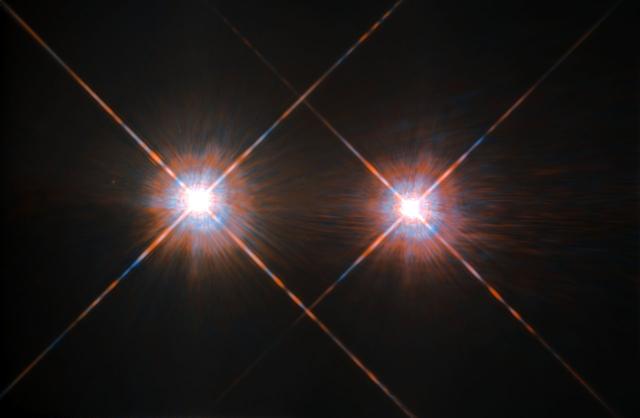
Proxima Centauri b
extrasolar planet
%20(weic2309a).jpg)
TRAPPIST-1 b
TRAPPIST-1b is a terrestrial, Earth-sized exoplanet orbiting around the ultra-cool dwarf star TRAPPIST-1, located away from Earth in the constellation of Aquarius. The planet was detected using the transit method, where a planet dims the host star's light as it passes in front of it. It was first announced on May 2, 2016, and later studies were able to refine its physical parameters.

TRAPPIST-1 d
TRAPPIST-1d is a small exoplanet (about 40 percent the mass of the Earth), which orbits on the inner edge of the habitable zone of the ultracool dwarf star TRAPPIST-1, located away from Earth in the constellation of Aquarius. The exoplanet was found by using the transit method. The first signs of the planet were announced in 2016, but it was not until the following years that more information concerning the probable nature of the planet was obtained. TRAPPIST-1d is the second-least massive planet of the system. It receives just 4.3% more sunlight than Earth, placing it on the inner edge of the
.gif)
KELT-9 b
KELT-9b, also designated HD 195689 b, is an exoplanet and ultra-hot Jupiter that orbits the late B-type/early A-type star KELT-9, located about 670 light-years from Earth. Detected using the Kilodegree Extremely Little Telescope, the discovery of KELT-9b was announced in 2016. As of June 2017, it is the hottest known exoplanet.

TRAPPIST-1 c
TRAPPIST-1c is a mainly rocky exoplanet orbiting around the ultracool dwarf star TRAPPIST-1, located away from Earth in the constellation Aquarius. It is the third most massive and third largest planet of the system, with about 131% the mass and 110% the radius of Earth. Its density indicates a primarily rocky composition, and observations by the James Webb Space Telescope announced in 2023 suggests against a thick CO2 atmosphere, however this does not exclude a thick abiotic oxygen-dominated atmosphere as is hypothesized to be common around red dwarf stars.
Kepler-1625 b
Kepler-1625b is a super-Jupiter exoplanet orbiting the Sun-like star Kepler-1625 about away in the constellation of Cygnus. The large gas giant is approximately the same radius as Jupiter, and orbits its star every 287.4 days. In 2017, hints of a Neptune-sized exomoon in orbit of the planet were found using photometric observations collected by the Kepler Mission. Further evidence for a Neptunian moon was found the following year using the Hubble Space Telescope, where two independent lines of evidence constrained the mass and radius to be Neptune-like. The mass-signature has been independentl
Kepler-1638 b
REDIRECT Kepler-1638#Planetary system
1638b
Category:Exoplanets discovered in 2016
Category:Transiting exoplanets
Category:Super-Earths in the habitable zone
Kepler-1229 Ab
| eccentricity = ~0
| period = 86.829 d
| inclination = ~89.5
| star = Kepler-1229 (KOI-2418)
| mean_radius =
| mass = ~2.7
| single_temperature =
BD+20594b
extrasolar planet

Kepler-1647 b
Kepler-1647b (sometimes named Kepler-1647(AB)b to distinguish it from the secondary component) is a circumbinary exoplanet that orbits the binary star system Kepler-1647, located from Earth in the constellation Cygnus. It was announced on June 13, 2016, in San Diego at a meeting of the American Astronomical Society. It was detected using the transit method, when it caused the dimming of the primary star, and then again of the secondary star blended with the primary star eclipse.
The first transit of the planet was identified in 2012, but at the time the single event was not enough to rule out

K2-72e
K2-72e (also known by its EPIC designation EPIC 206209135.04), is a confirmed exoplanet, likely rocky, orbiting within the habitable zone of the red dwarf star K2-72, the outermost of four such planets discovered in the system by NASA's Kepler spacecraft on its "Second Light" mission. It is located about 217.1 light-years (66.56 parsecs, or nearly km) away from Earth in the constellation of Aquarius. The exoplanet was found by using the transit method, in which the dimming effect that a planet causes as it crosses in front of its star is measured.
HIP 41378 f
extrasolar planet
Kepler-1544 b
Kepler-1544b is a potentially habitable (optimistic sample) exoplanet announced in 2016 and located 1138 light years away, in the constellation of Cygnus.
__TOC__
list of exoplanets discovered in 2016
Wikimedia list article
K2-33 b
K2-33b (also known by its EPIC designation EPIC 205117205.01) is a very young super-Neptune exoplanet, orbiting the pre-main-sequence star K2-33. It was discovered by NASA's Kepler space telescope on its "Second Light" mission. It is located about away from Earth in the constellation of Scorpius. The exoplanet was found by using the transit method, in which the dimming effect that a planet causes as it crosses in front of its star is measured.
Gliese 536 b
extrasolar planet
Kepler-1520b
Kepler-1520b (initially published as KIC 12557548 b), is a confirmed exoplanet orbiting the K-type main sequence star Kepler-1520. It is located about 2,020 light-years (620 parsecs) away from Earth in the constellation of Cygnus. The exoplanet was found by using the transit method, in which the dimming effect that a planet causes as it crosses in front of its star is measured. The planet was previously proposed in 2012 when reports of its host star recorded drops in its luminosity varying from 0.2% to 1.3%, which indicated a possible planetary companion rapidly disintegrating. In 2015, the pl
KELT-11b
KELT-11b is an exoplanet orbiting around the yellow subgiant star KELT-11 (HD 93396) about 320 light-years away from Earth. It is an inflated planet, one of the "puffiest planets" (lowest-density) known, as a result of its close orbiting distance with its parent star. It has a radius 1.37 times that of Jupiter, but only 19% of its mass. It was discovered in 2016.
HR 2562 b
astronomical body orbiting the star HR 2562 A
OGLE-2007-BLG-349(AB)b
OGLE-2007-BLG-349Lb is a circumbinary extrasolar planet about 8,000 light-years away in the constellation of Sagittarius. It is the first circumbinary exoplanet to be discovered using the microlensing method of detecting exoplanets.
K2-25 b
REDIRECT K2-25
WASP-127b
REDIRECT WASP-127
Kepler-20 Ag
REDIRECT Kepler-20
Qatar-5b
Qatar-5b is a Hot Jupiter orbiting the star Qatar-5 located in Andromeda constellation. It orbits its star every 2.87 days. It was discovered in 2016 by the Qatar Exoplanet Survey (QES).