Category
page 1Explorers Program

Explorer 1
first satellite of the United States

Wilkinson Microwave Anisotropy Probe
NASA Cosmic Microwave Background probe launched in 2001
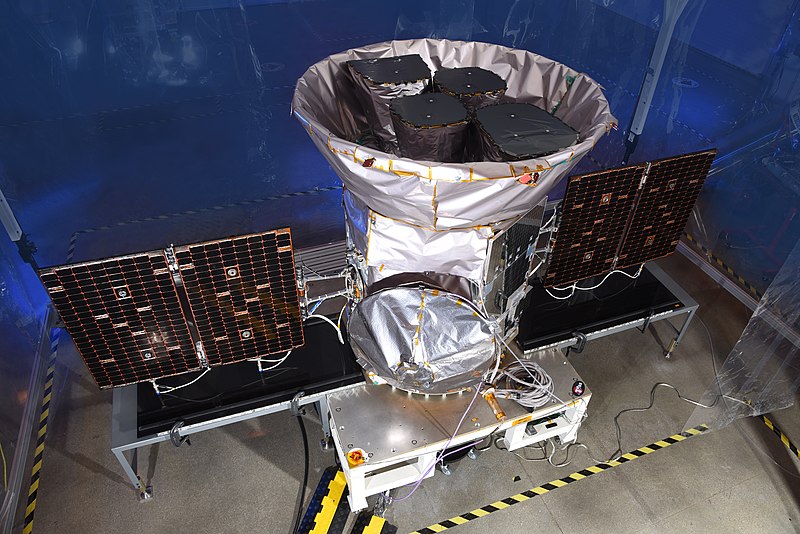
Transiting Exoplanet Survey Satellite
NASA satellite of the Explorer program
Wide-field Infrared Survey Explorer
decommissioned American infrared space telescope
Cosmic Background Explorer
NASA space observatory
Neil Gehrels Swift Observatory
mission concerning a space observatory in low earth orbit measuring gamma ray radiation

Galaxy Evolution Explorer
Galaxy Evolution Explorer (GALEX or Explorer 83 or SMEX-7) was a NASA orbiting space telescope designed to observe the universe in ultraviolet wavelengths to measure the history of star formation in the universe. In addition to paving the way for future ultraviolet missions, the space telescope allowed astronomers to uncover mysteries about the early universe and how it evolved, as well as better characterize phenomena like black holes and dark matter. GALEX was launched on 28 April 2003 for a 29-month primary mission, which was extended three times before the spacecraft was placed into standb
Interstellar Boundary Explorer
NASA satellite
Explorers Program
United States space exploration program that provides flight opportunities for various investigations from space

Nuclear Spectroscopic Telescope Array
NuSTAR (Nuclear Spectroscopic Telescope Array, also named Explorer 93 and SMEX-11) is a NASA space-based X-ray telescope that uses a conical approximation to a Wolter telescope to focus high energy X-rays from astrophysical sources, especially for nuclear spectroscopy, and operates in the range of 3 to 79 keV.

THEMIS
Time History of Events and Macroscale Interactions during Substorms (THEMIS) mission began in February 2007 as a constellation of five NASA satellites (THEMIS-A through THEMIS-E) to study energy releases from Earth's magnetosphere known as substorms, magnetic phenomena that intensify auroras near Earth's poles. The name of the mission is an acronym alluding to the Titan Themis.

INTEGRAL
thumb|right|Animation of INTEGRAL spacecraft orbit trajectory
The INTErnational Gamma-Ray Astrophysics Laboratory (INTEGRAL) is a retired space telescope for observing gamma rays of energies up to 8 MeV. It was launched by the European Space Agency (ESA) into Earth orbit in 2002, and is designed to provide imaging and spectroscopy of cosmic sources. In the MeV energy range, it is the most sensitive gamma ray observatory in space. It is sensitive to higher energy photons than X-ray instruments such as NuSTAR, the Neil Gehrels Swift Observatory, XMM-Newton, and lower than other gamma-ray instrum
Advanced Composition Explorer
NASA scientific satellite
Uhuru
first satellite launched specifically for the purpose of X-ray astronomy
Explorer 2
American research satellite, lost during a launch vehicle failure

Transition Region And Coronal Explorer
Transition Region and Coronal Explorer (TRACE, or Explorer 73, SMEX-4) was a NASA heliophysics and solar observatory designed to investigate the connections between fine-scale magnetic fields and the associated plasma structures on the Sun by providing high-resolution images and observation of the solar photosphere, the transition region, and the solar corona. A main focus of the TRACE instrument was the fine structure of coronal loops low in the solar atmosphere. TRACE was the third spacecraft in the Small Explorer program, launched on 2 April 1998, and obtained its last science image on 21 J
International Cometary Explorer
American magnetospheric research satellite
Reuven Ramaty High Energy Solar Spectroscopic Imager
space observatory which reentered in 2023
Interface Region Imaging Spectrograph
NASA solar observation satellite
Far Ultraviolet Spectroscopic Explorer
decommissioned NASA space observatory
Rossi X-ray Timing Explorer
NASA space observatory
Explorer 3
American military research satellite

SPHEREx
SPHEREx (Spectro-Photometer for the History of the Universe, Epoch of Reionization, and Ices Explorer) is a near-infrared space observatory that is performing an all-sky survey to measure the near-infrared spectra of approximately 450 million galaxies. In February 2019, SPHEREx was selected by NASA for its next Medium-Class Explorers mission, beating out two competing mission concepts: Arcus and FINESSE. SPHEREx launched on 12 March 2025 on a Falcon 9 Block 5 rocket alongside the PUNCH microsatellites from Vandenberg Space Force Base. The principal investigator is James Bock at California Inst
Extreme Ultraviolet Explorer
NASA space telescope for ultraviolet astronomy
Explorer 4
American research satellite launched in 1958
High Energy Transient Explorer
space observatory
Explorer 6
NASA earth science satellite launched in 1959
X-ray Imaging and Spectroscopy Mission
Japanese X-ray space telescope
Explorer 49
satellite launched by NASA for long range radio astronomy
Small Astronomy Satellite 2
NASA space observatory launched on 1972
Explorer 8
American research satellite
Explorer 11
space observatory
Wide-Field Infrared Explorer
former NASA space observatory
Explorer 7
1959 research satellite
Explorer 35
space probe
Submillimeter Wave Astronomy Satellite
NASA space observatory
Cosmic Hot Interstellar Plasma Spectrometer
NASA satellite
Fast Auroral Snapshot Explorer
NASA satellite of the Explorer program
Aeronomy of Ice in the Mesosphere
NASA satellite of the Explorer program
Solar Anomalous and Magnetospheric Particle Explorer
NASA space observatory
IMAGE
NASA geomagnetic satellite

Imaging X-ray Polarimetry Explorer
Imaging X-ray Polarimetry Explorer, commonly known as IXPE or SMEX-14, is a space observatory with three identical telescopes designed to measure the polarization of cosmic X-rays of black holes, neutron stars, and pulsars. The observatory, which was launched on 9 December 2021, is an international collaboration between NASA and the Italian Space Agency (ASI). It is part of NASA's Explorers program, which designs low-cost spacecraft to study heliophysics and astrophysics.
Explorer 17
former NASA research satellite
Explorer 5
United States satellite launched in 1958
Explorer 10
NASA satellite of the Explorer program
Solar Mesosphere Explorer
NASA satellite of the Explorer program
Small Astronomy Satellite 3
NASA space observatory
Explorer 33
American scientific satellite from Explorer programme, forth in the Interplanetary Monitoring Platform series

Neutron Star Interior Composition Explorer
X-ray telescope on the International Space Station
Explorer 18
satellite statunitense appartenente al Programma Explorer
Explorer 9
American satellite
Ionospheric Connection Explorer
NASA atmospheric observation satellite
Explorer 32
former NASA research satellite
EPE-B
former American research satellite
MagSat
joint NASA and USGS satellite for studying Earth's magnetic field
EPE-A
former American research satellite
Student Nitric Oxide Explorer
NASA atmospheric research satellite
EPE-C
former American research satellite
Explorer 20
NASA satellite of the Explorer program
Charge Composition Explorer
AMPTE-Charge Composition Explorer, also called as AMPTE-CCE or Explorer 65, was a NASA satellite designed and tasked to study the magnetosphere of Earth, being launched as part of the Explorer program. The AMPTE (Active Magnetospheric Particle Tracer Explorers) mission was designed to study the access of solar wind ions to the magnetosphere, the convective-diffusive transport and energization of magnetospheric particles, and the interactions of plasmas in space.