Category
page 1Extant Late Devonian first appearances

Amphibia
thumb|250px|Many amphibians—like this Ceratophrys cranwelli—exhibit [[biofluorescence.]]
%20havaiana%20mini%2C%20em%20ambiente%20dom%C3%A9stico%2002.jpg)
fern
The ferns (Polypodiopsida or Polypodiophyta) are a group of vascular plants (land plants with vascular tissues such as xylem and phloem) that reproduce via spores and have neither seeds nor flowers. They differ from non-vascular plants (mosses, hornworts and liverworts) by having specialized transport bundles that conduct water and nutrients from and to the roots, as well as life cycles in which the branched sporophyte is the dominant phase.

Gymnospermae
The gymnosperms ( ; from Ancient Greek γυμνός, gumnós 'naked' and σπέρμα, spérma 'seed', thus 'naked seed') are a group of woody, perennial seed-producing plants, typically lacking the protective outer covering which surrounds the seeds in flowering plants, that include conifers, cycads, Ginkgo, and gnetophytes, forming the clade Gymnospermae. The name is based on the unenclosed condition of their seeds (called ovules in their unfertilized state). The non-encased condition of their seeds contrasts with the seeds and ovules of flowering plants (angiosperms), which are enclosed within an ovary.

lamprey
upright=1.2|thumb|Sea lamprey, Petromyzon marinusthumb|Mouth of a sea lamprey, [[Petromyzon marinus]]
thumb|318x318px|Median plane|Median section of lamprey demonstrating internal anatomy
thumb|Microscopic cross section through the pharynx of a larva from an unknown lamprey species

Dendrobranchiata
Dendrobranchiata is a suborder of decapods, commonly known as prawns (though this may be ambiguous). There are 540 extant species in seven families, and a fossil record extending back to the Devonian. They differ from related animals, such as Caridea and Stenopodidea, by the branching form of the gills (hence their scientific name Dendrobrachiata) and by the fact that they do not brood their eggs, but release them directly into the water. They may reach a length of over and a mass of , and are widely fished and farmed for human consumption.
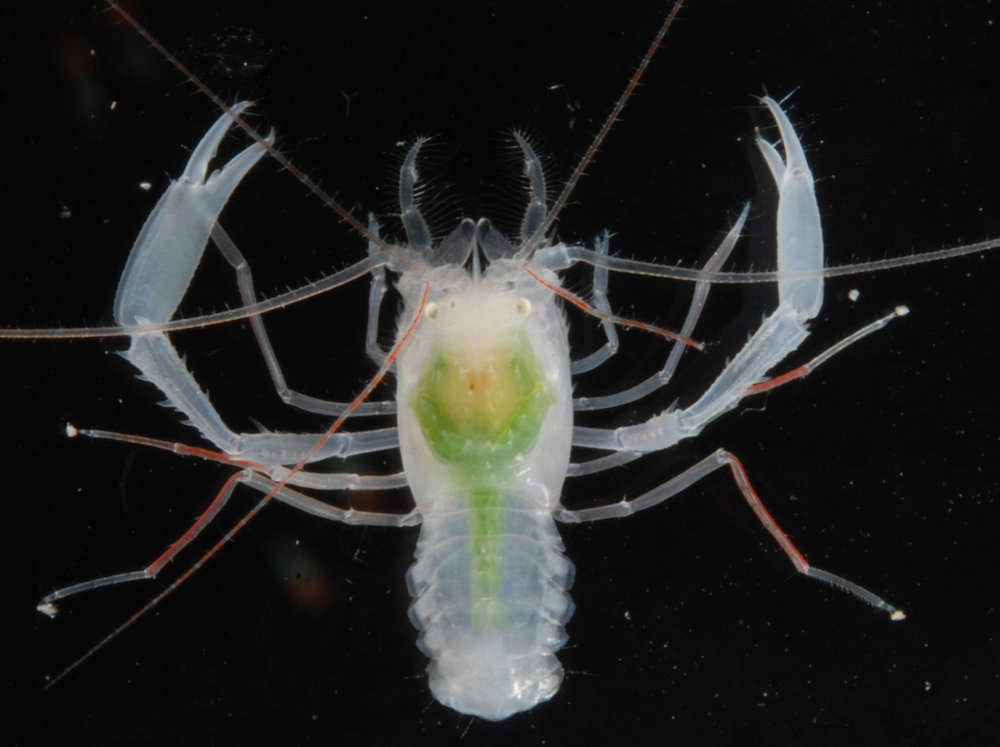
Stenopodidea
The Stenopodidea or boxer shrimps are a small group of decapod crustaceans. Often confused with Caridea shrimp or Dendrobranchiata prawns, they are neither, belonging to their own group.
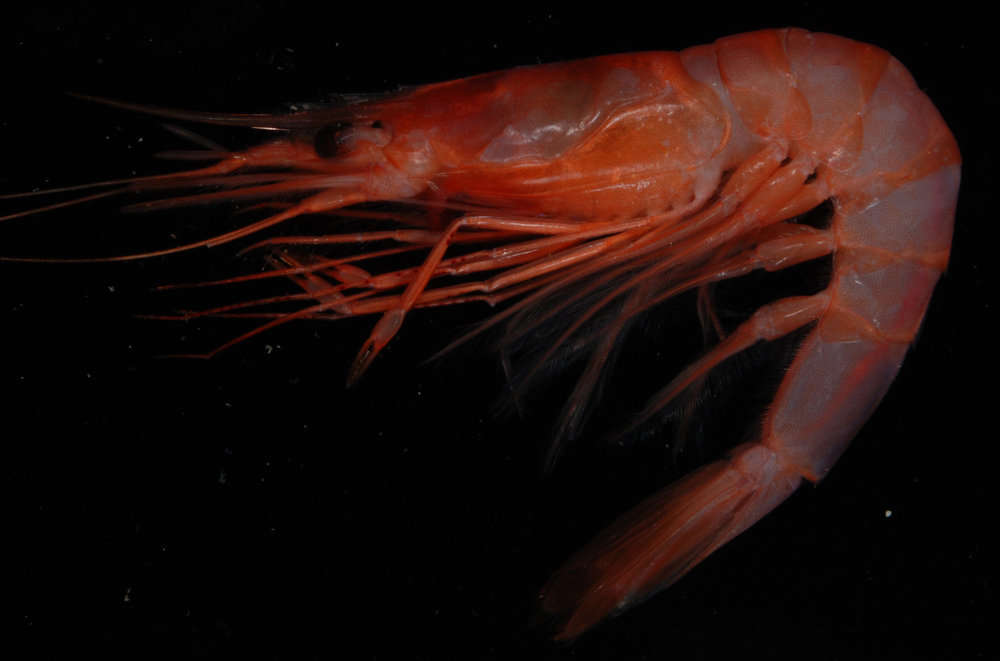
Penaeoidea
Penaeoidea is the larger of the two superfamilies of prawns. It comprises eight families, three of which are known only from fossils. The fossil record of the group stretches back to Aciculopoda, discovered in Famennian sediments in Oklahoma.
† Aciculopodidae (1 genus, 1 species)
† Aegeridae (2 genera, 25 species)
Aristeidae (10 genera, 28 species)
Benthesicymidae (5 genera, 43 species)
† Carpopenaeidae (1 genus, 3 species)
Penaeidae (48 genera, 286 species)
Sicyoniidae (1 genus, 53 species)
Solenoceridae (10 genera, 86 species)
Terebratula
Terebratula is a modern genus of brachiopods with a fossil record dating back to the Late Devonian. These brachiopods are stationary epifaunal suspension feeders and have a worldwide distribution.

Equisetidae
Equisetidae is one of the four subclasses of Polypodiopsida (ferns), a group of vascular plants with a fossil record going back to the Devonian. They are commonly known as horsetails. They typically grow in wet areas, with whorls of needle-like branches radiating at regular intervals from a single vertical stem.

Terebratulidae
Terebratulidae is a family of brachiopods with a fossil record dating back to the Late Devonian. It is subdivided into 11 subfamilies.