Category
page 1Extant Lutetian first appearances
%20male%20in%20flight.jpg)
butterfly
.jpg)
Carnivora
Carnivora ( ) is an order of placental mammals specialised primarily in eating flesh, whose members are formally referred to as carnivorans. The order Carnivora is the sixth largest order of mammals, comprising at least 279 species. Carnivorans are found on every major landmass and in a variety of habitats, ranging from the cold polar regions of Earth to the hyper-arid region of the Sahara Desert and the open seas. Carnivorans exhibit a wide array of body plans, varying greatly in size and shape.

Charadriiformes
Charadriiformes (, from Charadrius, the type genus of family Charadriidae) is a diverse order of small to medium-large birds. It includes about 390 species and has members in all parts of the world. Most charadriiform birds live near water and eat invertebrates or other small animals; however, some are pelagic (seabirds), others frequent deserts, and a few are found in dense forest. Members of this group can also collectively be referred to as shorebirds.

Accipitriformes
The Accipitriformes (; ) are an order of birds that includes most of the diurnal birds of prey, including hawks, eagles,
vultures, kites, ospreys and secretary birds, but not falcons or seriemas. The generally nocturnal owls, also considered birds of prey, are a separate order from the accipitriformes.

Camelidae
Camelidae is a family of mammals belonging to the ungulate order Artiodactyla (even-toed ungulates) and the only living family in the suborder Tylopoda. The seven extant species of camelid are divided into two tribes, Camelini, including dromedary camels, Bactrian camels and wild Bactrian camels, and Lamini, including llamas, alpacas, vicuñas, and guanacos.

Tetraodontidae
thumb|right|Deflated Valentin's sharpnose puffer|Valentinni's sharpnose puffer
Tetraodontidae is a family of marine and freshwater fish in the order Tetraodontiformes. The family includes many familiar species variously called pufferfishes, puffers, balloonfishes, blowfishes, blowers, blowies, bubblefishes, globefishes, swellfishes, toadfishes, toadies, botetes, toadle, honey toads, sugar toads, and sea squabs. They are morphologically similar to the closely related porcupinefish, which have large external spines (unlike the thinner, hidden spines of the Tetraodontidae, which are only visible

Caniformia
Caniformia is a suborder within the order Carnivora consisting of "dog-like" carnivorans. They include dogs (wolves, foxes, etc.), bears, raccoons, mustelids, and pinnipeds (seals, walruses and sea lions). The center of diversification for the Caniformia is North America and northern Eurasia. Caniformia stands in contrast to the other suborder of Carnivora, the Feliformia ("cat-like" carnivorans), the center of diversification of which was in Africa and southern Asia.

Cichlidae
Cichlids () are a large, diverse, and widespread family of percomorph fish in the family Cichlidae, order Cichliformes. At least 1,760 species have been scientifically described, making it one of the largest vertebrate families, with only the Cyprinidae being more speciose. New species are discovered annually, and many species remain undescribed. The actual number of species is therefore unknown, with estimates varying between 2,000 and 3,000. They are native to the Neotropics, Africa (including Madagascar), the Middle East, and the Indian subcontinent, although some species have been int
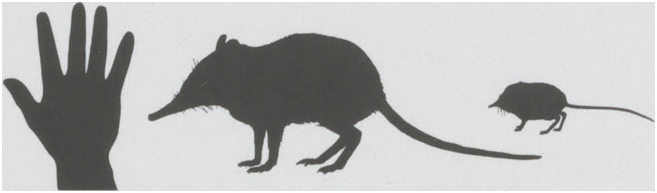
Macroscelididae
family of mammals
.jpg)
Tarsier
Tarsiers ( ) are haplorhine primates of the family Tarsiidae, which is the lone extant family within the infraorder Tarsiiformes. Although the group was prehistorically more globally widespread, all of the existing species are restricted to Maritime Southeast Asia, predominantly in Brunei, Indonesia, Malaysia and the Philippines.thumb|Tarsier image inside National Museum of the Philippines|Philippine National Museum of Natural HistoryThey are found primarily in forested habitats, especially forests that have liana, since the vine gives tarsiers vertical support when climbing trees.

golden mole
family of mammals

Lophius
Members of the genus Lophius, also sometimes called monkfish, fishing-frogs, frog-fish, and sea-devils, are various species of lophiid anglerfishes found in the Atlantic and Indian Oceans. Lophius is known as the "monk" or "monkfish" to the North Sea and North Atlantic fishermen, a name which also belongs to Squatina squatina, the
angelshark, a type of shark. The North European species is Lophius piscatorius, and the Mediterranean species is Lophius budegassa.

Polypterus
Polypterus is a genus of freshwater fish in the bichir family (Polypteridae) of order Polypteriformes. The type species is the Nile bichir (P. bichir). Fish in this genus live in various areas in Africa. Polypterus is the only known vertebrate to have lungs, but no trachea.

Parsley frog
genus of amphibians
Agroecomyrmecinae
Agroecomyrmecinae is a subfamily of ants containing two extant and two fossil genera. The subfamily was originally classified in 1930 by Frank M. Carpenter as Agroecomyrmecini, a Myrmicinae tribe. Bolton raised the tribe to subfamily status in 2003, suggesting that Agroecomyrmecinae might be the sister taxon to Myrmicinae. It has since been discovered to be one of the earliest lineages of ants, a clade from the basal polytomy for all ants. In 2014, the subfamily was expanded to two tribes. The tribe Ankylomyrmini was moved from the subfamily Myrmicinae to Agroemyrmecinae.
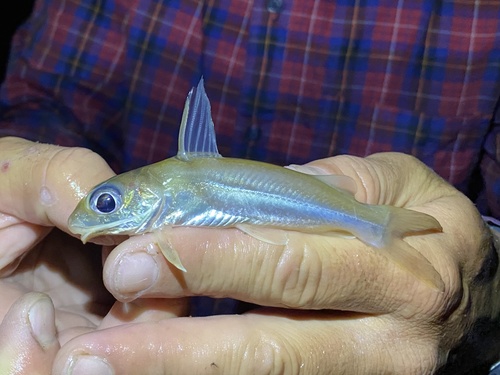
Chrysichthys
Chrysichthys is a genus of claroteid catfishes native to Africa. Two fossil species are known. Chrysichthys macrotis, Van Neer, 1994, is known from the Miocene-Pliocene of the Albertine Rift in Uganda and Chrysichthys mahengeensis, Murray & Budney, 2003, is known from the Eocene of the Mahenge Formation, Tanzania.
Orthopristis
Orthopristis is a genus of marine ray-finned fish, grunts belonging to family Haemulidae. They are found in the Atlantic and Pacific coasts of the Americas.

Justitia
genus of crustaceans
Coronuloidea
Coronuloidea is a superfamily of barnacles in the order Balanomorpha.
Epiaeschna
Epiaeschna is a genus of darners in the dragonfly family Aeshnidae. A single extant species, E. heros, is known from eastern North America, in addition to six fossil species known from Eurasia, suggesting the genus had a much wider distribution in the past.
thumb|Epiaeschna heros
Hexapus
Hexapus is a genus of crabs in the family Hexapodidae. It contains only three extant species found in the Indo-West Pacific. They inhabit the intertidal and subtidal areas of shorelines.
Heroini
Heroini is a fish tribe from the Cichlasomatinae subfamily in the family Cichlidae (cichlids). All cichlids native to the Greater Antilles, United States (southern Texas), Mexico and northern Central America are members of this tribe. It also includes most cichlid species in southern Central America (where the only non-Heroini cichlids are Andinoacara and Geophagus) and several species from South America (where several other tribes exist). A large percentage of its species were formerly placed in the genus Cichlasoma (itself now placed in the tribe Cichlasomatini) but have since been moved to