Category
page 1Extinct animals of India
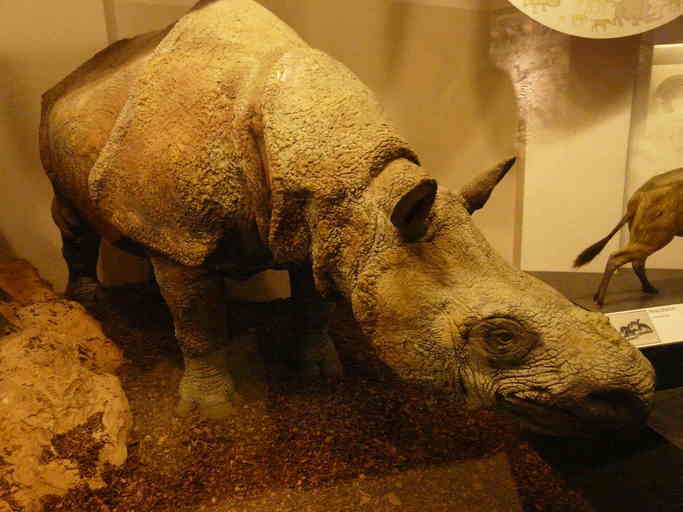
Javan rhinoceros
species of mammal

Gigantopithecus
Gigantopithecus ( ) is an extinct genus of ape that lived in central to southern China from 2 million to approximately 200,000–300,000 years ago during the Early to Middle Pleistocene, represented by one species, Gigantopithecus blacki. The first remains of Gigantopithecus, two third-molar teeth, were identified in a drugstore by anthropologist Ralph von Koenigswald in 1935 in England, who subsequently described the ape. In 1956, the first mandible and more than 1,000 teeth were found in Liucheng, and numerous more remains have since been found in at least 16 sites. Only teeth and four mandibl

Ichthyolestes
Ichthyolestes (meaning "fish robber" from Ancient Greek ἰχθύς (ikhthús), meaning "fish", and λῃστής (lēistḗs), meaning "robber") is an extinct genus of pakicetid cetacean endemic to the northern Indian subcontinent during the Lutetian age of the Eocene. It is monotypic, with I. pinfoldi as the only species.
Himalayacetus subathuensis
Himalayacetus is an extinct genus of carnivorous aquatic mammal of the family Ambulocetidae. The holotype was found in Himachal Pradesh, India, (: paleocoordinates ) in what was the remnants of the ancient Tethys Ocean during the Early Eocene. This makes Himalayacetus the oldest archaeocete known, extending the fossil record of whales some 3.5 million years.
Vasuki indicus
extinct species of giant snake

Northern Sumatran rhinoceros
subspecies of the endangered species of Dicerorhinus Sumatrensis
Bharatisiren
Bharatisiren is an extinct genus of mammal which existed in what is now India during the early Miocene (Aquitanian) period.
Deccanolestes
Deccanolestes is a scansorial, basal Euarchontan from the Late Cretaceous (Maastrichtian) and Paleocene Intertrappean Beds of Andhra Pradesh, India. It may be closely related to Sahnitherium. Deccanolestes has been referred to Palaeoryctidae in the past, but recent evidence has shown that it is either the most basal Euarchontan, as the earliest known Adapisoriculid, or as a stem-afrotherian.
Bharattherium
Bharattherium is a mammal that lived in India during the Maastrichtian (latest Cretaceous) and possibly the Paleocene. The genus has a single species, Bharattherium bonapartei. It is part of the gondwanathere family Sudamericidae, which is also found in Madagascar and South America during the latest Cretaceous. The first fossil of Bharattherium was discovered in 1989 and published in 1997, but the animal was not named until 2007, when two teams independently named the animal Bharattherium bonapartei and Dakshina jederi. The latter name is now a synonym. Bharattherium is known from a total of e
Bos primigenius namadicus
subspecies of mammal
Babiacetus
Babiacetus is an extinct genus of early cetacean that lived during the late Lutetian middle Eocene of India ().
It was named after its type locality, the Harudi Formation in the Babia Hills (: paleocoordinates ), Kutch District, Gujarat, India.
Indohyaenodon
Indohyaenodon ("indian Hyaenodon") is an extinct genus of placental mammals from family Indohyaenodontidae within extinct order Hyaenodonta, that lived during the early Eocene in India.