Category
page 1Extinct apex predators

Neanderthal
Neanderthals ( ; Homo neanderthalensis or sometimes Homo sapiens neanderthalensis) are an extinct group of archaic humans who inhabited Europe and Western and Central Asia during the Middle to Late Pleistocene. Neanderthal extinction occurred roughly 40,000 years ago with the immigration of modern humans (Cro-Magnons), but Neanderthals in Gibraltar may have persisted for thousands of years longer.

Tyrannosaurus
Tyrannosaurus () is a genus of large theropod dinosaur. The type species Tyrannosaurus rex ( meaning 'king' in Latin), often shortened to T. rex or colloquially t-rex, is one of the best represented theropods. It lived throughout what is now western North America, on what was then an island continent known as Laramidia. Tyrannosaurus had a much wider range than other tyrannosaurids. Fossils are found in a variety of geological formations dating to the late Maastrichtian age of the late Cretaceous period, 69 to 66 million years ago, with isolated specimens possibly indicating an earlier or

Homo erectus
species of archaic humans believed to be extinct in a pure form

thylacine
The thylacine (; binomial name Thylacinus cynocephalus), also commonly known as the Tasmanian tiger or Tasmanian wolf, is an extinct species of carnivorous marsupial that was native to the Australian mainland and the islands of Tasmania and New Guinea. The thylacine died out in New Guinea and mainland Australia around 3,600–3,200 years ago, possibly because of the introduction of the dingo, whose earliest record dates to around the same time, but which never reached Tasmania. Prior to European settlement, around 5,000 remained in the wild on the island of Tasmania. Beginning in the nineteenth

Haast's Eagle
extinct species of eagle
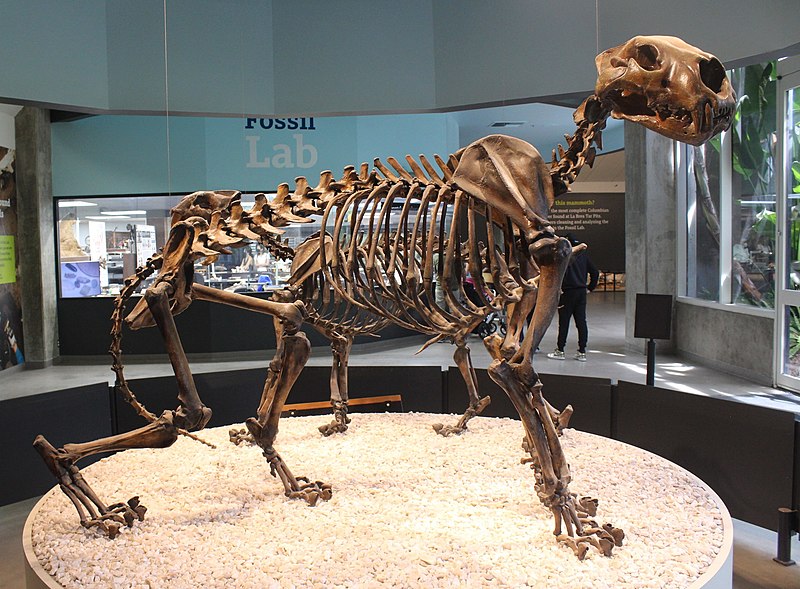
American lion
extinct species of big cats (Pantherinae)

Mosasaurus
Mosasaurus (; "lizard of the Meuse River") is the type genus (defining example) of the Mosasauridae, an extinct group of aquatic squamate reptiles. It lived from about 82 to 66 million years ago during the Campanian and Maastrichtian stages of the Late Cretaceous. The genus was one of the first Mesozoic marine reptiles known to science—the first fossils of Mosasaurus were found as skulls in a chalk quarry near the Dutch city of Maastricht in the late 18th century, and were initially thought to be crocodiles or whales. One skull discovered around 1780 was famously nicknamed the "great animal of

Anomalocaris
Anomalocaris (from Ancient Greek , meaning "unlike", and , meaning "shrimp", with the intended meaning "unlike other shrimp") is an extinct genus of radiodont, an order of early-diverging stem-group marine arthropods. It is best known from the type species A. canadensis, found in the Stephen Formation (particularly the Burgess Shale) of British Columbia, Canada. The other named species A. daleyae is known from the somewhat older Emu Bay Shale of Australia. Other unnamed Anomalocaris species are known from China and the United States.

Varanus priscus
Megalania (Varanus priscus) is an extinct species of giant monitor lizard, part of the megafaunal assemblage that inhabited Australia during the Pleistocene. It is the largest terrestrial lizard known to have existed, but the fragmentary nature of known remains make estimates highly uncertain. Studies suggest that most known specimens would have reached around in body length excluding the tail, while some individuals would have been significantly larger, reaching sizes around , or perhaps even in total length.

Kronosaurus
Kronosaurus ( ) is an extinct genus of large short-necked pliosaur that lived during the Aptian to Albian stages of the Early Cretaceous in what is now Australia. The first known specimen was received in 1899 and consists of a partially preserved mandibular symphysis, which was first thought to come from an ichthyosaur according to Charles De Vis. However, it was in 1924 that Albert Heber Longman formally described this specimen as the holotype of an imposing pliosaurid, to which he gave the scientific name K. queenslandicus, which is still the only recognized species nowadays. The genus name,

Titanis
Titanis (meaning "Titan" for the Titans of Greek mythology) is a genus of phorusrhacid ("terror birds", a group originating in South America), an extinct family of large, predatory birds, in the order Cariamiformes that inhabited the United States from the early Pliocene to early Pleistocene. The first fossils were unearthed by amateur archaeologists Benjamin Waller and Robert Allen from the Santa Fe River in Florida and were named Titanis walleri by ornithologist Pierce Brodkorb in 1963, the species name honoring Waller. The holotype material is fragmentary, consisting of only an incomplete r

Tylosaurus
Tylosaurus (; "knob lizard") is a genus of russellosaurine mosasaur (an extinct group of predatory marine lizards) that lived about 92 to 66 million years ago during the Turonian to Maastrichtian stages of the Late Cretaceous. Its fossils have been found primarily around North Atlantic Ocean including in North America, Europe, and Africa.
Panthera spelaea
species of extinct mammal (fossil)

Arctodus
Arctodus is an extinct genus of short-faced bears that inhabited North America during the Pleistocene (about 2.6 Mya until 12,800 years ago). The two recognized species are the lesser short-faced bear (Arctodus pristinus) and the giant short-faced bear (Arctodus simus). Of these species, A. simus was larger, is known from more complete remains, and is considered one of the best-known members of North America's extinct Ice Age megafauna. A. pristinus was largely restricted to the Early Pleistocene of the eastern United States, whereas A. simus had a broader range, with most finds being from the

Livyatan
Livyatan is an extinct genus of macroraptorial sperm whale containing one known species: L. melvillei. The genus name was inspired by the biblical sea monster Leviathan, and the species name by Herman Melville, the author of the famous novel Moby-Dick about a white bull sperm whale. Herman Melville often referred to whales as "Leviathans" in his book. It is mainly known from the Pisco Formation of Peru during the Tortonian stage of the Miocene epoch, about 9.9–8.9 million years ago (mya); however, finds of isolated teeth from other locations such as Chile, Argentina, the United States (Califor

Thylacoleo
Thylacoleo ("pouch lion") is an extinct genus of carnivorous marsupials that lived in Australia from the late Pliocene to the Late Pleistocene (until around 40,000 years ago), often known as marsupial lions. They were the largest and last members of the family Thylacoleonidae, occupying the position of apex predator within Australian ecosystems. The largest and last species, Thylacoleo carnifex, had an estimated average weight of , approaching the weight of a modern lioness (Panthera leo).

Ornimegalonyx
The Cuban giant owl or cursorial giant owl (Ornimegalonyx) is an extinct genus of giant owl that measured in height. It is closely related to the many species of living owls of the genus Strix. It was a flightless or nearly flightless bird and it is believed to be the largest owl that ever existed. It lived on the island of Cuba.

megalneusaure
Megalneusaurus is a genus of large pliosaurid plesiosaur from the Late Jurassic of North America. It was provisionally described as a species of Cimoliosaurus by the geologist Wilbur Clinton Knight in 1895, before being given its own genus by the same author in 1898. The only known species is M. rex, known from several specimens mainly found in the Redwater Shale Member, within the Sundance Formation, Wyoming, United States. A specimen discovered in the Naknek Formation in southern Alaska was referred to the genus in 1994. The loss of most fossils has led some paleontologists to consider the g

Quinkana
Quinkana is an extinct genus of mekosuchine crocodylians that lived in Australia from about 25 million to about 10,000 years ago, with the majority of fossils having been found in Queensland. Four species are currently recognized, all of which have been named between 1981 and 1997. The two best understood species are Q. fortirostrum, the type species, and Q. timara, a more gracile form from the Miocene. The other two species, Q. babarra and Q. meboldi, from the Pliocene and Oligocene respectively, are only known from a few poorly preserved bone fragments. The name Quinkana comes from the "Quin