Category
page 1Extragalactic astronomy

cosmic dust
dust floating in space

Hubble sequence
morphological classification scheme for galaxies invented by Edwin Hubble
galaxy morphological classification
system for categorizing galaxies based on how they look like
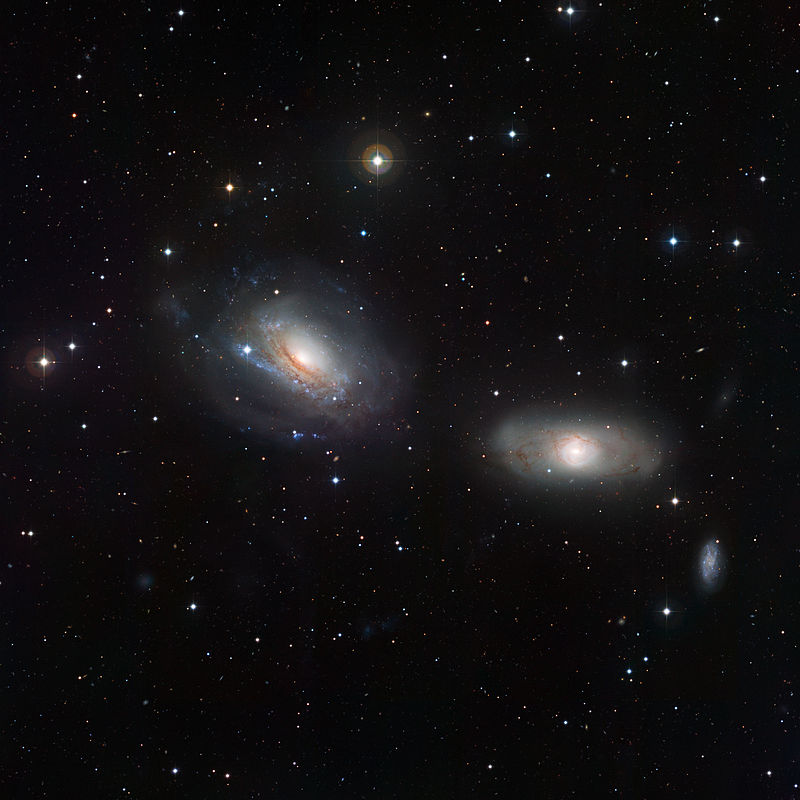
interacting galaxy
individual galaxy whose gravitational field disturbs another galaxy

extragalactic astronomy
astronomy dealing with objects outside the Milky Way
extinction
in astronomy, the absorption and scattering of electromagnetic radiation by dust and gas between an emitting astronomical object and the observer
satellite galaxy
galaxy that orbits a larger galaxy due to gravitational attraction
intergalactic star
star not located within any galaxy
extragalactic planet
planet that is outside the Milky Way Galaxy
galactic tide
tidal force experienced by objects subject to the gravitational field of a galaxy
Tully–Fisher relation
trend in astronomy
intergalactic dust
cosmic dust in between galaxies in intergalactic space
supergalactic coordinate system
coordinate system
intracluster medium
superheated plasma that permeates a galaxy cluster
peculiar velocity
velocity of an object relative to a rest frame
density wave theory
theory to explain the spiral arm structure of spiral galaxies
Galactic corona
geographic region
velocity dispersion
in astronomy, the statistical dispersion of velocities about the mean velocity for a cluster of stars or galaxies
MilkyWay@home
MilkyWay@home is a volunteer computing project in the astrophysics category, running on the Berkeley Open Infrastructure for Network Computing (BOINC) platform. Using spare computing power from over 38,000 computers run by over 27,000 active volunteers , the MilkyWay@home project aims to generate accurate three-dimensional dynamic models of stellar streams in the immediate vicinity of the Milky Way. With SETI@home and Einstein@home, it is the third computing project of this type that has the investigation of phenomena in interstellar space as its primary purpose. Its secondary objective is to

Faber–Jackson relation
empirical power-law relation between the luminosity and the central stellar velocity dispersion of elliptical galaxy
Great Observatories Origins Deep Survey
astronomical survey that combines observations from 3 great NASA observatories
Fundamental plane
which shows an empirical relationship among mean surface brightness, velocity dispersion and effective radius of an elliptical galaxy
Diffuse extragalactic background radiation
Photon field that fills our universe
Cooling flow
cooling of the intracluster medium in galaxy clusters
correlation function
function that describes the distribution of galaxies in the universe