Category
page 1Federalism

federation
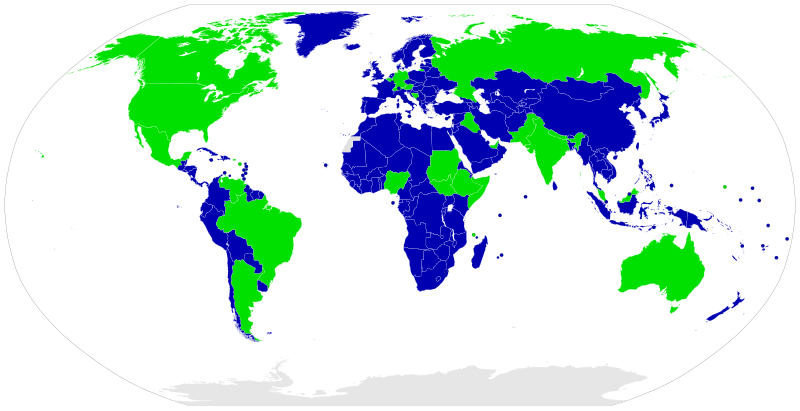
[[File:Map of unitary and federal states.svg|thumb|upright=1.7|
federalism
[[File:Map of unitary and federal states.svg|thumb|upright=1.5|

confederation
A confederation (also known as a confederacy or league) is a political union of sovereign states or chiefdoms united for purposes of common action. Usually created by a treaty, confederations of states tend to be established for dealing with critical issues, such as defence, foreign relations, internal trade or currency, with the central government being required to provide support for all its members. Confederalism represents a main form of intergovernmentalism, defined as any form of interaction around states that takes place on the basis of sovereign independence or government.
federated state
territorial and constitutional community forming part of a federal union
federal republic
federation of states or territories with a republican form of government

federal district
title for certain administrative divisions in various federations

foederati
Foederati ( ; singular: foederatus ) were peoples and cities bound by a treaty, known as foedus, with Rome. During the Roman Republic, the term identified the socii, but during the Roman Empire, it was used to describe foreign states, client kingdoms or barbarian tribes to which the empire provided benefits in exchange for military assistance. The term was also used, especially under the empire, for groups of barbarian mercenaries of various sizes who were typically allowed to settle within the empire.
subsidiarity
Subsidiarity is a principle of social organization that holds that social and political issues should be dealt with at the most immediate or local level that is consistent with their resolution. The Oxford English Dictionary defines subsidiarity as "the principle that a central authority should have a subsidiary function, performing only those tasks which cannot be performed at a more local level". The concept is applicable in the fields of government, political science, neuropsychology, cybernetics, management and in military command (mission command). The OED adds that the term "subsidiarity
political union
union of smaller states

Johannes Althusius
German–Dutch jurist and Calvinist political philosopher and father of modern federalism (1563-1638)
supranational union
political and government system, where several sovereign states give up and share part of their sovereignty for their common governance
federal monarchy
federation of states with a single main monarch and different leaders in the states of the federation
central government
type of government found in unitary states
regional state
form of state
Andrew Duff
British politician (born 1950)

composite monarchy
state consisting of several countries under one ruler

ethnic federalism
type of federal political system
superstate
A superstate is defined as "a large and powerful state formed when several smaller countries unite", or "A large and powerful state formed from a federation or union of nations", or "a hybrid form of polity that combines features of
ancient empires and modern states."
This is distinct from the concept of superpower, although these are sometimes seen together.
state government
government of a federated state (state, province, ...) in a federation
centralized government
type of government in which power is de facto concentrated centrally, rather than disseminated amongst governments of subdivisions
federacy
A federacy is a form of government where one or several substate units enjoy considerably more independence than the majority of the substate units. To some extent, such an arrangement can be considered to be similar to asymmetric federalism.
State List
Part of the Constitution of India
federal judge
judge appointed by a federal level of government as opposed to the state/provincial/local level
Staatenverbund
Staatenverbund is a neologism for a system of multi-level governance in which states work more closely together than in a confederation but, unlike a federal state, retain their own sovereignty. The concept is used in Germany to describe the European Union but has no direct equivalent in other languages. In German jurisprudence, a Staatenverbund is a supranational institution that may exercise sovereign acts (laws, coin money, etc.) but may not independently fix areas where it may exercise this power.
asymmetric federalism
term used to describe imbalance of powers among member states of a federation