Category
page 1Fertility medicine
embryo
An embryo ( ) is the initial stage of development for a multicellular organism. In organisms that reproduce sexually, embryonic development is the part of the life cycle that begins just after fertilization of the female egg cell by the male sperm cell. The resulting fusion of these two cells produces a single-celled zygote that undergoes many cell divisions that produce cells known as blastomeres. The blastomeres are arranged as a solid ball that when reaching a certain size, called a morula, takes in fluid to create a cavity called a blastocoel. The structure is then termed a blastula, or a

infertility
In biology, infertility is the inability of a male and female organism to reproduce. It is usually not the natural state of a healthy organism that has reached sexual maturity, so children who have not undergone puberty, which is the body's start of reproductive capacity, are excluded. It is also a normal state in women after menopause.

in vitro fertilization
assisted reproductive technology procedure (ART)
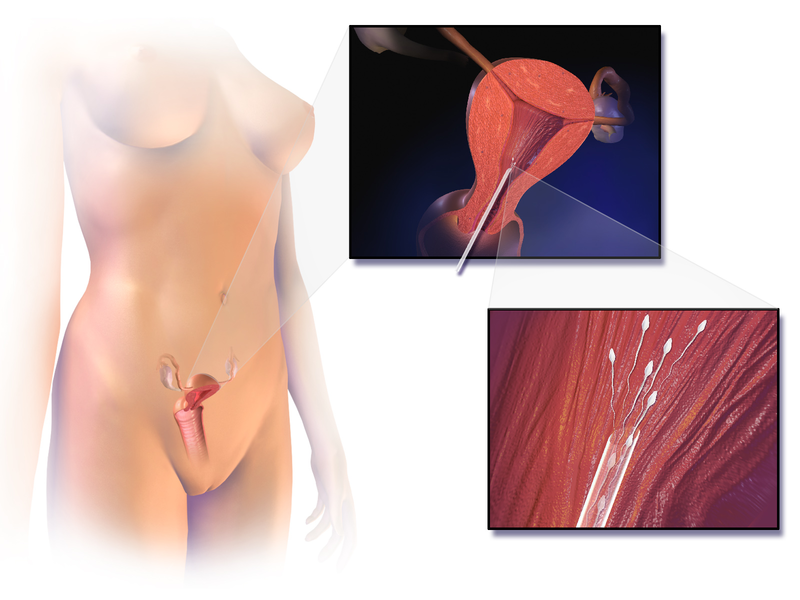
artificial insemination
pregnancy through in vivo fertilization
assisted reproductive technology
methods used to achieve pregnancy by artificial or partially artificial means
sperm bank
facility that collects and stores human semen from sperm donors for use by women who need donor-provided sperm to achieve a pregnancy or pregnancies.
semen analysis
analysis that evaluates certain characteristics of a male's semen
female infertility
diminished or absent ability of a female to achieve conception
Intracytoplasmic sperm injection
in vitro fertilization procedure
egg donation
method of assisted reproduction
fragmentation
form of asexual reproduction
anovulation
Anovulation is when the ovaries do not release an oocyte during a menstrual cycle. Therefore, ovulation does not take place. However, a woman who does not ovulate at each menstrual cycle is not necessarily going through menopause. Chronic anovulation is a common cause of infertility.
reproductive medicine
medicine dealing with prevention, diagnosis and management of reproductive problems
ovarian hyperstimulation syndrome
human disease
cetrorelix
Cetrorelix (, ), or cetrorelix acetate (, ), sold under the brand name Cetrotide, is an injectable gonadotropin-releasing hormone (GnRH) antagonist. A synthetic decapeptide, it is used in assisted reproduction to inhibit premature luteinizing hormone surges The drug works by blocking the action of GnRH upon the pituitary, thus rapidly suppressing the production and action of luteinizing hormone (LH) and follicle-stimulating hormone (FSH). In addition, cetrorelix can be used to treat hormone-sensitive cancers of the prostate and breast (in pre-/perimenopausal women) and some benign gynaecologic
male infertility
inability to father a child
designer baby
human embryo which has been genetically modified
recurrent miscarriage
human disease

Private Life
2018 film by Tamara Jenkins
Ganirelix
Ganirelix acetate (or diacetate), sold under the brand names Orgalutran and Antagon among others, is an injectable competitive gonadotropin-releasing hormone antagonist (GnRH antagonist). It is primarily used in assisted reproduction to control ovulation. The drug works by blocking the action of gonadotropin-releasing hormone (GnRH) upon the pituitary, thus rapidly suppressing the production and action of LH and FSH. Ganirelix is used in fertility treatment to prevent premature ovulation that could result in the harvesting of eggs that are too immature to be used in procedures such as in vitro
embryo transfer
conservation biology
gynecologic ultrasonography
application of medical ultrasonography to the female pelvic organs
Gonadotropin-releasing hormone agonist
drug class affecting sex hormones
Baby M Case
American custody case
Postcoital test
test used for the evaluation of infertility

fertility medication
medications which enhance reproductive fertility
embryo donation
to give up an embryo without compensation
gamete intrafallopian transfer
sperms and eggs are introduced in the fallopian tube for natural fertilization.
semen quality
measure of male fertility
Fertility testing
process for assessing human fertility
Testicular sperm extraction
Surgical procedure
ovulation induction
the stimulation of ovulation by medication
Sarah Martins Da Silva
consultant gynaecologist, obstetrician and researcher
sperm sorting
means of choosing what type of sperm cell (X-chromosome or Y-chromosome) is to fertilize the egg cell
transvaginal oocyte retrieval
technique used in vitro fertilization
Partner-assisted reproduction
assisted reproductive technique
reproductive endocrinology and infertility
surgical subspecialty of obstetrics and gynecology
semen collection
for artificial insemination, or medical study (usually in fertility clinics)
Oocyte selection
procedure performed prior to in vitro fertilization
fertility preservation
providing future reproductive opportunities before a medical treatment with known risk of loss of fertility
Sperm washing
separation of individual sperm from semen
Male infertility crisis
study of infertility in men
posthumous sperm retrieval
procedure in which spermatozoa are extracted from a legally dead person
LGBT reproduction
Theoretical biological reproduction by LGBT people
oncofertility
right|thumb|Placing ovarian tissue strips into the preserving solution
Oncofertility is a subfield that bridges oncology and reproductive research to support fertility preservation in cancer survivors. Cancer treatments, such as chemotherapy, radiation, and surgery, may reduce or destroy a person's ability to have children later in life. Oncofertility also encompasses reproductive issues after cancer treatment, such as family planning, complex contraception, hormonal management throughout survivorship, surrogacy, and adoption. , oncofertility services are available in most countries outside of
fertility fraud
fraud in fertility medicine