Category
page 1Finite element software
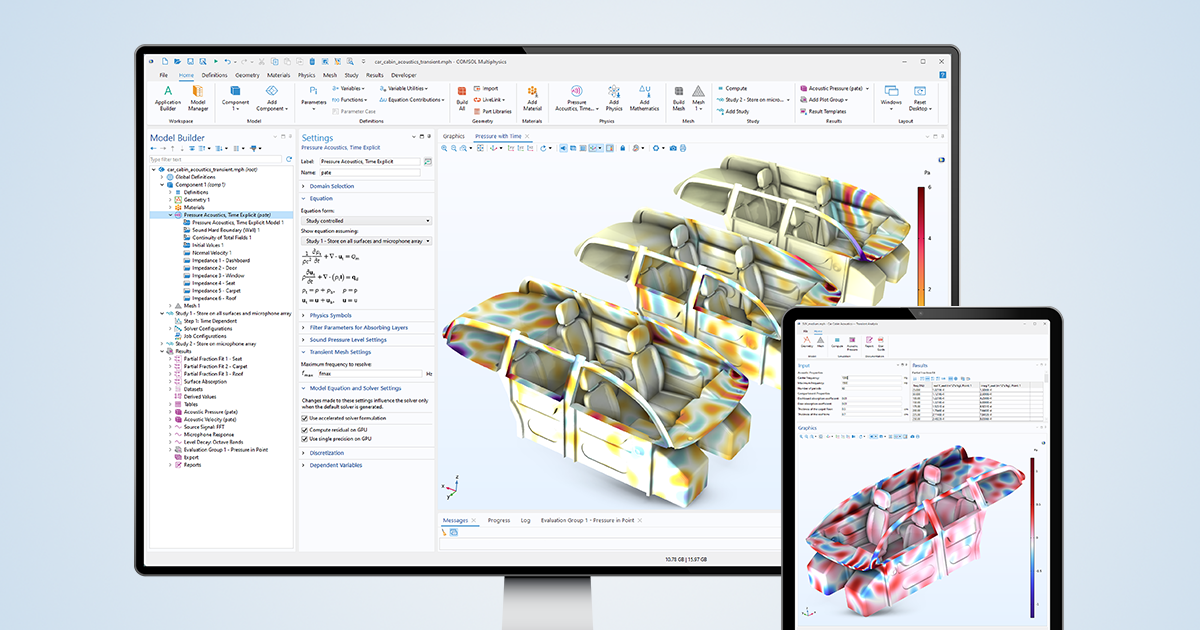
COMSOL Multiphysics
application
Wolfram Language
programming language and environment

Abaqus
Abaqus FEA (formerly ABAQUS) is a software suite for finite element analysis and computer-aided engineering, originally released in 1978. The name and logo of this software are based on the abacus calculation tool.
The Abaqus product suite consists of five core software products:
Abaqus/CAE, or "Complete Abaqus Environment" (a backronym with a root in Computer-Aided Engineering). It is a software application used for both the modeling and analysis of mechanical components and assemblies (pre-processing) and visualizing the finite element analysis result. A subset of Abaqus/CAE including only
Nastran
NASTRAN is a finite element analysis (FEA) program that was originally developed for NASA in the late 1960s under United States government funding for the aerospace industry. The MacNeal-Schwendler Corporation (MSC) was one of the principal and original developers of the publicly available NASTRAN code. NASTRAN source code is integrated in a number of different software packages, which are distributed by a range of companies.
Femap
Femap (Finite Element Modeling And Postprocessing) is an engineering analysis program sold by Siemens Digital Industries Software that is used to build finite element models of complex engineering problems ("pre-processing") and view solution results ("post-processing"). It runs on Microsoft Windows and provides CAD import, modeling and meshing tools to create a finite element model, as well as postprocessing functionality that allows mechanical engineers to interpret analysis results. The finite element method allows engineers to virtually model components, assemblies, or systems to determine
LS-DYNA
LS-DYNA is an advanced general-purpose multiphysics simulation software package developed by the former Livermore Software Technology Corporation (LSTC), which was acquired by Ansys in 2019. While the package continues to contain more and more possibilities for the calculation of many complex, real world problems, its origins and core-competency lie in highly nonlinear transient dynamic finite element analysis (FEA) using explicit time integration. LS-DYNA is used by the automobile, aerospace, construction and civil engineering, military, manufacturing, and bioengineering industries.
Altair Engineering
American Multinational Company
SimScale
SimScale is a computer-aided engineering (CAE) software platform for engineering AI & simulation. SimScale was developed by SimScale GmbH and integrates computational fluid dynamics, finite element analysis, thermal, and electromagnetic simulations with Artificial Intelligence (AI) to enable rapid virtual testing and design exploration. The backend of the platform uses both open source and proprietary simulation codes and Physics AI surrogate modeling frameworks using Graph Neural Networks. The platform is cloud-based and accessed through a web browser.
HFSS
Numerical simulation on electromagnets
ADINA
ADINA is a commercial engineering simulation software program that is developed and distributed worldwide by ADINA R & D, Inc. The company was founded in 1986 by Dr. Klaus-Jürgen Bathe, and is headquartered in Watertown, Massachusetts, United States. On April 7, 2022, Bentley Systems acquired ADINA R&D, Inc.
Plaxis
Plaxis (sometimes stylised in all caps; Plane strain and axial symmetry, indicating the geometric types handled in the original code) is a computer program that performs finite element analyses (FEA) within the realm of geotechnical engineering, including deformation, stability and water flow. The input procedures enable the enhanced output facilities provide a detailed presentation of computational results. PLAXIS enables new users to work with the package after only a few hours of training.
OpenVSP
OpenVSP (also Open Vehicle Sketch Pad) is an open-source parametric aircraft geometry tool originally developed by NASA. It can be used to create 3D models of aircraft and to support engineering analysis of those models.

RFEM
RFEM is a 3D finite element analysis software working under Microsoft Windows computer operating systems. RFEM can be used for structural analysis and design of steel, concrete, timber, glass, membrane and tensile structures as well as for plant and mechanical engineering or dynamic analysis and analysis of steel joints.