Category
page 1Flagellates

Mastigophora
thumb|"Flagellata" from Ernst Haeckel's Artforms of Nature, 1904 thumb|Parasitic Excavata (Giardia lamblia)
thumb|Green algae ([[Chlamydomonas)]]

parabasalid
The parabasalids are a group of flagellated protists within the supergroup Excavata. Most of these eukaryotic organisms form a symbiotic relationships with animals. These include a variety of forms found in the intestines of termites and cockroaches, many of which have symbiotic bacteria that help them digest cellulose in woody plants. Other species within this supergroup are known parasites and include human pathogens.

Diplomonadida
The diplomonads (Greek for "two units") are a group of flagellates, most of which are parasitic. They include Giardia duodenalis, which causes giardiasis in humans. They are placed among the metamonads, and appear to be particularly close relatives of the retortamonads.

Oxymonadida
The oxymonads (or Oxymonadida) are a group of flagellated protists found exclusively in the intestines of animals, mostly termites and other wood-eating insects. Along with the similar parabasalid flagellates, they harbor the symbiotic bacteria that are responsible for breaking down cellulose. There is no evidence for presence of mitochondria (not even anaerobic mitochondrion-like organelles like hydrogenosomes or mitosomes) in oxymonads and three species have been shown to completely lack any molecular markers of mitochondria.
Retortamonadida
The retortamonads are a small group of flagellates, most commonly found in the intestines of animals as commensals, although a free-living species called the Chilomastix cuspidata exists. They are grouped under the taxon Archezoa. They are usually around 5-20 μm in length, and all of their small subunit ribosomal RNA gene sequences are very similar to each other. There are two genera: Retortamonas with two flagella, and Chilomastix with four. In both cases there are four basal bodies anterior to a prominent feeding groove, and one flagellum is directed back through the cell, emerging from the

mastigoneme
thumb|right|Schematic drawing of Cafeteria roenbergensis ([[Heterokonta: Bicosoecida) with two unequal (heterokont) flagella: an anterior straminipilous (with tubular tripartite mastigonemes) and a posterior smooth]]
thumb|right|A chrysomonad (Heterokonta: [[Chrysophyceae) under TEM, with a smooth flagellum (1) and a long flagellum covered with mastigonemes (3)]]
thumb|Two cryptomonads (Cryptophyceae) under SEM. Mastigonemes not visible.
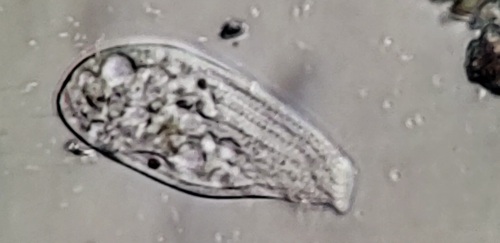
Stephanopogon
Stephanopogon is a genus of flagellated marine protist that superficially resembles a ciliate.
Tritrichomonas
Tritrichomonas is a genus of single celled flagellated parasitic excavates, some of whose species are known to be pathogens of the bovine reproductive tract as well as the intestinal tract of felines.
Spironucleus
Spironucleus is a diplomonad genus that is bilaterally symmetrical and can be found in various animal hosts. This genus is a binucleate flagellate, which is able to live in the anaerobic conditions of animal intestinal tracts. A characteristic of Spironucleus that is common to all metamonads is that it does not have aerobic mitochondria, but instead rely on hydrogenosomes to produce energy. Spironucleus has six anterior and two posterior flagella. The life cycle of Spironucleus involves one active trophozoite stage and one inactive cyst stage. Spironucleus undergoes asexual reproduction via lo
Perkinsus marinus
species of protist
Zoid
In botany, a zoid or zoïd is a reproductive cell that possesses one or more flagella, and is capable of independent movement. Zoid can refer to either an asexually reproductive spore or a sexually reproductive gamete. In sexually reproductive gametes, zoids can be either male or female depending on the species. For example, some brown alga (Phaeophyceae) reproduce by producing multi-flagellated male and female gametes that recombine to form the diploid sporangia. Zoids are primarily found in some protists, diatoms, green alga, brown alga, non-vascular plants, and a few vascular plants (ferns,
Tritrichomonas foetus
species of flagellate parasitic eukaryote