Category
page 1Fleas
%3B%20adult%2C%20pupa%2C%20egg%20and%20lar%20Wellcome%20V0022501EL.jpg)
flea
Flea, the common name for the order Siphonaptera, includes 2,500 species of small flightless insects that live as external parasites of mammals and birds. Fleas live by ingesting the blood of their hosts. Adult fleas grow to about long, are usually dark in color, and have bodies that are "flattened" sideways or narrow, enabling them to move through their hosts' fur or feathers. They lack wings; their hind legs are extremely well adapted for jumping. Their claws keep them from being dislodged, and their mouthparts are adapted for piercing skin and sucking blood. Some species can leap 50 times t

Chigoe flea
species of fleas
flea circus
circus sideshow attraction in which fleas are attached (or appear to be attached) to miniature carts and other items, and encouraged to perform circus acts within a small housing
Ischnopsyllidae
Ischnopsyllidae (Sometimes called a bat flea) is a family of fleas belonging to the order Siphonaptera. They have primarily parasitized bats, and have evolved to live in the fur of various bat species.
Leptopsyllidae
Leptopsyllidae is a family of fleas in the order Siphonaptera. There are at least 30 genera and 250 described species in Leptopsyllidae.

Pseudopulex
Pseudopulex is an extinct genus of primitive fleas that lived between the Middle Jurassic and Early Cretaceous periods in what is now modern-day China. The Latin root for the name Pseudopulex roughly translates to "false fleas".

Stephanocircidae
Stephanocircidae is a family of fleas native to South America and Australia, where they are found on rodents.
Echidna flea
species of insect
Porribius pacificus
species of insect
Ancistropsylla
Ancistropsylla is a genus of fleas belonging to the monotypic family Ancistropsyllidae.
Stephanocircus domrowi
species of insect
Hectopsylla
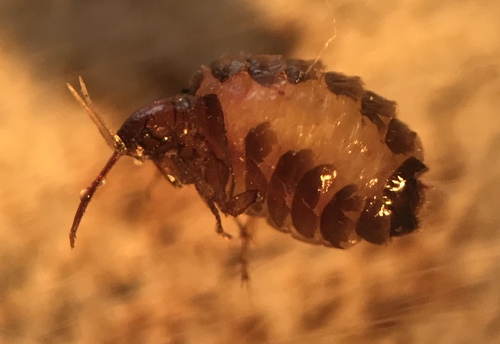
Hectopsylla is a genus of fleas in the family Hectopsyllidae that parasitize non-volant mammals, birds, and bats. The genus comprises thirteen species, six of which were described in whole or part by Karl Jordan between 1906–1942. Two of the species in Hectopsylla, H. psittaci and H. pulex, go under common names, with H. psittaci identified as the sticktight flea and H. pulex identified as the chiggerflea. Hastritter and Méndez (2000) consider the genus Rhynchopsyllus a junior synonym of the genus.
Tarwinia
Tarwinia is an extinct genus of stem-group flea known from a single species, T. australis, from the Early Cretaceous (Aptian) Koonwarra Fossil Bed of Victoria, Australia, it is the only member of the family Tarwiniidae, and the only stem-group flea known from the Southern Hemisphere.
Uropsylla tasmanica
species of insect

Amphipsylla
Amphipsylla is a genus of fleas belonging to the family Leptopsyllidae.
Pseudopulicidae
Pseudopulicidae is an extinct family of stem-group fleas from the Middle Jurassic to Early Cretaceous of China. They represent the oldest known group of stem-fleas. Like other stem-group "giant fleas", they are much larger and lack the specialised morphology of modern fleas.

Ectinorus
Ectinorus is a genus of fleas in the family Rhopalopsyllidae (marsupial fleas), erected by Karl Jordan in 1942. It is endemic to South America, specifically the Andes and surrounding regions, especially Chile. The genus includes species that are parasitic to rodents and are a vector for the bubonic plague. At least one species within Ectinorus is viable at altitudes above .
Tarwiniidae
REDIRECT Tarwinia

Leptopsylla
Leptopsylla is a genus of fleas belonging to the family Leptopsyllidae. The species Leptopsylla segnis was named by Carl Johan Schönherr in 1811.