Category
page 1Food goddesses

Demeter
In ancient Greek religion and mythology, Demeter (; Attic: Dēmḗtēr ; Doric: Dāmā́tēr) is the Olympian goddess of the harvest and agriculture, presiding over crops, grains, food, and the fertility of the earth. Although Demeter is mostly known as a grain goddess, she also appeared as a goddess of health, birth, and marriage, and had connections to the Underworld. She is also called Deo ( Dēṓ).
.JPG)
Persephone
In ancient Greek mythology and religion, Persephone ( ; , classical pronunciation: ), also called Kore () or Cora, is the daughter of Zeus and Demeter. She became the queen of the underworld after her abduction by her uncle Hades, the king of the underworld, who later took her into marriage. The myth of her abduction, her sojourn in the underworld, and her cyclical return to the surface represents her functions as the embodiment of spring and the personification of vegetation, especially grain crops, which disappear into the earth when sown, remain hidden for a period, sprout from the earth, a

Rhea
female Titan in Greek mythology, mother of Zeus and mother of Hera
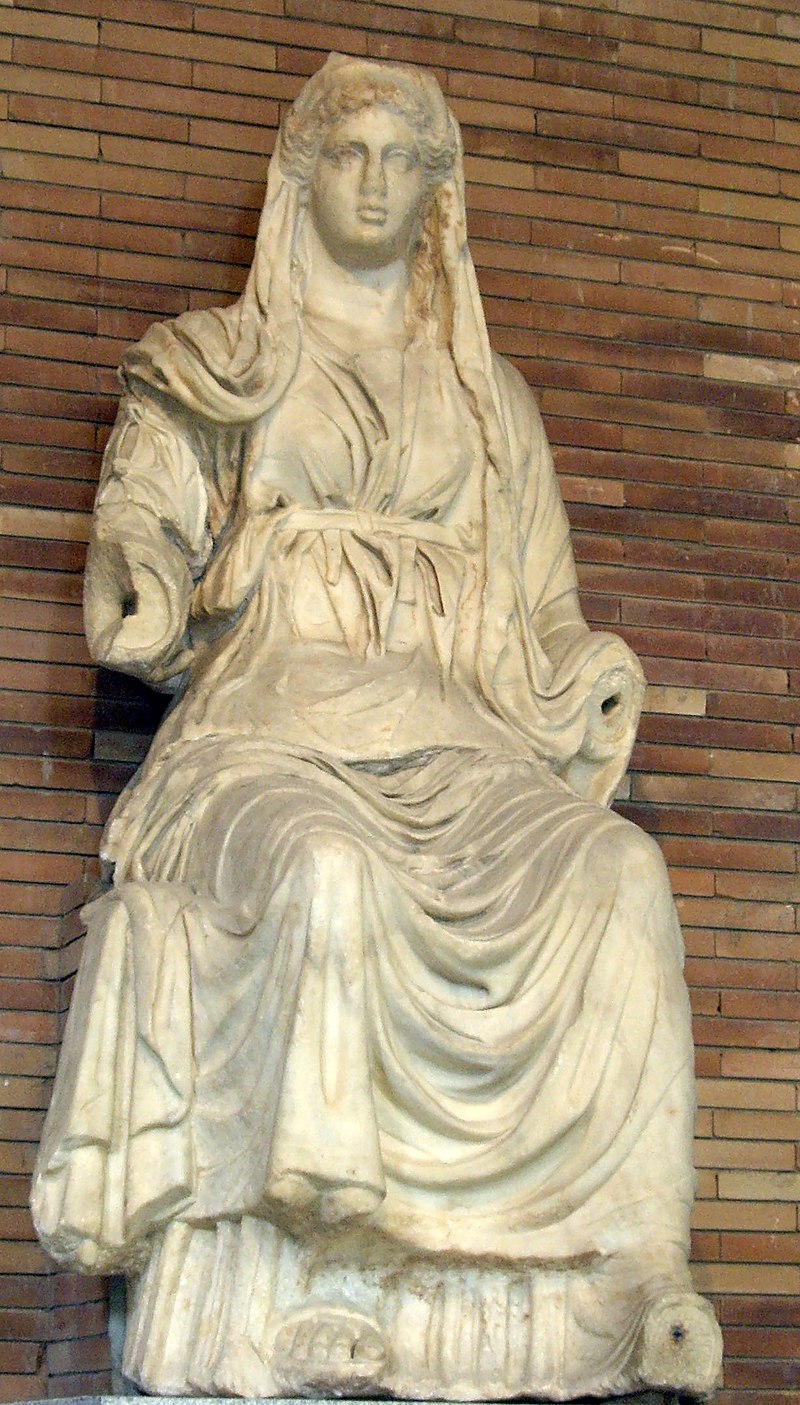
Ceres
Roman goddess of agriculture

Hebe
ancient Greek goddess of youth

Proserpina
Proserpina ( ; ) or Proserpine ( ) is an ancient Roman goddess whose iconography, functions and myths are virtually identical to those of the Greek Persephone. Proserpina replaced or was combined with the ancient Roman fertility goddess Libera, whose principal cult was housed in a temple atop Rome's Aventine Hill, which she shared with the grain-goddess Ceres and the wine god Liber (Liber Pater).

Horae
thumb|upright=1.3|Dionysus leads the Horae. Dionysus carries his [[thyrsus, and the middle Hora hold ears of wheat. Neo-Attic Roman relief, c. 50–25 BC.]]
In Greek mythology, the Horae (), Horai () or Hours (, ) were the goddesses of the seasons and the natural portions of time.
%20by%20H.%20W.%20Bissen%20-%20angle.jpg)
Iðunn
thumb|Ydun (1858) by Herman Wilhelm Bissen

Ops
In ancient Roman religion, Ops, (Latin: "Plenty") also spelled Opes or Opis, was a fertility and earth goddess of abundance, prosperity, and agriculture, and the consort of Saturn. As Ops Consiva, she presided over the reserved portion of the harvest alongside Consus, the god of stored grain. She was celebrated during two yearly festivals: Opiconsivia in August and Opalia in December.

Renenutet
Renenūtet (also transliterated Ernūtet, Renen-wetet, Renenet) was a goddess of grain, grapes, nourishment and the harvest in the ancient Egyptian religion. The importance of the harvest caused people to make many offerings to Renenutet during harvest time.
Initially, her cult was centered in Terenuthis. Renenutet was depicted as a cobra or as a woman with the head of a cobra.
Annapoorna
Hindu Goddess of Food and Nourishment
Chicomecoatl
In Aztec mythology, Chicōmecōātl "Seven Serpent", was the Aztec goddess of agriculture during the Middle Culture period. She is sometimes called "goddess of nourishment", a goddess of plenty and the female aspect of maize.

Ukemochi
thumb | right | Kagoshima Jingu Overseas Hoshoku Shrine
, commonly known as , the daughter of the deities Izanagi and Izanami, is a goddess of food in Japan and appears as a dema deity. Ukemochi is referred to as both male and female in different contexts. When shown in other forms, Ukemochi takes the shape of a fox.

Nehalennia
thumb|250px|An altar for Nehalennia in Domburg, [[Netherlands. On her right is a dog and in her hands a basket of apples.]]
Nehalennia (also Nehalenia, Nehalaenniae, Nehalaenia, Nehellenia) is a tutelary goddess who was worshipped in 2nd- and 3rd-century Gallia Belgica by travelers, especially sailors and traders, at the mouth of the Scheldt. Her origin is unclear, perhaps Germanic or Celtic. She is attested on and depicted upon numerous votive altars discovered around what is now the province of Zeeland, the Netherlands, where the Schelde River flowed into the North Sea. Worship of Nehalennia

Kushinadahime
, also known as or Inadahime (稲田姫、いなだひめ) among other names, is a goddess (kami) in Japanese mythology and the Shinto faith. According to these traditions, she is one of the wives of the god Susanoo, who rescued her from the monster Yamata no Orochi. As Susanoo's wife, she is a central deity of the Gion cult and worshipped at Yasaka Shrine.

Phosop
thumb|180px|Rudimentary Phi Na spirit house at a rice field in [[Isan]]
Ameretat
'''''' () is the Avestan language name of the Zoroastrian divinity/divine concept of immortality. Amerdad is the Amesha Spenta of long life on earth and perpetuality in the hereafter.
Ninsar
Ninšar (, dNIN.SAR; also read Nin-nisig) was a Mesopotamian goddess commonly associated with the preparation of meat. The reading of her name remains uncertain, and its possible etymology appears to be unrelated to her role in the Mesopotamian pantheon. She was chiefly worshiped in Nippur, though her original cult center was the settlement AB.NAGAR.
Mellona
Mellona or Mellonia was an ancient Roman goddess said by St. Augustine to promote the supply of honey (Latin mel, mellis) as Pomona did for apples and Bubona for cattle. Arnobius describes her as "a goddess important and powerful regarding bees, taking care of and protecting the sweetness of honey."