Category
page 1Force carriers

photon
A photon () is an elementary particle that is a quantum of the electromagnetic field, including electromagnetic radiation such as light and radio waves, and the force carrier for the electromagnetic force. Photons are massless particles that can only move at one speed, the speed of light measured in a vacuum. The photon belongs to the class of boson particles.

Higgs boson
elementary particle transmitting the Higgs field giving particles mass

gluon

meson
In particle physics, a meson () is a type of hadronic subatomic particle composed of an equal number of quarks and antiquarks, usually one of each, bound together by the strong interaction. Because mesons are composed of quark subparticles, they have a meaningful physical size, a diameter of roughly one femtometre (10 m), which is about 0.6 times the size of a proton or neutron. All mesons are unstable, with the longest-lived lasting for only a few tenths of a nanosecond. Heavier mesons decay to lighter mesons and ultimately to stable electrons, neutrinos and photons.

graviton
In theories of quantum gravity, the graviton is the hypothetical elementary particle that mediates the force of gravitational interaction. It is a quantum of gravitational wave energy. There is no complete quantum field theory of gravitons due to the unsolved mathematical problem of renormalization in general relativity. This problem is avoided in string theory, which has the graviton as a massless state of a fundamental string, but that theory has not made sufficient progress.
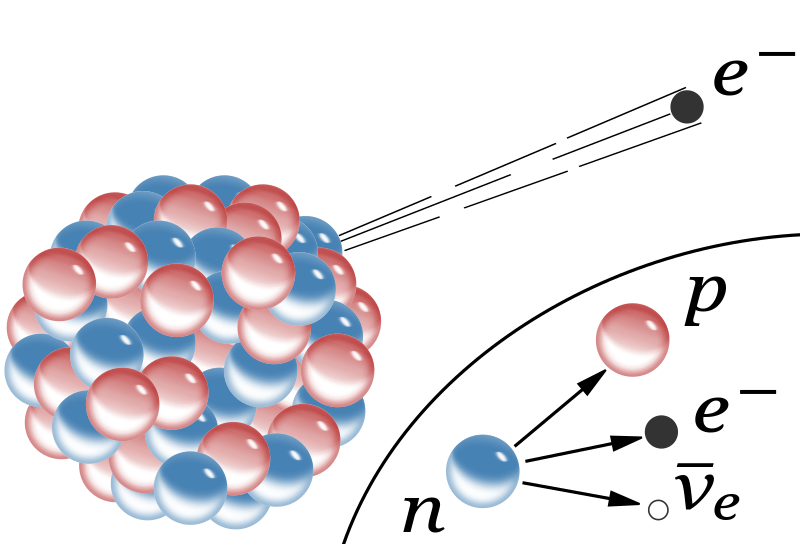
W or Z boson
massive gauge bosons that mediate the weak nuclear interaction
X and Y bosons
charged massive gauge bosons in the SU(5) Georgi–Glashow grand unified model mediating proton decay, filling out the adjoint representation of SU(5) together with the gluon, the photon and the W and Z bosons
dark photon
theoretical elementary particle
X17 particle
hypothetical subatomic particle as the cause of anomalous measurement results near 17 MeV
W' and Z' bosons
hypothetical gauge bosons that arise from extensions of the electroweak symmetry of the Standard Model
graviphoton
In theoretical physics and quantum physics, a graviphoton or gravivector is a hypothetical particle which emerges as an excitation of the metric tensor (i.e. gravitational field) in spacetime dimensions higher than four, as described in Kaluza–Klein theory.
graviscalar
In theoretical physics, the hypothetical particle called the graviscalar or radion emerges as an excitation of general relativity's metric tensor, i.e. gravitational field, but is indistinguishable from a scalar in four dimensions, as shown in Kaluza–Klein theory. The scalar field \phi comes from a component of the metric tensor g_{55} where the figure 5 labels an additional fifth dimension. The only variations in the scalar field represent variations in the size of the extra dimension. Also, in models with multiple extra dimensions, there exist several such particles. Moreover, in theories wi
Magnetic photon
ia hypothetical particle
chameleon
hypothetical scalar particle