Category
page 1Forced labour
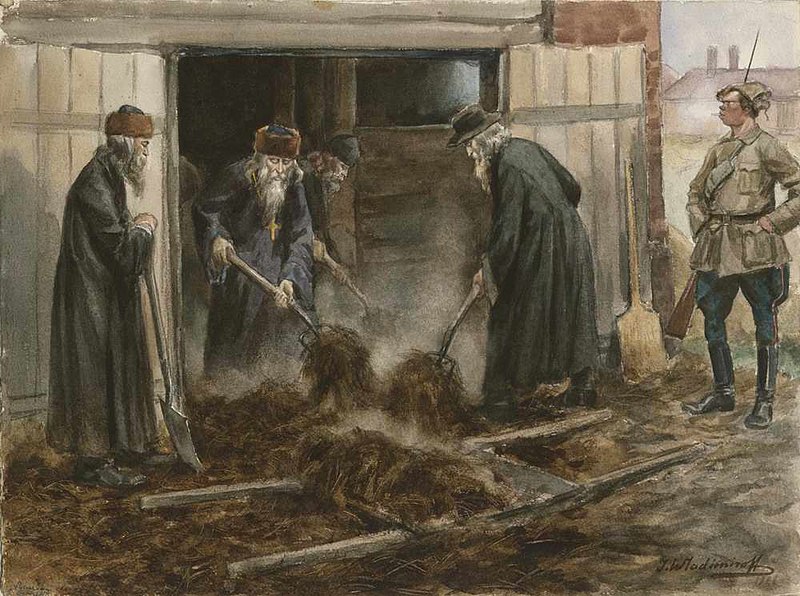
forced labor
work people are employed in, but against their will

coltan
thumb|upright|right|A piece of columbite–tantalite, size 6.0 × 2.5 × 2.1 cm
Coltan (short for columbite–tantalite and known industrially as tantalite) is a dull black metallic ore from which the elements niobium and tantalum are extracted. The niobium-dominant mineral in coltan is columbite (after niobium's original name columbium), and the tantalum-dominant mineral is tantalite.

Herero and Nama genocide
1904–1908 genocide committed by the German colonial administration in Africa

encomienda
thumb|200px|Francisco Hernández Girón was a Spanish encomendero in the [[Viceroyalty of Peru who protested the New Laws in 1553. These laws, passed in 1542 but repealed in 1545, gave certain rights to indigenous peoples and protected them against abuses. Drawing by Felipe Guamán Poma de Ayala.]]

corvée
thumb|14th-century serfs in England, working under the supervision of the lord's reeve at harvest time

hacienda
thumb|right|250px|Hacienda Lealtad is a working coffee hacienda which used slave labor in the 19th century, located in [[Lares, Puerto Rico.]]
Kafala system
system used to monitor migrant laborers in Arab countries
Rape of Belgium
systematic war crimes against Belgian civilians during World War I
mit'a
'''Mit'a''' () was a system of mandatory labor service in the Inca Empire, as well as in Spain's empire in America. ''Mit'a'' (federal work) was effectively a form of tribute to the Inca government in the form of labor, i.e. a corvée. Tax labor accounted for much of the Inca state tax revenue; beyond that, it was used for the construction of the road network, bridges, agricultural terraces, and fortifications in ancient Peru. Military service was also mandatory.
Atrocities in the Congo Free State
atrocities perpetrated in the Congo Free State (today the Democratic Republic of the Congo) which, at the time, was a colony under the personal rule of King Leopold II of Belgium
Abolition of Forced Labour Convention
International Labour Organization Convention
Forced Labour Convention
international treaty, 1930-
Cultivation System
Dutch government policy for its Dutch East Indies colony

blackbirding
thumb|300px|In 1869, seized the blackbirding schooner and freed its passengers, who were bound for Queensland, Australia.
conscription in the Republic of Korea
compulsory military service in South Korea

Shanghaiing
Shanghaiing or crimping is the practice of kidnapping people to serve as sailors by coercive techniques such as trickery, intimidation, or violence. Those engaged in this form of kidnapping were known as crimps. The related term press gang refers specifically to impressment practices in the United Kingdom's Royal Navy.

repartimiento
The Repartimiento () (Spanish, "distribution, partition, or division") was a colonial labor system imposed upon the indigenous population of Spanish America and the Philippines. In concept, it was similar to other tribute-labor systems, such as the ''mit'a of the Inca Empire or the corvée of the Ancien Régime de France: Through the pueblos de indios, the Amerindians were drafted work for cycles of weeks, months, or years, on farms, in mines, in workshops (obrajes''), and public projects.
Carlos Fitzcarrald
Peruvian businessman (1862-1897)

Accla
thumb|250px|right|Acllas in the manuscript of Guamán Poma of 1615.
Aclla (), also called Chosen Women, Virgins of the Sun, and Wives of the Inca, were sequestered women in the Inca Empire. They were virgins, chosen at about age 10. They performed several services. They were given in marriage to men who had distinguished themselves in service to the empire; they produced luxury items, weaving fine cloth, preparing ritual food, and brewing the chicha (beer) drunk at religious festivals; and some, the most "perfect," were selected as human sacrifices for religious rites. Others lived out their li
workfare
thumb|right|Activists dressed as prisoners demonstrating against workfare in the United Kingdom (October 2011)
Workfare is a governmental plan under which welfare recipients are required to accept public-service jobs or to participate in job training. Many countries around the world have adopted workfare (sometimes implemented as "work-first" policies) to reduce poverty among able-bodied adults; however, their approaches to execution vary. The United States and United Kingdom are two countries utilizing workfare, albeit with different backgrounds.
Military Units to Aid Production
Cuban labor camps
Child auction
historical form of poor care
Batey
settlement built around a sugar mill, in the Caribbean
re-education camp
prison camp operated by the Communist government of Vietnam following the end of the Vietnam War
construction soldier
person who didn't bear arms but instead did construction work in the military of the German Democratic Republic
involuntary unemployment
when people are without work and actively seeking work, and are willing to work at the prevailing wage but still unemployed
Action Z
Article 4 of the European Convention on Human Rights
prohibition of torture and forced labour under the European Convention on Human Rights
bagno
penitentiaries in Italy and France from the 17th century
2007 Chinese slave scandal
forced labour scandal in Shanxi, China