Category
page 1Former countries in Korean history

Joseon
Joseon ( ; ; also romanized as Chosun), officially Great Joseon (), was a dynastic kingdom of Korea that existed for 505 years. It was founded by Taejo of Joseon in 1392 and replaced by the Korean Empire in 1897. The kingdom was founded after the overthrow of Goryeo in what is today the city of Kaesong. Early on, Korea was retitled and the capital was moved to modern-day Seoul. The kingdom's northernmost borders were expanded to the natural boundaries at the rivers of Amnok and Tuman through the subjugation of the Jurchens.
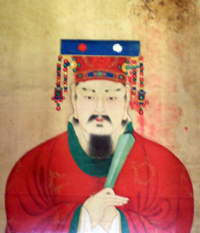
Silla
Silla (; Old Korean: 徐羅伐, Yale: Syerapel, RR: Seorabeol; IPA: ) was a Korean kingdom that existed between 57 BCE and 935 CE and was located on the southern and central parts of the Korean peninsula. Silla, along with Baekje and Goguryeo, formed the Three Kingdoms of Korea. Silla had the lowest population of the three, approximately 850,000 people (170,000 households), significantly smaller than those of Baekje (3,800,000 people) and Goguryeo (3,500,000 people).

Goguryeo
Goguryeo (37 BC – 668 AD) (; ; Old Korean: Guryeo) also later known as Goryeo (; ; Middle Korean: 고ᇢ롕〮, kwòwlyéy), was a Korean kingdom which was located on the northern and central parts of the Korean peninsula and the southern and central parts of modern-day Northeast China (Manchuria). At its peak of power, Goguryeo encompassed most of the Korean peninsula and large parts of Manchuria, along with parts of eastern Mongolia, Inner Mongolia, and modern-day Russia.

Baekje
Paekche or Baekje () was a Korean kingdom located in southwestern Korea from 18 BCE to 660 CE. It was one of the Three Kingdoms of Korea, together with Goguryeo and Silla. While the three kingdoms existed separately, Paekche had the largest population, at approximately 3,800,000 (760,000 households), which was much larger than that of Silla (850,000 people) and comparable to that of Goguryeo (3,500,000 people).

Goryeo
Goryeo (; ) was a Korean state founded in 918, during a time of national division called the Later Three Kingdoms period, that unified and ruled the Korean Peninsula until the establishment of Joseon in 1392. Goryeo achieved what has been called a "true national unification" by Korean historians as it not only unified the Later Three Kingdoms but also incorporated much of the ruling class of the northern kingdom of Balhae, who had origins in Goguryeo of the earlier Three Kingdoms of Korea. According to Korean historians, it was during the Goryeo period that the individual identities of Gogurye

Gojoseon
ancient state, based in northern Korean peninsula and Manchuria

Balhae
Balhae() or Parhae, also rendered as Bohai, was a multiethnic kingdom established in 698 by Dae Joyeong (대조영). It was called by Tang dynasty as the Kingdom of Jin (震, 진) until 713 when its name was officially declared as Parhae. At its greatest extent it corresponded to what is today Northeast China, the northern half of the Korean Peninsula and the southeastern Russian Far East.

Buyeo
Buyeo or Puyŏ (; ), also rendered as Fuyu () in Chinese, was an ancient kingdom that was centered in northern Manchuria in modern-day northeast China. It had deep ties to the Yemaek people, who are considered to be the ancestors of modern Koreans. It is also called Northern Buyeo () according to its founding legend.
Gaya confederacy
confederacy of territorial polities in the Korean Nakdong River basin (AD 42-562)
Later Silla
former Korean kingdom

Okjeo
Okjeo () was an ancient Korean tribal state which arose in the northern Korean peninsula from perhaps the 2nd century BCE to the 5th century CE.
Jin
Korean state during the Iron Age
Taebong
'''T'aebong''' () was a state established by Kung Ye on the Korean Peninsula in 901 during the Later Three Kingdoms period.
Dongye
former state
Wiman Chosŏn
ancient kingdom in the Korean peninsula and Manchuria (194–108 BCE)
Samhan
Samhan, or Three Hans (), is the collective name of the three confederacies: Byeonhan, Jinhan, and Mahan that emerged in the first century BCE during the Proto–Three Kingdoms of Korea, or Samhan, period. Located in the central and southern regions of the Korean Peninsula, the Samhan confederacies eventually merged and developed into the Paekche, Silla kingdoms and Kaya confederacy. The name "Samhan" also refers to the Three Kingdoms of Korea.
Byeonhan confederacy
former country
Jinhan confederacy
confederation of protostates in southeastern Korean peninsula
Later Baekje
former country
Mahan confederacy
former country on Korean peninsula
Geumgwan Gaya
former state in Korea
Kija Chosŏn
period after the alleged arrival of the Han Chinese sage Gija in the northwest of Korean peninsula

Usan
Usan-guk or the State of Usan () was a statelet that occupied the island Ulleungdo and several adjacent islands in Korea during the Three Kingdoms period. According to the Samguk sagi, it was conquered by the Silla general Kim Isabu in 512. He is said to have used wooden lions or tigers to intimidate the residents into surrendering. It has been written that the alias of Usan-guk is Ulleung-do. Usan-guk rarely entered into historical records, but appears to have continued a largely autonomous existence until its loss of independence to Goryeo in 930.
Daegaya
Daegaya () was a city-state in the Gaya confederacy during the Korean Three Kingdoms period. Daegaya was located in present-day Goryeong County, in North Gyeongsang Province of South Korea. (It should not be confused with Goryeong Gaya, which was located around present-day Sangju.)

Dongdan Kingdom
established by Yelü Bei (926-930)
Later Balhae
former state
Jeong-an kingdom
Chŏngan () or '''Ding'an' () was a state in Manchuria that existed from 938 to 986. It was the successor state of Parhae (Bohai) founded by Yŏl Manhwa (Lie Wanhua'').
Dongbuyeo
Kingdom in northern Korea (86 BCE – 22 CE)
Jolbon
Cholbon () was the first capital of Goguryeo, which arose in the north of the Korean Peninsula. Cholbon is thought to have been in modern Wunü Mountain, Liaoning province of China. Cholbon was also known by the names of Heulseunggol-seong in the Book of Wei and Holbon in the Gwanggaeto Stele.
Ara Gaya
city-state kingdom in the Gaya confederacy, in modern-day Haman County, South Korea
Little Goguryeo
hypothesized state in Liaodong and northern Korean peninsula after collapse of Goguryeo
Heungyo
Xingliao or Heungyo (; ; 1029–1030) was a state founded by Da Yanlin (Dae Yeon-rim), a Liao dynasty rebel, who was the 7th-generation descendant of Dae Joyeong, the founder of Parhae (Bohai).
Nakrang Kingdom
a country in the northwestern part of the Korean Peninsula
Takri Kingdom
proto-Korean kingdom
Bihwa Gaya