Category
page 1Fossil taxa described in 1925
.JPG)
Australopithecus
Australopithecus (, ; or , , ) is a genus of early hominins that existed in Africa during the Pliocene and Early Pleistocene. The genera Homo (which includes modern humans), Paranthropus, and Kenyanthropus evolved from some Australopithecus species. Australopithecus is a member of the subtribe Australopithecina, which sometimes also includes Ardipithecus, though the term "australopithecine" is sometimes used to refer only to members of Australopithecus. Species include A. garhi, A. africanus, A. sediba, A. afarensis, A. anamensis, A. bahrelghazali, and A. deyiremeda. Debate exists as to whethe
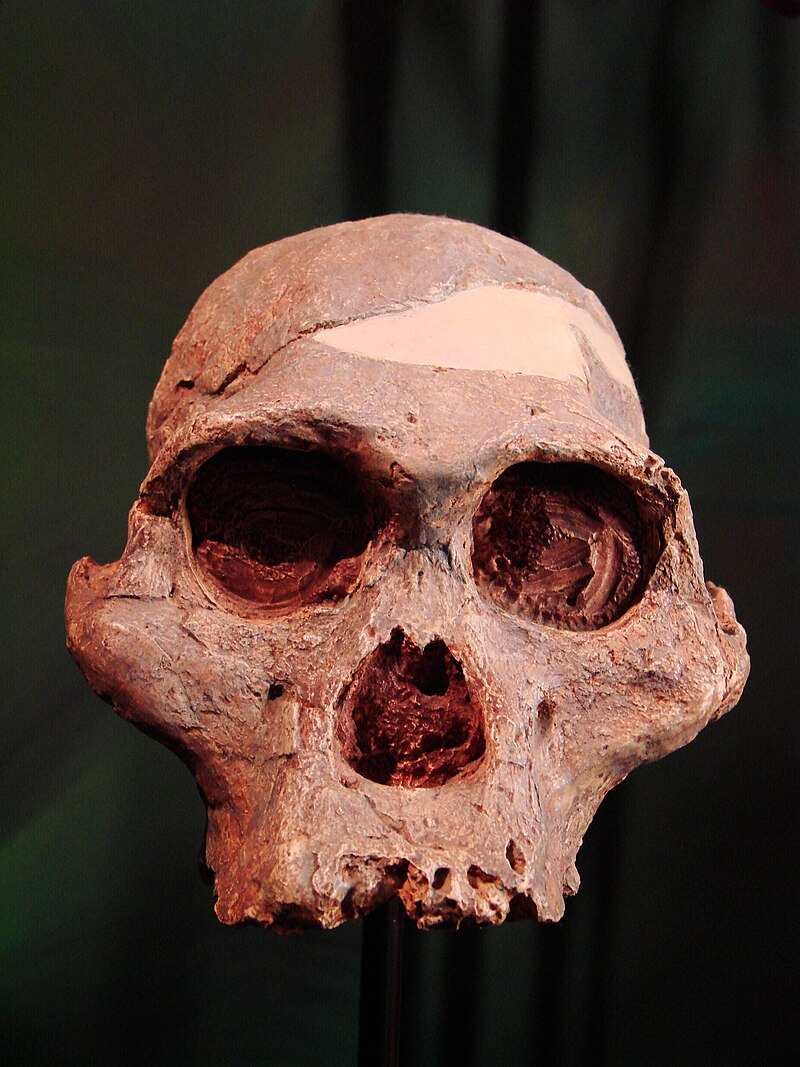
Australopithecus africanus
extinct hominid from South Africa
.jpg)
Tremarctinae
The Tremarctinae or short-faced bears is a subfamily of Ursidae that contains one living representative, the spectacled bear (Tremarctos ornatus) of South America, and several extinct species from four genera: the Florida spectacled bear (Tremarctos floridanus), the North American giant short-faced bears Arctodus (A. pristinus and A. simus), the South American giant short-faced bear Arctotherium (including A. angustidens, A. vetustum, A. bonariense, A. wingei, and A. tarijense) as well as Plionarctos (P. edensis and P. harroldorum), which is thought to be ancestral to the other three genera. O

Arrhinoceratops
Arrhinoceratops (meaning "no nose-horn face", derived from the Ancient Greek "a-/α-" "no", rhis/ῥίς "nose" "keras/κέρας" "horn", "-ops/ὤψ" "face") is a genus of herbivorous ceratopsian dinosaur. The name was coined as its original describer concluded it was special because the nose-horn was not a separate bone, however further analysis revealed this was based on a misunderstanding. It lived during the latest Campanian/earliest Maastrichtian stage of the Late Cretaceous, predating its famous relative Triceratops by a few million years, although it was contemporary with Anchiceratops. Its remain

Mantellisaurus
Mantellisaurus is a genus of iguanodontian dinosaur that lived in the Barremian and early Aptian ages of the Early Cretaceous Period of Europe. Its remains are known from Belgium (Bernissart), England, Spain and Germany. The type and only species is M. atherfieldensis. Formerly known as Iguanodon atherfieldensis, the new genus Mantellisaurus was erected for the species by Gregory Paul in 2007. According to Paul, Mantellisaurus was more lightly built than Iguanodon and more closely related to Ouranosaurus, making Iguanodon in its traditional sense paraphyletic. It is known from many complete an
.jpg)
Lycaenops
Lycaenops ("wolf-face") is a genus of carnivorous therapsids. It lived during the Middle Permian to the early Late Permian, about 260 mya, in what is now South Africa.
Stomatosuchus inermis
Stomatosuchus (meaning "mouth crocodile") is an extinct stomatosuchid neosuchian from the Late Cretaceous (Cenomanian) Bahariya Formation of Egypt. The type and only species is S. inermis. Much of what is known about Stomatosuchus has been inferred from the related genus Laganosuchus.

Pantelosaurus
Pantelosaurus (meaning "complete lizard") is an extinct genus of basal sphenacodonts known from the Early Permian period (Asselian stage) of Saxony, Germany. It contains a single species, Pantelosaurus saxonicus.
Mandschurosaurus
Mandschurosaurus (meaning "lizard from Manchuria") is an extinct genus of hadrosaurids based on material from the Late Cretaceous of China and possibly also the Early Cretaceous of Laos. It was the first dinosaur genus named from China.

Chendytes lawi
Chendytes is a genus of extinct, goose-sized flightless marine duck, once common on the California coast, the California Channel Islands, and possibly southern Oregon. It lived in the Pleistocene and survived into the Holocene. It appears to have gone extinct at about 450–250 BCE. The youngest direct radiocarbon date from a Chendytes bone fragment dates to 770–400 BCE and was found in an archeological site in Ventura County. Its remains have been found in fossil deposits and in early coastal archeological sites. Archeological data from coastal California show a record of human exploi
Bubalus mephistopheles
species of mammal (fossil)
Microposaurus
Microposaurus (meaning "small eyed lizard"; from Greek , "small" + , "face" or "eye" + , "lizard") is an extinct genus of trematosaurid temnospondyl. Fossils are known from the Cynognathus Assemblage Zone of the Beaufort Group (part of the Karoo Supergroup) in South Africa and the Rouse Hill Siltstone of Australia that date back to the Anisian stage of the Middle Triassic. These aquatic creatures were the short snouted lineage from Trematosaurinae.
Idiorophus
Idiorophus is a genus of extinct toothed whales in the family Physeteridae. Fossils have been found in the Colhuehuapian Gaiman Formation of Argentina and the Libano Sandstone in Italy.
Notochoerus
Notochoerus is an extinct genus of very large pigs from the subfamily Tetraconodontinae. Fossils have been found in Africa, notably Uganda and Ethiopia.
Deperetella
Deperetella is an extinct genus of deperetellid perissodactyls from Middle to Late Eocene of Asia. The genus was defined in 1925 by W. D. Matthew and Walter W. Granger, who named it after French paleontologist Charles Depéret. The type species is Deperetella cristata.
Amphidon aequicrurius
Amphidon is an extinct genus of Late Jurassic mammal from the Morrison Formation. It is present in stratigraphic zone five. Two species have been named in the genus: Amphidon superstes and Amphidon aequicrurius, by Simpson in 1925.
Propotamochoerus
Propotamochoerus is an extinct genus of pig-like animals that lived from the Miocene to the Pliocene of Algeria, India, Moldova, China, Russia, Ukraine, Georgia, Greece, Hungary, Myanmar, Thailand, Tunisia and Pakistan.
Aploconodon
Aploconodon is an extinct genus of Late Jurassic mammals belonging to the family Amphidontidae. It contains one species, A. comoensis.
Parapytanga
Parapytanga is an extinct monotypic genus of temnospondyl, the type species being Parapytanga catarinensis. Parapytanga belongs to the family Rhinesuchidae. Fossils have been found in the Middle Permian Rio do Rasto Formation of Brazil.
Corydoras revelatus
species of fish (fossil)
Cynariops
Cynariops is an extinct genus of gorgonopsian that lived in what is now South Africa during the Permian. The holotype skull specimen BMNH R5743 was made the basis of the new genus and species Cynariops robustus by Robert Broom in 1925, but the genus was later synonymised with other genera such as Scylacognathus. Specimen MB.R.999 was catalogued as a specimen of Aelurognathus at the Museum für Naturkunde, Berlin, until it was further prepared and described in 2018, and the genus Cynariops resurrected.
Promicroceras
Promicroceras is an extinct ammonite genus from the upper Sinemurian (Lower Jurassic) of Europe, named by Leonard Spath in 1925. Promicroceras is included in the family Eoderoceratidae, which is part of the ammonitid superfamily Eoderoceratoidea.